

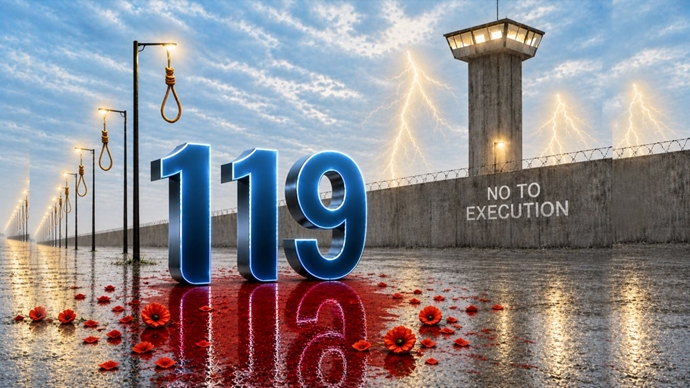

On Tuesday, May 5, 2026, political prisoners and inmates across 56 facilities in Iran held the 119th consecutive week of the “No to Executions Tuesdays” hunger strike. The campaign continues to expand its reach as the Iranian regime accelerates its use of capital punishment, specifically targeting protesters and dissidents following recent nationwide uprisings.
Over the past week, the regime’s Judiciary has executed several political prisoners and youths. In Isfahan, authorities hanged Sasan Azadvar, a 21-year-old karate champion. In Mashhad, three prisoners arrested during the December 2025 to January 2026 uprisings—Mehdi Rasouli, Mohammadreza Miri, and Ebrahim Dowlatabadi—were sent to the gallows. Concurrently, Mehrab Abdollahzadeh, a detainee from the 2022 uprising, was executed in Urmia. The Judiciary also hanged two Kurdish prisoners, Nasser Bakerzadeh and Yaghoub Karimpour, under the charge of espionage.
The striking prisoners noted that the execution of inmates with non-political charges has also increased significantly during this period.
In their weekly statement, the campaign warned that many detainees from recent protests remain at imminent risk of execution. Ten individuals recently sentenced to death were named, including Erfan Amiri, Matin Mohammadi, Ehsan Hosseini-Pour Hesarloo, Maryam Hadavandmiri, Mohammad Abbasi, Saeed Zarei Kordshouli, Hamidreza Fathi, Abdolreza Fathi, Hamidreza Sabet-Ray, and Mohammadreza Tabari. Additionally, the Judiciary has denied a retrial for Peyman Farah-Avar, a political prisoner in Lakan Prison in Rasht, placing his life in serious danger.
The surge in death sentences follows remarks last week by Judiciary Chief Gholamhossein Mohseni Ejei, who publicly attacked opponents of the death penalty and threatened further executions for dissenting youth.
Prison authorities have increasingly retaliated against inmates participating in the anti-execution protests. In the women’s ward of Evin Prison, several activists who chanted “No to execution” and “Death to the dictator” in the prison yard last Tuesday have been systematically deprived of their visitation and phone call rights.
Despite these punitive measures, the striking prisoners assert that the country’s legal apparatus has lost all independence. “The increase in executions is the result of the Judiciary’s surrender to the security institutions MOIS, IRGC Intelligence, and the Country’s Intelligence Coordination Council,” the statement read.
Highlighting the regime’s ongoing crisis of legitimacy following the recent waves of protests, the campaign emphasized that state-sanctioned killings only demonstrate the government’s weakness. “It is clear to everyone that the policy of repression, imprisonment, and execution cannot prevent the uprising and revolt of the people against the government,” the prisoners wrote. “Because for a government that has lost its legitimacy among the people, repression and execution will not cure its pain.”
The statement concluded with an urgent appeal to “all awakened consciences, opponents of execution, human rights organizations, and international communities to take immediate and effective action to save the lives of political and non-political prisoners in Iran.”
The prisoners participating in the 119th week of the hunger strike span 56 facilities, including Evin Prison (men’s and women’s wards), Ghezel Hesar Prison (units 2, 3, and 4), Karaj Central Prison, Greater Tehran Prison, Qarchak Prison, Adelabad Prison in Shiraz, Zahedan Prison, Mashhad Prison, Rasht Prison, Urmia Prison, Sanandaj Prison, and dozens of other regional penitentiaries across the country.