


Six years ago this week, a sudden hike in gasoline prices ignited one of the most significant nationwide uprisings in Iran’s modern history. The November 2019 uprising, which began over economic grievances, quickly evolved into a direct challenge to the ruling theocracy, with demonstrators in scores of cities calling for an end to the regime and its Supreme Leader, Ali Khamenei. The state’s response was swift and merciless. Under the cover of a near-total internet blackout, security forces, including the IRGC and Basij, were ordered to “do whatever it takes,” killing at least 1,500 protesters in a brutal crackdown.
Today, on the sixth anniversary of that bloody confrontation, the regime has placed cities under heavy surveillance in fear of a renewed popular explosion. Yet, this atmosphere of intimidation has not silenced the call for change. Across the country, the People’s Mojahedin Organization of Iran (PMOI/MEK) Resistance Units have launched a coordinated campaign of activities, demonstrating that the spirit of the November 2019 uprising is not only alive but has grown more organized and defiant.
Shiraz
Flower wreath to commemorate the martyrs of the November 2019 uprising pic.twitter.com/yHTe3wzAcu— People's Mojahedin Organization of Iran (PMOI/MEK) (@Mojahedineng) November 15, 2025
Widespread commemorative acts honor the martyrs and defy state-imposed silence
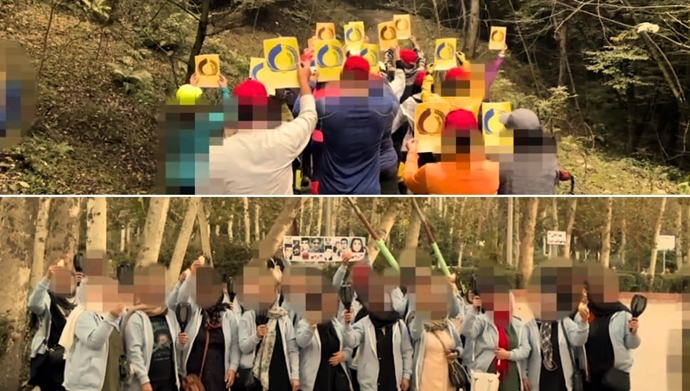
A central element of the campaign on November 14, 2025, involved symbolic acts to honor the thousands of martyrs and directly challenge the regime’s attempt to erase the memory of its crimes. In major cities such as Shiraz, Shahriar, Mahshahr, and Kermanshah, Resistance Units laid flowers alongside banners with powerful messages, including, “November is always in our memory” and “From 1988 [massacre] to November, we will stand to the end,” linking the 2019 massacre to the 1988 massacre of political prisoners.
In Tehran and Isfahan, women’s units organized poignant marches, holding candles, torches, and pictures of the martyrs of the 2019 uprising. These public displays of remembrance served as a bold rejection of the state-enforced silence and a promise that the sacrifices made for freedom will not be forgotten.
Shiraz pic.twitter.com/H6fkJqJnIP
— People's Mojahedin Organization of Iran (PMOI/MEK) (@Mojahedineng) November 15, 2025
Resistance Units demonstrate a new level of organized, collective action
These anniversary activities reveal a “new quality” in the Resistance Units’ campaign, marking a clear shift toward more organized and collective actions. This evolution from individual acts to coordinated group activities demonstrates a growing capacity to challenge the regime’s authority in a structured manner.
One of the most striking examples took place in Karaj, where a 12-person unit of cyclists rode in disciplined formation, each wearing a t-shirt bearing the image of a martyr. In an extraordinary act of defiance, they publicly announced their names one by one, declaring their readiness to continue the path of the fallen. Elsewhere, organized marches were held by a unit in Tehran and Hamedan, while in Isfahan, a youth unit marched chanting slogans such as, “Death to the oppressor, be it the Shah or the Supreme Leader.” These acts showcase a significant leap in the organizational strength and public presence of the resistance movement.
Karaj pic.twitter.com/7aycAtAvko
— People's Mojahedin Organization of Iran (PMOI/MEK) (@Mojahedineng) November 15, 2025
Sustaining the uprising’s momentum and undermining the regime’s authority
These activities are not merely commemorative; they are part of a calculated strategy to sustain the momentum of the November 2019 uprising and erode the regime’s repressive capabilities. The Resistance Units act as the beating heart of the uprising, challenging the state’s omnipresence and proving that its authority is not absolute.
By carrying out these defiant acts across the country—from Zahedan in the southeast to Karaj near the capital—the Resistance Units are demonstrating their nationwide reach and their ability to challenge the religious dictatorship in any location. They send a clear message to the Iranian people that the regime’s power is a “propaganda” front that can be broken by a determined and organized popular will. This strategy, centered on expanding organized resistance, is presented as the definitive path to achieving the goals for which thousands sacrificed their lives in November 2019: the overthrow of the regime and the establishment of a democratic republic.