

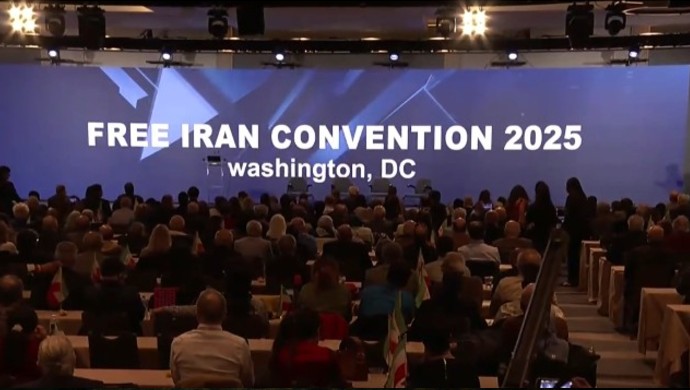

The Free Iran Convention 2025, held in Washington D.C., brought together Iranian scholars, professionals, and activists to discuss the imminent end of the clerical regime and the blueprint for establishing a democratic, secular, and non-nuclear republic. The all-day event featured four panels dissecting Iran’s socio-political readiness for change, the central role of women in the opposition, the technical roadmap for transition, and the decisive power of the youth movement. The convention framed the current crisis not as temporary unrest but as the final maturation of social readiness for a fundamental, organized overthrow of the religious tyranny.
Society ripe for change: Analyzing the accelerating path to regime collapse
The first panel, “Society Ripe for Change,” analyzed the compounding economic and political crises pushing Iran toward a revolutionary breaking point. Scholars presented empirical evidence demonstrating that the regime’s failures are structural and irreversible, leading to widespread discontent that has crystallized into organized defiance.
Free Iran Convention 2025: The Path to a Prosperous Republic in Iran#FreeIranConvention2025 #OurChoiceMaryamRajavi #NCRIAlternative https://t.co/vb9yHs91UV
— People's Mojahedin Organization of Iran (PMOI/MEK) (@Mojahedineng) November 15, 2025
Professor Kazem Kazerounian detailed the catastrophic state of the economy. He asserted that Iran’s economic collapse is structural, not a result of international sanctions. Gross domestic product (GDP) is ranked 117th per capita. Close to 80% of Iranians live below the poverty line, while the IRGC controls an estimated 60% of the economy, transforming Iran into a military oligarchy. Professor Kazerounian stated, “Iran’s economic collapse is structural. It is not temporary, and by no means is it a result of the sanctions.” He also pointed out that rising taxation means, “The poor in the country are financing the repression and financing the plunder of the country.” The estimated cost of the regime’s nuclear program since the 1990s totals $2 trillion, a massive resource drain that has fueled isolation instead of development.
Dr. Hossein Saiedian addressed the regime’s inherent illegitimacy, arguing that the Khomeini regime stole the 1979 revolution and built its survival on three failed pillars: repression, the export of terrorism, and the pursuit of nuclear weapons. Dr. Saiedian highlighted the crucial role of the opposition in countering the nuclear threat, noting that NCRI revelations in 2002 exposed the secret Natanz site. He stressed, “The pillar that meant to provide strength only provided vulnerability.” He also pointed to escalating internal violence, noting that executions have tripled in the last three years, which he called “a desperate grip of a regime whose only remaining language remains pure violence.” Dr. Saiedian concluded that this history showed, “Khomeini’s role was ahistorical. It ran entirely counter to the one-hundred-and-twenty-year arc of Iranian history.”
At #FreeIranConvention2025, Dr. @HSaiedian shows why Tehran’s regime is illegitimate and failing on all 3 pillars: nuclear project exposed by NCRI-US, export of terrorism backfiring, and executions/censorship at record levels. Crises + MEK-backed defiance make change inevitable.… pic.twitter.com/SadpImToq2
— NCRI-U.S. Rep Office (@NCRIUS) November 15, 2025
Dr. Ashraf Zadshir detailed how discontent has manifested in sustained revolts, shattering regime myths. The 2017 uprising rejected the possibility of internal reform (“Reformer, hardliner, the game is now over”). The 2019 uprising ended the myth that the lower economic class supported the mullahs. The 2022 uprising, following the killing of Mahsa Amini, established a clear rejection of all forms of dictatorship: “Down with the oppressor, be it the Shah or the Leader.” Dr. Zadshir noted that the regime’s oppressive actions ironically fuel the resistance. She observed, “The regime’s survival strategy, built on repression, corruption, and proxy militias, ironically creates the very conditions that reignite rebellion.” The panel affirmed that Iran is igniting toward a democratic future.
Iranian women and the legacy of resistance: The transformative force for freedom
The second panel, “Iranian Women and the Legacy of Resistance,” focused on how women have transformed the decades-long struggle into an organized leadership movement, making them the decisive force for democratic change.
Dr. Azadeh Sami established the historical context, explaining that misogyny became state doctrine under the clerical regime, but that systematic oppression ultimately allowed for women’s leadership to emerge. She noted that the PMOI formulated and implemented an egalitarian leadership framework that placed qualified women in senior strategic and operational roles, creating, “the longest-running women-led movement in the region.” Dr. Sami declared, “The regime knew that women’s emancipation means the end of tyranny.” She emphasized that the framework is “the secret sauce behind the movement’s multi-generational appeal inside Iran and across the diaspora.”
At #FreeIranConvention2025 Panel 2, Hannane Amanpour, Esq., Dr. Azadeh Sami, Dr. Ramesh Sepehrrad and Dr. Azadeh Zangeneh showed how 100+ years of Iranian women’s struggle has evolved into today’s women-led MEK/NCRI movement: confronting state-encoded misogyny, turning… pic.twitter.com/RXRiF3ppnR
— NCRI-U.S. Rep Office (@NCRIUS) November 15, 2025
Attorney Hannane Amanpour discussed the institutionalization of gender inequality, noting that the Islamic Republic is founded on gender-segregated law under the Velayat-e Faghih. She highlighted that the regime routinely demonizes female MEK members by portraying them as abandoning their family roles, a clear attempt to undermine their revolutionary leadership. Ms. Amanpour asserted, “Women’s rights is not this ancillary issue to the freedom of the Iranian people. It is at the forefront of that because the Islamic Republic was built exactly on that principle.”
The discussion turned to the issue of the hijab. Dr. Sami stressed that the debate is fundamentally about choice and political agency, not about the fabric itself. She referenced Maryam Rajavi’s stated commitment: “No to compulsory hijab, no to compulsory religion, no to compulsory government.” Ms. Amanpour concurred, explaining that compulsory observance is oppressive regardless of personal choice. She added, “What is important is that it is their choice of how and what parts of themselves they want to present to the world.”
Dr. Azadeh Zangeneh shared her personal experience growing up in Iran, where she witnessed how prominent the repression is, noting, “Womanhood in Iran is essentially something to be managed or controlled, or defined by men.” She concluded that the MEK’s model provides a living example that empowers successive generations. “They see that this is possible. They know the injustice is real… But they also know that leadership is possible.” The panel concluded by defining the legacy of Iranian women’s resistance as ‘Unwavering’ and ‘Fearless’.
Prospects for change in Iran, the plan for transition: Strategy and the blueprint for a democratic republic
The third panel, “Prospects for Change in Iran, the Plan for Transition,” addressed the practical strategies for overthrowing the regime and ensuring a stable, peaceful transition to a democratic government, rejecting reliance on internal reformists.
Dr. Behzad Raofi, a NASA scientist, offered an analytical assessment, stating, “The only way, the only realistic strategy to bring this regime down is by fighting it and overthrowing it.” He explained that the strategy for change is determined by the totalitarian nature of the government in power, citing Khomeini’s order to fire on a peaceful opposition rally in 1981. Dr. Raofi asserted that combining nationwide uprisings with the power of the Resistance Units is the necessary formula for victory.
At #FreeIranConvention2025 panel “Prospects for Change in Iran”:
Dr. Daneshgari (@FDBOWTIE): NCRI/MEK has the record, structure & grassroots to lead a credible transition.@Farideh2020: Regime change is real & within reach; Iran won’t become a failed state.@NemoviReza: Iran’s… pic.twitter.com/3yLMkwqaZI
— NCRI-U.S. Rep Office (@NCRIUS) November 15, 2025
Farideh Sedighi underscored that regime change is “real and within reach,” citing the regime’s growing internal fragility and the rapid expansion of the Resistance Units, which performed over 39,000 symbolic acts in the past year alone. Addressing concerns about instability, Ms. Sedighi dismissed the regime’s narrative that Iran would descend into civil war, noting, “The main source of instability is the regime itself.” She stated that the “guarantors of a stable Iran after the fall of the Mullahs are the freedom-loving people of Iran and their NCRI, as the organized and political alternative.”
Dr. Firouz Daneshgari provided evidence of the NCRI’s decades-long capability and credibility. He detailed its history of successful social mobilization (over half a million people mobilized in 1981), military action (National Liberation Army forced Khomeini to accept a ceasefire in the Iran-Iraq war), and intelligence penetration (revealing Natanz and Fordow sites). Dr. Daneshgari focused on the trust factor, claiming the NCRI’s credibility is built on transparency and fidelity to its principles: “The foundation of trust goes back to credibility.” He added that the regenerative power of the Resistance Units “is unbelievable.”
Mr. Reza M. Nemovi connected the NCRI’s blueprint to the aspirations of the youth, stating, “They already carry the mindset of freedom. The regime is only a wall waiting to fall.” He praised Maryam Rajavi’s Ten-Point Plan for its clear, scientific approach to redesigning the state, noting that Point 4 (separation of religion and state) ensures stability by keeping governance impartial. He emphasized that Point 8 (justice and equality) would replace favoritism with fairness, shifting Iran “from a restriction-based economy to an innovation-driven economy.” The panel concluded that the organized resistance provides the necessary alternative for a six-month transitional government.
The power of youth in driving change in Iran: From repression to organized defiance
The final panel highlighted Iran’s youth as the primary engine for transformative change, fueled by defiance against repression and a clear vision for a democratic future embodied by the organized resistance.
Mohammadreza Hesami, reflecting on his time in Iran, stated, “It felt like we were in a prison.” He explained that the regime must perpetually suppress the youth because stopping harassment would force the government to answer for its failures in economics and politics. He emphasized that the youth have only three options: “accept the humiliation, accept the poverty, or you have to fight the regime back and try to gain control of your destiny.” He noted the regime’s ramped-up executions prove, “The only thing that they haven’t failed at yet is suppressing the Iranian people.”
At #FreeIranConvention2025, Mohammadreza Hesami tells Nicole Shariati that growing up in Iran felt like living in a prison: a regime obsessed with ideology and control, not youth dreams. For young Iranians there are only 3 paths: accept humiliation, flee the country, or fight… pic.twitter.com/nWvAmrifNg
— NCRI-U.S. Rep Office (@NCRIUS) November 15, 2025
Mahrana Mohammadi discussed how Maryam Rajavi’s plan empowers youth through economic independence, citing the need to reclaim IRGC assets and establish entrepreneurship funds. She stressed the importance of a secular system of values for future governance. Ms. Mohammadi argued that establishing a strong and independent judiciary is vital because “religious doctrine such as Sharia law… cannot coexist with any sort of impartial judicial process or democratic governance as a whole.”
Ryan Nasir spoke about the pivotal role of the Resistance Units, calling them the “tip of the spear” and a “guiding beacon of hope” deeply embedded in society. He detailed how their daily acts of defiance—often on video—demonstrate that the regime is “not ten feet tall.” Mr. Nasir highlighted the synergy between internal units and the NCRI abroad, asserting, “The Resistance Units keep the flame of resistance burning inside the country, and the NCRI ensures that the flame is protected and seen throughout the world.”
At #FreeIranConvention2025’s youth panel, each speaker shared the moment they chose MEK/NCRI: children of former political prisoners refusing silence, students who couldn’t live in a safe “bubble” while friends were jailed or executed, young professionals inspired by Ashraf,… pic.twitter.com/eHBWQWItZY
— NCRI-U.S. Rep Office (@NCRIUS) November 15, 2025
Seena Saiedian explained why the youth reject incremental reform, arguing that so-called “moderate” politicians, such as former regime presidents Mohammad Khatami and Hassan Rouhani, delivered only increased repression. He stated that the uprisings quickly radicalize because the youth recognize that the root cause of all grievances is the regime itself, leading to national chants of “Down with the oppressor, be it the Shah, be it the mullahs.” Mr. Saiedian concluded that the PMOI resonates because it offers a credible alternative with organizational capacity and an “unwavering commitment to popular sovereignty” backed by decades of relentless struggle, unlike “the fake opposition movements we see on things like social media.” The panel underscored that this generation is committed to replacing the tyranny with a truly pluralistic democracy.
The Free Iran Convention 2025 concluded with a unified assertion: Iran’s long-standing struggle against tyranny is entering its decisive phase. The convergence of economic collapse, political illegitimacy, and organized defiance provides the necessary conditions for success. The Iranian people, led by the unwavering commitment of women and the fearless resolve of the youth, now possess both the blueprint and the organization to achieve their goal. The future holds the promise of a democratic, secular, and non-nuclear republic—a nation where dignity, justice, and the rule of law replace decades of repression, finally establishing an Iran at peace with itself and the world.