

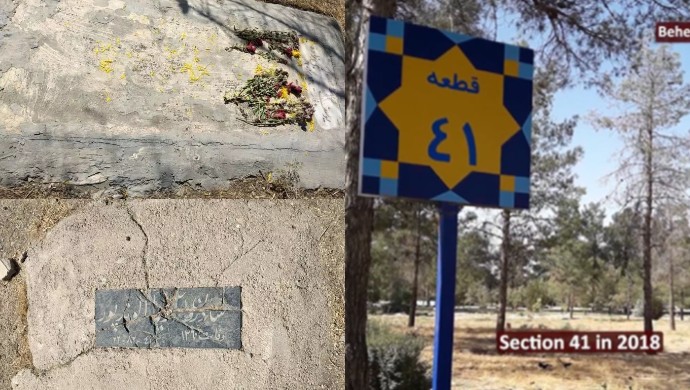

In a move that reeks of desperation, the clerical regime in Iran has openly admitted to destroying the final resting place of thousands of executed PMOI martyrs, confirming its direct involvement in erasing the evidence of its decades-long crimes against humanity. The recent admission by a Tehran official to “flattening” Section 41 of the Behesht-e Zahra cemetery and converting it into a parking lot is not an act of urban planning; it is the frantic work of a criminal regime terrified of its inevitable day of reckoning. This brazen act is a confession, broadcast to the world, that the mullahs fear the memory of their victims as much as they fear the future justice they represent.
The regime’s brazen confession
For years, the regime has covertly desecrated the graves of its opponents. Now, it has moved to open admission. On August 22, 2025, the manager of the Behesht-e Zahra cemetery publicly confessed that Section 41, where thousands of PMOI members executed in the 1980s are buried, was “flattened… and turned into a parking lot.”
The CEO of Tehran's Behesht-e Zahra cemetery confirmed that Iranian authorities destroyed a historic mass grave, paving it over to create a parking lot.
Section 41, the burial site of thousands of PMOI/MEK political prisoners executed in the early 1980s, has been leveled.… pic.twitter.com/EKCAZ9HtI1— Ehsan Eghbal Eslami (@Ehsaneghbale) August 20, 2025
This was preceded by an even more damning admission from Tehran’s Deputy Mayor, Davoud Goudarzi, who stated on August 19, 2025, that the regime “got permission from the officials” for the destruction. In the opaque language of the Iranian regime, “officials” is a clear reference to the highest echelons of power, implicating Supreme Leader Ali Khamenei in this heinous crime. This is no longer a clandestine operation but a state-sanctioned policy to obliterate the evidence of genocide.
International condemnation: A crime scene under attack
This deliberate destruction of a crime scene has drawn sharp international condemnation. Amnesty International immediately called out the regime’s actions, stating that Iranian authorities are “destroying vital evidence of the mass executions of dissidents in early 1980s.”
Tehran’s Deputy Mayor Davoud Goudarzi shockingly admitted that the graves in slot 41 of the cemetery were being destroyed with official permission from authorities. This move follows decades of cruel restrictions on families planting flowers or fixing desecrated gravestones. 2/6 pic.twitter.com/qiGBEb7pRc
— Amnesty Iran (@AmnestyIran) August 22, 2025
In a thread on X, the organization highlighted that this is another grim reminder of the “systemic impunity” for the crimes against humanity committed by the regime. Amnesty correctly identifies these individual and mass graves as “crime scenes requiring forensic expertise for exhumation and evidence preservation.” By bulldozing them, the authorities are not only deepening the pain of the victims’ families but are actively obstructing the path to truth, justice, and reparations.
A systematic policy of erasure: Decades of desecration
The destruction of Section 41 is not an isolated event but the desperate culmination of a 45-year campaign to erase the physical record of the regime’s massacres. This systematic policy has been implemented across Iran. In June 2017, the regime vandalized the graves of PMOI martyrs in Tabriz, pouring 10 centimeters of cement over the site and leveling the grounds. In July 2018, it demolished the graves of martyrs from the 1988 massacre in Ahvaz under the pretext of building a boulevard. Mass graves in Mashhad have also been targeted. This war on memory extends beyond PMOI martyrs, as Amnesty International has documented the desecration of graves belonging to the persecuted Baha’i minority and those unlawfully killed during the 2022 uprising. The goal has always been the same: to eliminate any physical trace of the regime’s brutality.
Fear of a looming reckoning
The timing of this accelerated destruction is no coincidence. It is a direct, panicked response to mounting international legal pressure. In his July 2024 report, the then-UN Special Rapporteur on human rights in Iran, Professor Javaid Rehman, officially categorized the 1980s executions as constituting “crimes against humanity as well as genocide.” The report urged UN member states to use universal jurisdiction to investigate and prosecute the perpetrators, many of whom remain in power.
With the noose of international justice tightening, the regime is desperately trying to destroy the crime scene. As the Iranian Resistance has repeatedly stressed, the obliteration of evidence of genocide is, under international law, a continuation of and participation in that very crime. This act of desecration is a confession of guilt from a weak and brittle regime terrified that these graves are not just markers of past crimes, but signposts to its future in the dock.