

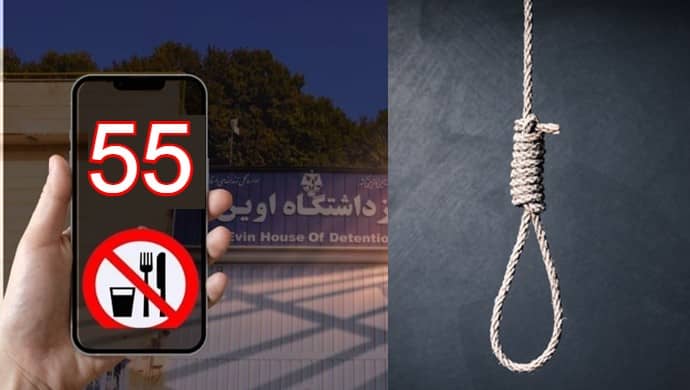

Political prisoners across Iran have launched a coordinated hunger strike in 35 prisons as part of the 55th week of the “No to Executions Tuesdays” campaign, an initiative aimed at opposing the regime’s escalating use of capital punishment. The movement, which began in January 2024, has gained significant momentum, with detainees organizing weekly acts of defiance against the Iranian judiciary’s systematic execution of political prisoners and other detainees.
In a statement marking the latest week of the campaign, prisoners declared that the ruling establishment, increasingly isolated domestically and internationally, is resorting to heightened repression and mass executions to maintain its grip on power. According to the statement, “Since February 2024, the regime has executed approximately 1,021 individuals by hanging alone, a stark reminder that its survival depends on fear and bloodshed.”
The latest developments have brought renewed international scrutiny to Iran’s judiciary, particularly in the wake of two new politically motivated death sentences. Kurdish political prisoner Pezhman Soltani, who was arrested during the 2023 anti-regime protests, has been sentenced to death on charges of killing a paramilitary Basij officer. The campaign also warns of an imminent execution in the case of Pakhshan Azizi, another political prisoner whose appeal for retrial has been rejected by Iran’s Supreme Court.
The campaign’s statement condemned these rulings, calling them arbitrary and issued without due process. “These executions are not about justice; they are calculated moves to instill fear, crush dissent, and suppress uprisings before they begin,” the statement read.
Amnesty International and UN Special Rapporteur Mai Sato have strongly denounced the death sentence issued against Azizi, warning that her execution would constitute a further escalation in Iran’s systematic use of capital punishment as a tool of repression.
https://twitter.com/en_simayazadi/status/1889425204029341851
As opposition to executions grows, authorities have tightened restrictions on political prisoners participating in the campaign. In Evin Prison, inmates who protested the recent execution orders against two political prisoners, Behrouz Ehsani and Mehdi Hassani, have reportedly been denied visitation rights as a punitive measure.
The statement also called attention to how executions are used as a means of social control rather than a legal process. “Each execution is a price that the Iranian people are forced to pay to keep this regime in power,” the campaigners wrote. “The judiciary does not serve justice; it serves as an arm of oppression, silencing opposition under the guise of law enforcement.”
Despite the regime’s attempts to suppress the movement, the “No to Executions Tuesdays” campaign continues to expand, both inside prisons and among activists outside Iran. This week’s hunger strike marks the third coordinated strike since the start of the second year of the campaign, reflecting the growing determination among detainees to resist.
Prisoners and human rights activists have urged the Iranian people and international organizations to take immediate action to prevent further executions. The campaign issued a stark warning: “This time, we must not mourn another life lost to state-sanctioned murder. We must resist before it happens. This is a test for all of us.”
Deeply alarmed to receive reports that Iran's Supreme Court has rejected the judicial review request for Pakhshan Azizi's conviction&death sentence. Her imminent execution would violate int' human rights law. I urge Iranian authorities to immediately halt her execution.
— Mai Sato (@drmaisato) February 7, 2025
As Iran’s execution machine continues at full speed, the “No to Executions Tuesdays” campaign remains one of the most significant organized resistance efforts inside the country’s prisons. Whether it can sustain its momentum in the face of increasing state repression remains to be seen.
The prisoners participating in the 55th week of the “No to Executions Tuesdays” hunger strike are from Evin Prison (women’s ward, wards 4 and 8), Ghezel Hesar Prison (units 3 and 4), Karaj Central Prison, Greater Tehran Prison, Arak Prison, Khorramabad Prison, Asadabad Prison in Isfahan, Dastgerd Prison in Isfahan, Sheiban Prison in Ahvaz, Nezam Prison in Shiraz, Bam Prison, Kahnuj Prison, Mashhad Prison, Qaemshahr Prison, Lakan Prison in Rasht (men’s and women’s wards), Ardabil Prison, Tabriz Prison, Urmia Prison, Salmas Prison, Khoy Prison, Naqadeh Prison, Saqqez Prison, Baneh Prison, Marivan Prison, Kamyaran Prison, Tabas Prison, Khorin Prison in Varamin, Rudsar Prison in Gilan, Sepidar Prison in Ahvaz, Ramhormoz Prison, Talesh Prison, Adelabad Prison in Shiraz (men’s and women’s wards), Joveyn Prison, Borazjan Prison, and Gonbad-e Kavus.