


As we stand in May 2026, the political landscape of Iran is unrecognizable from just a year ago. Following the massive nationwide uprisings in January, the devastating aftermath of recent conflict, and the death of Supreme Leader Ali Khamenei in February, the Iranian regime is in a deepening crisis.
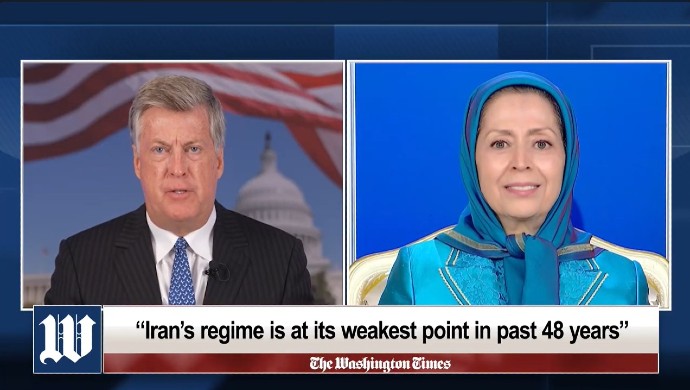
In a recent, exclusive interview with the Washington Times, Mrs. Maryam Rajavi, President-elect of the National Council of Resistance of Iran (NCRI), offered a clear vision of the regime’s terminal weakness.
Addressing those who claim the regime is stronger following the recent developments, Mrs. Rajavi stated bluntly, “In my view, this assessment is incorrect, because the regime is at its weakest point in the past 48 years.” She explained that “the super-crises that led to the January uprising have not only remained unresolved but have in fact intensified after the war.”
To counter the explosive state of society, the regime has escalated its killings. Mrs. Rajavi noted that “the executions in recent weeks demonstrate the regime’s deep concern about defiant youth and Resistance Units.” Pointing to the 23 political prisoners executed in a single month—including eight MEK commanders and 15 uprising participants—she emphasized this violence aims “to instill fear and terror among the public, especially the youth, to deter them from pursuing protest and rebellion.”
The engine of regime change: Resistance on the ground
Mrs. Rajavi stressed that the proven solution to the Iran crisis is change brought about by the Iranian people themselves. “Our specific strategy for overthrowing this regime is centered on the fusion of two elements: popular uprising and organized resistance, including the Resistance Units,” she explained.
The sheer scale of this resistance is immense. Mrs. Rajavi revealed that “Resistance Units—during the January uprising alone—carried out 630 operations against repressive centers to protect the protestors.” Furthermore, she highlighted the boldness of these forces, noting that “on February 23, 250 MEK fighters launched an assault on Khamenei’s heavily guarded headquarters.”
In an interview with @TimConstantine1 of the @WashTimes on the current situation in Iran and the Iranian people’s struggle for freedom, I stressed that the viable solution to the Iranian crisis is regime change by the people of Iran and the organized Resistance. https://t.co/fFiEJa0uFL pic.twitter.com/ahSPa22WeJ
— Maryam Rajavi (@Maryam_Rajavi) May 20, 2026
The social base of the MEK inside Iran has been paid for in blood. Reminding the world of the ultimate price paid for freedom, she stated, “In total, more than 100,000 members of the Resistance have been executed by this regime.” She also pointed to the regime’s desperate attempts to stop the resistance, such as the absentia trials in Tehran “targeting 104 members of the resistance,” the purpose of which “is to level accusations in an effort to halt the growing trend of youth joining the movement.”
Rejecting the dictatorships of the past and present
As the prospect of the regime’s collapse becomes imminent, Mrs. Rajavi warned against the illusion of fake alternatives. “As I have repeatedly stated, real change in Iran requires a combat-ready, organized force on the ground,” she said. “The fake alternatives, polished through social media engineering and glossy television programs, lack even the slightest real role or relevance.”
She explicitly condemned efforts to elevate remnants of the former Pahlavi dictatorship, notably the Shah’s son. “These represent remnants of the former dictatorship who aspire to return Iran to the past. But a people who sacrifice their lives do so not for a return to the past, but for a democratic future,” she emphasized. In fact, she warned that “elevating a manufactured alternative built around the Shah’s son and the remnants of the former dictatorship serves as one of the clerical regime’s key levers to confront and contain the uprising.”
A blueprint for stability: Preventing a power vacuum
Addressing Western fears that a regime collapse could lead to regional instability, Mrs. Rajavi provided resounding reassurance. “Neither the experiences of Iraq and Libya are applicable to Iran, nor is a ‘Chalabi-style’ scenario conceivable, nor is a return to monarchical dictatorship,” she declared. She explained that unlike those nations, Iran possesses “a long-standing national identity and a deeply rooted, cohesive social structure.”
EXCLUSIVE: Maryam Rajavi, president-elect of the National Council of Resistance of Iran, tells The Times that Iran's clerical regime is at its weakest point in decades.
She outlines the NCRI's 10-point plan for a democratic Iran and urges international support for regime change. pic.twitter.com/Gd3AHS4gx0
— The Washington Times (@WashTimes) May 20, 2026
More importantly, the NCRI has a predefined, concrete political roadmap to prevent a power vacuum. Mrs. Rajavi detailed that “a provisional government designated by the Council will, within a maximum of six months, hold free and fair elections for a constituent and national legislative assembly, thereby transferring sovereignty to the people.” Once this is achieved, “the provisional government will then resign.”
Human rights, women’s leadership, and ethnic inclusion
The transition to democracy in Iran is underpinned by the NCRI’s Ten-Point Plan. Recognizing the driving force behind recent protests, Mrs. Rajavi noted that the prominent role of women “was not spontaneous or created overnight. Rather, it is rooted in 48 years of struggle by Iranian women.” Today, this leadership is institutionalized, as “one thousand heroic women serve in the MEK’s Central Council,” and “women constitute 52 percent of the more than 450 members of the National Council of Resistance of Iran.”
Furthermore, recognizing Iran’s diverse demographics, Mrs. Rajavi emphasized that “preserving Iran’s territorial integrity and national unity is possible precisely through guaranteeing the rights of all its constituent peoples and components.” For this reason, the NCRI advocates “internal autonomy for oppressed nationalities such as the Baluchis, Kurds, Arabs, and Turkmen.”
A call to the international community
Mrs. Rajavi concluded with clear demands for global policymakers. She urged the international community “to predicate any diplomatic engagement or agreement on the halt in executions and the release of political prisoners.” Furthermore, she demanded that “the regime’s dossier of human rights violations must be referred to the United Nations Security Council.”
She also called for the regime’s embassies to be closed and for “agents and operatives of the Ministry of Intelligence and the Revolutionary Guards” to be expelled globally.
In a powerful final statement regarding the Resistance’s intentions, Mrs. Rajavi clarified: “Our struggle and sacrifices are not aimed at gaining power, nor do we seek a share of power. Our only goal is to establish popular sovereignty and democracy.”