

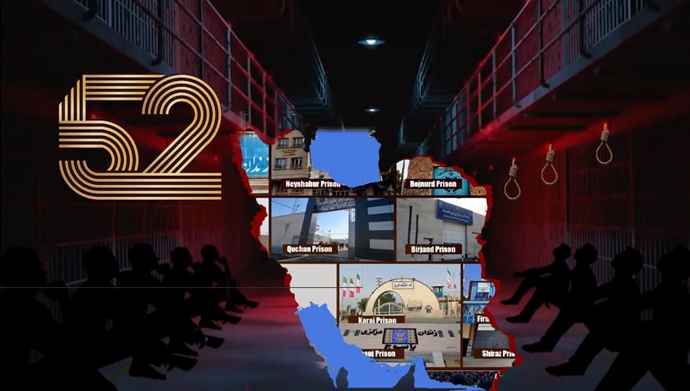

Prisoners across Iran held the 52nd week of the “No to Executions Tuesdays” campaign on January 21, 2025. The “No to Executions Tuesdays” campaign is a coordinated protest movement initiated by political prisoners across Iran to oppose the regime’s extensive use of the death penalty. Since it began in early 2024, the campaign involves weekly hunger strikes and statements condemning executions, aiming to raise awareness and mobilize both national and international support against capital punishment in Iran. It has now expanded to 34 prisons across the country. On the eve of the first anniversary of the “No to Executions Tuesdays” campaign, the men’s ward of Adelabad Prison in Shiraz joined the initiative.
In their statement, the prisoners noted that the regime has executed more than 110 prisoners in the Persian calendar month of Dey (December 21–January 20). Since the beginning of the Persian calendar year 1403 (beginning in March 2024), the regime has hanged more than 950 prisoners. “These statistics reflect an unprecedented increase in the use of executions as a tool to suppress society,” the statement reads in part.
“In the latest developments, a political prisoner named Malek Davarshenas (Mousavi), 26 years old, from Khorramshahr, has been sentenced to execution on charges of rebellion and faces the imminent threat of the death penalty,” the prisoners warn.
The “No to Executions Tuesdays” campaign has garnered extensive support both inside and outside the country. Among these supporters are 11 teachers’ unions from various provinces, who have courageously backed the campaign despite pressure by the regime’s security institutions.
The prisoners’ statement also reads: “The people’s jubilation over the punishment of Mohammad Moghiseh and Ali Razini reflects the widespread public disgust with executions and their support for the campaign. This is the outcome of 45 years of executions and massacres of prisoners, demonstrating the Iranian people’s aversion to the death penalty. It shows that the ‘No to Executions Tuesdays’ campaign and all actions against executions echo the voices of most Iranians, demanding the abolition of this medieval punishment.”
The statement adds: “Once again, we urge all prisoners in various prisons to join the ‘No to Executions Tuesdays’ campaign so that we can unite as one voice to defend the right to life for those sentenced to execution.”
The reliance of Iran’s regime on executions
According to a statement by the National Council of Resistance of Iran (NCRI) on January 2, 2025, at least 1,000 executions were carried out in 2024—a number unprecedented in the past 30 years. This horrifying statistic once again draws attention to the judicial system of this regime and its instrumental use of executions.
The primary reason for reliance on executions is the regime’s illegitimacy and its obsessive fear of being overthrown.
The regime relies heavily on repression and executions for its survival. However, these tools have so far failed to suppress the revolutionary spirit and the embrace of organized resistance in Iran’s volatile society.
Iranian society has overcome the barrier of fear imposed by executions. This method of intimidation no longer deters; rather, the brutality and frequency of executions have increased public anger and bolstered resistance. The social climate is intensely revolutionary, and the desire to overthrow the regime grows stronger by the day.
A regime that once boasted of its strategic depth in Syria, Iraq, and Lebanon now reveals its political weakness and deadlock through increased executions, resorting to widespread domestic repression. Instead of fighting in distant territories, this regime is now waging a survival battle on the streets of Tehran and even within its prisons and dark cells.
The beginning of the “No to Executions Tuesdays” campaign
The “No to Executions Tuesdays” campaign began with a hunger strike by ten political prisoners in Ghezel Hesar Prison on January 30, 2024. Accompanied by a statement, this campaign called on public opinion and the international community to stop the regime’s execution machine.
One week later, female prisoners in the women’s ward of Evin Prison joined the campaign with their weekly hunger strike, adding a new dimension to the movement.
This symbolic act, particularly the choice of Tuesdays for hunger strikes, carried profound meaning, as Tuesdays are often the final day for many prisoners transferred to solitary confinement before execution.
The initial protest by Ghezel Hesar prisoners received widespread support from other prisons, gradually leading inmates in other cities to join the movement. By the first anniversary of the hunger strike in Ghezel Hesar, 34 prisons had joined the “No to Executions Tuesdays” campaign, including:
Evin Prison (women’s ward, wards 4 and 8), Ghezel Hesar Prison (units 3 and 4), Karaj Central Prison, Greater Tehran Prison, Arak Prison, Khorramabad Prison, Asadabad Prison in Isfahan, Dastgerd Prison in Isfahan, Sheiban Prison in Ahvaz, Nezam Prison in Shiraz, Bam Prison, Kahnuj Prison, Mashhad Prison, Qaemshahr Prison, Lakan Prison in Rasht Prison (men’s and women’s wards), Ardabil Prison, Tabriz Prison, Urmia Prison, Salmas Prison, Khoy Prison, Naqadeh Prison, Saqqez Prison, Baneh Prison, Marivan Prison, Kamyaran Prison, Tabas Prison, Khorin Prison in Varamin, Rudsar Prison in Gilan, Sepidar Prison in Ahvaz, Ramhormoz Prison, Talesh Prison, Adelabad Prison in Shiraz (men’s and women’s wards), Joveyn Prison, and Borazjan Prison.
This participation highlights the depth of solidarity among political prisoners and underscores their collective resistance against the regime’s repressive policies of bloodshed and execution.
Connection with Iran’s explosive society
The “No to Executions Tuesdays” campaign gradually expanded beyond prison walls, reaching Iran’s volatile society and the families of political prisoners. Human rights activists, families of executed prisoners, and even professional and labor organizations issued statements of support. The Coordinating Council of Teachers’ Associations and dozens of other groups also joined the campaign. These endorsements transformed the movement from a limited prison protest into a widespread campaign with social and international dimensions.
The first anniversary of the “No to Executions Tuesdays” campaign
The “No to Executions Tuesdays” campaign reached its first anniversary as it entered its 52nd week. This continuity over the past year has created a new alignment linking prisons with Iran’s explosive society.
The campaign, marked by hunger strikes and protests by political prisoners, has sent a clear message to society and the regime: political and non-political prisoners, despite the regime’s efforts to isolate them, have united to demonstrate that the common enemy of all Iranians is the clerical regime.
Female prisoners have played a leading role in this campaign. Through active participation in protests and sit-ins, they have demonstrated their steadfast and transformative determination, proving their pioneering role in social struggles.
Every week, prisoners release statements to honor and preserve the memory and values of resistance martyrs. In these statements, they declare their right to resist repression and executions.
The role of 1980s political prisoners
One notable aspect of this campaign was the participation of political prisoners from the 1980s and the families of martyrs. Through statements from inside and outside Iran, they announced their support for the “No to Executions Tuesdays” campaign. Recalling the tragedies of the 1980s, including the mass executions of political prisoners, added historical and emotional dimensions to the movement, forging a new bond between different generations.
International Support
Amnesty International and other human rights organizations issued statements praising the “No to Executions Tuesdays” campaign and condemning the widespread executions in Iran. These organizations called on world governments to prosecute officials of the clerical regime under the principle of universal jurisdiction for crimes against humanity. Such support drew global attention to the issue of executions in Iran and increased international pressure on the Iranian regime.
The continuation and significance of the campaign
The “No to Executions Tuesdays” campaign continues with strength and determination, spreading from prison to prison. It has demonstrated that even in the darkest circumstances and under the shadow of execution, you can fight back against oppressors. The choice of Tuesdays as the protest day emphasizes the human tragedy of executions and serves as a constant reminder of this calamity to the international community.
The “No to Executions Tuesdays” campaign, built on internal solidarity and awakening international consciences, holds significant potential for bringing about change. This movement—emerging from the heart of execution’s shadow—connects with the larger movement of the Iranian people and organized resistance for freedom in Iran.