

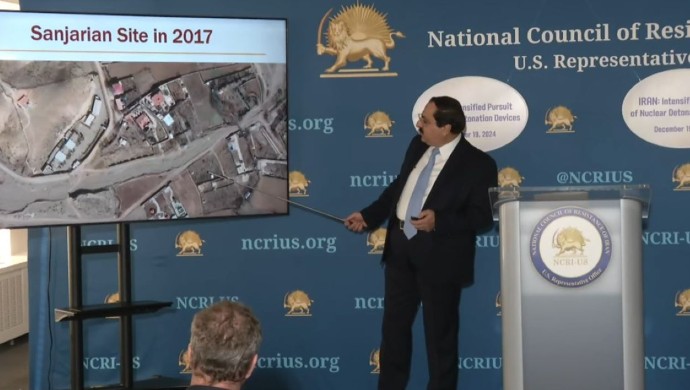

On December 19, 2024, the National Council of Resistance of Iran (NCRI) unveiled alarming new evidence about the Iranian regime’s clandestine nuclear weapons development during a press conference held in Washington, D.C.
These revelations, centered around Iran’s intensified activities at covert nuclear sites, are based on intelligence sourced from the extensive network of the People’s Mojahedin Organization of Iran (PMOI/MEK) within Iran. This network has consistently provided credible, detailed information about Tehran’s nuclear program, often at significant personal risk.
The latest revelations, centered around Iran’s intensified activities at covert nuclear sites, arrive at a critical juncture as international scrutiny over Tehran’s nuclear program escalates.
The NCRI disclosed that Iran has significantly expanded its efforts to develop nuclear detonators through activities conducted by METFAZ, the Center for Research and Expansion of Technologies on Explosions and Impact. This organization, a subdivision of Iran’s Ministry of Defense, operates under Brigadier General Reza Mozafarinia’s command and is closely tied to the Organization for Advanced Defense Research (SPND).
NCR-US Press Conference to Reveal Intensification of Iran’s Nuclear Weapons Program, Dec 19, 2024
🔷️ Sanjarian Site detailed by Alireza Jafarzadeh, NCRI-US deputy director.#Iran #IranNuclear @A_Jafarzadeh pic.twitter.com/x6FwCnjb1C— NCRI-U.S. Rep Office (@NCRIUS) December 19, 2024
SPND, established in 2010, oversees weaponization activities for Iran’s nuclear program and was founded by Brigadier General Mohsen Fakhrizadeh, who led its operations until his assassination in 2020. Under SPND’s guidance, METFAZ has focused on developing high-explosive technologies critical to the assembly and detonation of nuclear warheads. SPND’s network of research and manufacturing facilities plays a central role in sustaining the Iranian regime’s nuclear ambitions, making it a critical component of the regime’s covert operations.
The NCRI’s new revelations include information about two facilities that are playing a key role in the regime’s nuclear weapons activities:
- Sanjarian (Meshkat Complex): METFAZ is using this site to intensify its research and manufacturing of nuclear detonation technology, including Exploding Bridgewires (EBWs). The site, located southeast of Tehran near the Parchin military zone, operates under strict secrecy, with local villagers barred from entering the vicinity.
- Parchin Site (Plan 6): This location, situated southeast of Tehran near the Parchin military zone, has seen significant expansions, particularly for high-explosive testing. Known as Zeinoddin Industries, its activities further indicate Iran’s nuclear weaponization efforts.
In its revelations, the NCRI also provided names and details of the key officials leading the activities at these sites. Saeed Borji and Akbar Motallebizadeh were named as central figures in these developments. Borji, a long-time member of the Islamic Revolutionary Guard Corps (IRGC), has overseen nuclear detonator projects since the early 2000s. Motallebizadeh, CEO of the covert Arvin Kimia Abzar Company, leads efforts to disguise nuclear-related activities under the pretense of oil and gas industry services.
Arvin Kimia Abzar operates under the guise of producing equipment for the oil and gas sector, but intelligence reveals its true focus on high-explosive materials for nuclear applications. The company’s incomplete public website and the secrecy around its activities further underscore its role in Iran’s covert operations. Satellite imagery and intelligence have corroborated the NCRI’s findings, pointing to a coordinated effort to advance weaponization under a veil of secrecy.
The NCRI’s revelations align with unresolved concerns raised by the International Atomic Energy Agency (IAEA), particularly regarding EBW detonators and Iran’s explanations for high-explosive testing. Patterns of deception, such as masking nuclear development as oil industry research, are consistent with Iran’s longstanding tactics to evade scrutiny. This new evidence reinforces fears that Iran’s program is advancing rapidly toward weaponization, undermining international peace and stability.
The NCRI’s revelations follow a December 18, 2024, UN Security Council session addressing nuclear non-proliferation and Iran’s compliance with Resolution 2231. Representatives from the United States, the United Kingdom, and France issued stark warnings about Iran’s escalating nuclear activities. The French representative highlighted that Iran now possesses “four significant stockpiles” of enriched uranium, well beyond levels required for civilian use. Western nations increasingly advocate for the activation of the snapback mechanism to reimpose sanctions on Tehran.
A joint statement from Berlin, London, and Paris underscored that Iran’s stockpile of highly enriched uranium grants it the capability to produce multiple nuclear weapons rapidly. As Resolution 2231 approaches expiration in October 2025, international efforts to curb Iran’s nuclear ambitions are reaching a critical crossroads.
The NCRI’s findings shows that the weaponization side of the Iranian regime’s nuclear program has not received the scrutiny it deserves. “Our revelation today shows that the regime has no transparency related to its program for building an atomic bomb and is moving towards building the bomb at a rapid pace,” the NCRI said.
It is also further proof that since 2002, when the Iranian Resistance first revealed the regime’s nuclear program, Tehran has never cooperated with the international community and the UN nuclear watchdog. It has denied all its bomb[1]making activities despite the evidence.
As global powers grapple with Iran’s nuclear escalation, the NCRI’s latest revelations underscore the urgency of decisive international action. While snapback sanctions and robust inspections are immediate necessities, they are not necessary.
As Mrs. Maryam Rajavi, the President-elect of the National Council of Resistance of Iran, stated on December 17 during a session at the House of Representatives: “After the regime’s failures in the region, it has accelerated its nuclear weapons program to avoid its downfall. Therefore, the snapback mechanism in UN Security Council Resolution 2231 must be activated immediately. However, the ultimate solution to prevent a terrorist regime from obtaining nuclear weapons is its overthrow by the Iranian people and its organized Resistance.”