

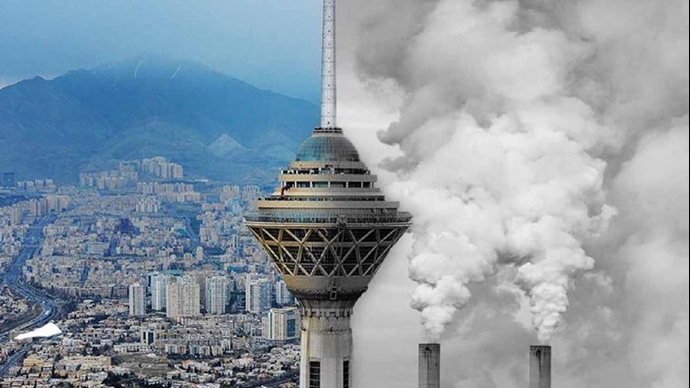

Air pollution in Iran, which annually causes illness and death for thousands of people, has become a serious environmental, economic, and social issue. This crisis has escalated with school closures, the cancellation of sports events, and the resumption of using highly polluting fuels like mazut.
On December 12, the state-run Tabnak newspaper reported: “Studies of Tehran’s predominant pollutants these days indicate that fine particulate matter smaller than 2.5 microns (PM2.5) is the main air pollutant in Tehran.
“These particles, primarily emitted from mobile sources, have been the predominant pollutants during the cold seasons for years. According to Tehran’s pollution emission inventory, mobile sources account for 68% of the fine particulate matter (particles smaller than 10 microns and those smaller than 2.5 microns).”
On December 13, Tejarat News website reported: “We reviewed Tehran’s air pollution index from various sources as of 12:00 PM on Friday, December 14. The Microsoft index was 269, IqAir 196, Waqi 195, and Tehran Municipality’s Air Quality Control 147.” The site added that domestic systems report lower real numbers.
Silent death
Air pollution has reached alarming levels in many Iranian cities, particularly during the colder seasons, with air quality dropping to dangerously low levels for many individuals. Prolonged exposure to these pollutants can increase the risk of premature death.
On November 24, the state-run Setareh Sobh newspaper quoted Mohammad Sadegh Hassanvand, head of the Air Pollution Research Center at Tehran University of Medical Sciences, as saying, “Particles smaller than 2.5 microns have been classified as carcinogenic compounds since 2013.”
In Tehran, one of the world’s most polluted cities, over 4,000 people lose their lives annually due to air pollution. The impacts are particularly severe for children, the elderly, individuals with cardiac and respiratory conditions, and pregnant women. This pollution leads to increased cases of respiratory diseases such as asthma and bronchitis, cardiovascular illnesses, lung cancer, and neurological disorders.
Rising air pollution in Iran has also led to mental health issues, including anxiety, depression, and psychological problems stemming from constant concerns about air quality. These hidden effects add additional pressure to Iranian society, making the air pollution crisis not just a physical health issue but also a significant psychological challenge.
These threats, which gradually and silently claim lives, are known as the “Silent Death.”
On November 24, Setareh Sobh wrote, “Approximately 50,000 Iranians died from air pollution last year. Adding 20,000 fatalities from traffic accidents brings the total to 70,000 deaths. This media identifies air pollution as the second leading cause of mortality in Iran.”
A Chronic Crisis, the Product of an Anti-Iranian Regime
Air pollution in Iran has evolved into a chronic crisis, far beyond a simple environmental issue. This crisis stems not only from factors such as industrialization and the increasing number of vehicles but also from inefficient policies and the lack of fundamental measures by the Iran’s regime. The regime of Iran through its misguided policies, is the primary factor perpetuating the air pollution crisis.
Three main factors contributing to the intensification of the air pollution crisis are:
- The Presence of Polluting Industries and Vehicles
Due to the dominance of regime-affiliated mafias in the automobile industry and widespread use of low-quality fuels, outdated vehicles remain unreplaced, and industrial facilities fail to meet emission standards. As a result, factories and vehicles release vast amounts of toxic gases, carbon dioxide, and particulate matter into the atmosphere daily.
On December 12, the state-run Tabnak newspaper wrote, “According to Shina Ansari, head of the Department of Environment: ‘The imbalance in gasoline production is one of the country’s issues, leading to the production of substandard gasoline in some cases, which contributes to increased pollutants’.”
- Inefficient Policies in Public Transportation
Another significant factor exacerbating the air pollution crisis is the poor state of public transportation in Iran. Despite rapid population growth and urban expansion, public transportation systems in many cities, especially Tehran and Isfahan, remain outdated and lack sufficient infrastructure to meet citizens’ needs. This underdevelopment has led to increased reliance on private vehicles, further intensifying air pollution.
- Not Utilizing Clean Energy Resources
The Iran’s regime remains heavily reliant on fossil fuels instead of adopting renewable and clean energy sources. Polluting power plants and the lack of investment in clean energy technologies like solar, wind, and geothermal energy continue to produce greenhouse gases and pollutants.
This is despite Iran holding the second-largest natural gas reserves globally, accounting for 17% of the world’s gas supply.
On December 11, Borna news website quoted Mostafa Rajabi Mashhadi, spokesperson for the electricity industry, as saying, “Over 90% of the country’s electricity is supplied by thermal power plants using gas. During the cold seasons each year, as domestic and commercial gas consumption rises, power plants’ gas quotas are reduced, and liquid fuels—mainly diesel—are used as substitutes.”
The spokesperson failed to mention that the use of mazut fuel in power plants persists. Despite legal mandates and environmental warnings, three major power plants—Shazand in Arak, Montazer Qaem in Alborz, and Montazeri in Isfahan—have reverted to burning mazut.
Solutions and basic remedies
Considering the issues, the air pollution crisis, alongside other crises and overarching challenges, stems primarily from a regime that prioritizes exploiting Iran over its prosperity, turning it into a barren land.
To overcome the air pollution crisis, the following measures are of critical importance:
– Immediate and extensive investment in renewable energy sources.
– Revisiting energy sources and reducing dependency on fossil fuels.
– Strict enforcement of environmental regulations and the establishment of independent monitoring mechanisms.
– Transparency in budget allocation and prioritizing public health.
However, achieving these changes seems unlikely within the current regime framework. A regime that squanders national resources on domestic repression and regional adventurism rather than serving its people can only be replaced with a democratic republic—a responsible government committed to the welfare of its citizens—to bring hope for a cleaner and healthier future for Iran and its people.