

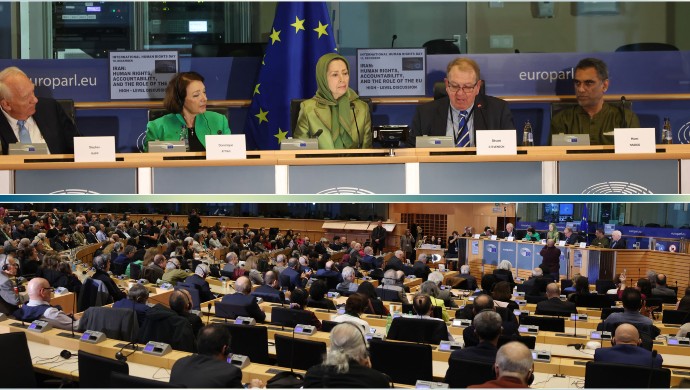

On December 10, 2025, marking the 77th anniversary of the Universal Declaration of Human Rights, the European Parliament became the focal point for a high-level conference addressing the critical human rights situation in Iran.
The session, which followed another conference earlier that day, convened a diverse coalition of European lawmakers, former senior US officials, international jurists, and human rights activists. Against the backdrop of a record-breaking surge in executions and intensifying repression within Iran, the speakers scrutinized the European Union’s current policy trajectory. The discussion centered on the necessity of holding the clerical regime accountable for crimes against humanity, specifically the 1988 massacre of political prisoners and the current wave of state-sanctioned killings.
Furthermore, the conference provided a platform to discuss the “Third Option” for Iran—a strategy rejecting both military intervention and appeasement in favor of supporting the Iranian people and their organized resistance movement, the National Council of Resistance of Iran (NCRI), to bring about democratic change.
Maryam Rajavi: A Call to End Silence and Impunity
The keynote address was delivered by Mrs. Maryam Rajavi, President-elect of the National Council of Resistance of Iran (NCRI). In her remarks, Mrs. Rajavi contextualized the struggle of the Iranian people within the broader history of human rights, noting that for Iranians, these rights are written in blood. She highlighted the grim statistics of the regime’s machinery of death, pointing out that in November alone, 335 prisoners were executed.
The Second Conference in the European Parliament on International #HumanRightsDay
In Iran, the mullahs hang human rights every single day. Their record of horrific crimes does not need an annual review. This tragic dossier is open every day of the year, every hour of the day.
In… pic.twitter.com/ISXYNCsPpH— Maryam Rajavi (@Maryam_Rajavi) December 10, 2025
Mrs. Rajavi emphasized that the regime’s repression is not confined to Iran’s borders, citing the terrorist assassination attempt against Professor Alejo Vidal-Quadras in Madrid and the regime’s harassment of dissidents in Europe. She argued that the intensification of repression is a symptom of the regime’s fragility, stating, “Never before have the mullahs been so much in need of intensifying repression because never before have they felt so close to being overthrown.”
Outlining a vision for a future Iran, she reiterated the NCRI’s commitment to a republic based on free elections, the separation of religion and state, gender equality, and the abolition of the death penalty. Mrs. Rajavi concluded her address with specific policy recommendations for the European Union. She called on the EU to condition all relations with Tehran on a halt to executions, to close the regime’s embassies which serve as hubs for espionage, and to designate the Islamic Revolutionary Guard Corps (IRGC) and the Ministry of Intelligence as terrorist organizations.
“We write the history of human rights with our own blood,” Mrs. Rajavi said, quoting Professor Kazem Rajavi. She urged European leaders to end their silence regarding the “18 political prisoners, whose only ‘crime’ is supporting the PMOI,” warning that the regime is currently destroying the graves of the 1988 massacre victims to erase evidence of its crimes.
An Industrial Scale of State Murder
A central theme of the conference was the staggering rise in capital punishment in Iran, which speakers described as a calculated tactic to terrorize the population and suppress dissent. The figures presented painted a harrowing picture of the human rights landscape in 2025.
Struan Stevenson opened the panel with grim data, noting that the regime has carried out 1,932 executions so far this year. “Executions, torture, amputations, disappearances, and medieval punishments are the daily machinery of the state,” Stevenson stated, emphasizing that under the presidency of Masoud Pezeshkian, 2,633 people have been sent to the gallows. He highlighted that November saw a horrific spike with 335 executions, describing the regime as one that has “never known justice” and “never permitted mercy.”
.@STRUANSTEVENSON: The West must stand with the #Iranian people, not the tyrants who oppress them. A regime built on fear, lies, and violence cannot endure; its collapse is inevitable. The question is whether the democratic world will stand with Iranians at the moment of…
— NCRI-FAC (@iran_policy) December 10, 2025
Stephen J. Rapp, the former U.S. Ambassador-at-Large for War Crimes, reinforced this assessment, calling the executions “acts of state terror.” He analyzed the judiciary’s methodology, noting that individuals are accused of vague crimes like “enmity against God” or condemned merely for affiliations with opposition groups rather than actual offenses. “Iran’s execution tally for 2025 exceeds any in modern memory except for the horror of 1988,” Rapp observed. He equated the systematic nature of these killings to the crimes he prosecuted in Rwanda and Sierra Leone, classifying them as crimes against humanity.
Mark Ellis, Executive Director of the International Bar Association (IBA), cited Amnesty International’s description of the situation as “state-sanctioned murder on an industrial scale.” Ellis presented findings from a recent IBA report which concluded that Iran’s legal community is being systematically dismantled. “There is no independent judiciary any longer in Iran,” Ellis asserted, explaining that courts approve executions without evidence, relying solely on files fabricated by security officers and confessions extracted under torture.
Amb Stephen Rapp: We must support the #Iranian people’s right to replace this regime and ensure justice for victims. This requires real resources to document crimes, build evidence for prosecutions, and resist pressure to hand over suspects. The world will be judged by whether…
— NCRI-FAC (@iran_policy) December 10, 2025
Dominique Attias, Chair of the Board of Directors of the European Lawyers Foundation, brought the statistics down to a human level. “What does 335 mean?” she said, referring to the abhorrent number of executions in November. “It means every day when we got up… 11 people were executed every day.” She highlighted the regime’s use of public executions to instill fear, a tactic she argued has failed to break the spirit of the Iranian people.
The Failure of Appeasement and the Demand for a Firm Policy
The gathered dignitaries delivered a scathing critique of Western diplomatic strategies, particularly the approach of engagement and appeasement adopted by many European governments. There was a consensus that this policy has not only failed to curb the regime’s aggression but has emboldened it.
Struan Stevenson condemned the “shameful language of engagement,” arguing that European leaders have “turned a blind eye to the death sentences, to the torture chambers, to hostage-taking, to cross-border terrorism.” He characterized this approach as “moral cowardice” and “complicity with tyranny,” urging the West to stand unequivocally with the Iranian people rather than the oppressors.
.@AttiasDominique: As we speak, 18 political prisoners face imminent execution for alleged ties to @Mojahedineng. Zahra Tabari described her “trial”: sound cut, no lawyer, video link only. Asked for final defense, ignored. She wrote, It took them 10 minutes to sentence me to…
— NCRI-FAC (@iran_policy) December 10, 2025
Dorien Rookmaker, a former Member of the European Parliament, described the regime as “100% pure evil” and proposed a specific “Ten-Point Plan for the European Union.” Her recommendations included conditioning trade and diplomatic relations on an immediate moratorium on the death penalty, urging the UN Security Council to issue arrest warrants for regime leaders, and endorsing the NCRI’s Ten-Point Plan. “I think the people of Iran have the right to get rid of an evil, malicious, and criminal regime and we have to say so out loud,” Rookmaker declared.
Kumi Naidoo, a South African human rights activist and former Secretary General of Amnesty International, offered a complementary six-point plan. He urged the EU to “condition any further diplomatic engagement on measurable human rights progress, not promises.” Naidoo drew parallels to the anti-apartheid struggle, advising activists to find allies even within authoritarian structures and to never underestimate the power of their cause. He stressed that the EU must “protect Iranian dissidents and human rights defenders in Europe” who are facing increasing intimidation.
.@kuminaidoo: My six-point plan for the EU:
1) demand an immediate moratorium on executions;
2) back a UN process to document crimes;
3) support civil society, women’s groups, and journalists;
4) protect dissidents in Europe;
5) call for a @UN probe on 1988;
6) condition…— NCRI-FAC (@iran_policy) December 10, 2025
Antonio López-Istúriz White, the host MEP, warned that the regime’s threat extends beyond Iran’s borders and the Middle East and its targets can include Europe. He called on the European Council and Commission to match the Parliament’s activism with concrete executive action, stating that the EU must refuse normalization unless there is real progress on human rights and the rule of law.
Legal Accountability and Preserving Historical Memory
The conference devoted significant attention to the legal pathways for holding Iranian officials accountable, particularly regarding the 1988 massacre of 30,000 political prisoners and the ongoing destruction of evidence related to those crimes.
Stephen Rapp drew on his experience with Syria to argue that accountability is possible even without immediate access to the International Criminal Court. He emphasized the importance of “civil society investigations on the ground” and “international mechanisms that built strong cases” to convict perpetrators under universal jurisdiction in foreign courts. “The day will come when the cell door will bang behind you and you will face trial before your survivors,” Rapp warned the regime’s officials.
.@RookmakerDorien: The EU should endorse the NCRI Ten-Point Plan. Across all political groups, we must unite to help the #Iranian people end this regime. We also need stronger targeted sanctions on Khamenei and senior officials responsible for crimes against humanity.…
— NCRI-FAC (@iran_policy) December 10, 2025
Mark Ellis highlighted the regime’s current efforts to “obliterate evidence of yesterday’s massacres” by destroying mass graves. He argued that these actions are an attempt to “terrorize the population and shield themselves from accountability.” Ellis stressed that the international community has a duty to amplify the voices of political prisoners who, even from behind bars, continue to send out testimonies. “The architects and executioners of Iran’s atrocities should harbor no illusions that time is on their side,” Ellis stated.
Dominique Attias detailed the regime’s recent desecration of a cemetery in Tehran, where 9,500 graves were destroyed to build a parking lot, calling it the “ultimate profanation.” She noted that the UN Special Rapporteur has recognized the 1988 massacre as both genocide and a crime against humanity. Attias urged the Parliamentarians to support the establishment of an international mechanism to prosecute those responsible, many of whom, including Supreme Leader Ali Khamenei, remain in power today.
The Third Option: Support for the NCRI and Resistance Units
Speakers repeatedly endorsed the “Third Option” as the only viable path to a free Iran. This strategy rejects both foreign military intervention and appeasement of the current regime, instead relying on the Iranian people and their organized resistance movement to effect change.
Struan Stevenson highlighted the growth of Resistance Units linked to the People’s Mojahedin Organization of Iran (PMOI/MEK) across the country. He described these units as comprised of young men and women who risk torture and execution to challenge the state’s apparatus of repression. Stevenson argued that the NCRI, with Mrs. Rajavi’s leadership and her Ten-Point Plan, acts as a “practical blueprint for a new Iran” rather than an abstract dream.
MEP @JFLopezAguilar: The EU must reach global stature so its human-rights commitments actually mean something when addressing 45 years of a regime that grossly violates rights—starting with the right to life. One execution is too many, but hundreds are intolerable and impossible…
— NCRI-FAC (@iran_policy) December 10, 2025
Dr. Sina Dashti, a medical professional and representative of the Iranian diaspora, provided a personal testament to the continuity of the resistance. He described the generational nature of the struggle, noting that families who supported the democratic movement against the Shah are now supporting the PMOI against the mullahs. “No force can stop the arrival of spring,” Dashti said, asserting that supporting the resistance is not about revenge but about building a future based on equality and freedom. “By supporting the Iranian Resistance, you are participating in the construction of this magnificent future,” he told the European lawmakers.
Mrs. Rajavi herself noted that the regime is “trapped in a dead-end” facing the Iranian people and the Resistance. She pointed to the expanding activities of the Resistance Units as proof of the people’s desire to end the religious dictatorship and establish a democratic republic.
Rejecting All Forms of Dictatorship
A recurring political theme was the rejection of any return to the monarchical dictatorship that preceded the current theocracy. The speakers and the resistance representatives made it clear that the Iranian people’s struggle is for a forward-looking democracy, not a regression to past tyrannies.
Dr. Sina Dashti spoke movingly about his parents’ support for Dr. Mohammad Mossadegh, the leader of Iran’s only democratic government, which was overthrown in a coup. He recalled the 25 years of “absolute dictatorship of the Shah” characterized by executions and torture, noting that the monarchy paved the way for the mullahs by destroying democratic forces. “The Iranian people reject both the mullahs’ and Shah’s dictatorships,” Mrs. Rajavi affirmed in her speech, underscoring that the fight is for a republic where sovereignty belongs to the people.
.@TonoEPP: The only path to peace is an Iran free from the Ayatollahs’ regime. From this house we will keep denouncing brutality, executions, and systematic abuses, demanding release of political prisoners and an end to the death penalty. No EU normalisation without real…
— NCRI-FAC (@iran_policy) December 10, 2025
Struan Stevenson also touched upon this, stating that the resistance is leading Iran toward a “democratic republic where theocracy and monarchy have no place.”
Solidarity with Women and the “No to Execution” Campaign
The conference paid special tribute to the role of women in the Iranian uprising and the resilience of political prisoners. The speakers highlighted the “No to Execution Tuesdays” campaign, a hunger strike movement initiated by prisoners that has been ongoing for nearly two years.
Azadeh Zabeti, a lawyer and spokesperson for the Committee of Justice for Victims of the 1988 Massacre in Iran (JVMI), focused on the 18 political prisoners currently on death row for supporting the PMOI. She read a powerful statement signed by over 300 prominent women from around the world—including former prime ministers and presidents like Yulia Tymoshenko of Ukraine and Micheline Calmy-Rey of Switzerland. The statement demanded the release of Zahra Tabari, a 67-year-old engineer sentenced to death after a 10-minute sham trial for holding a banner reading “Woman, Resistance, Freedom.”
“This is not a judicial action of the state. These are in fact political killings,” Zabeti declared. She noted that Iran is the world’s number one executioner of women per capita and that the death sentences are intended to terrorize society into submission.
Kumi Naidoo urged the audience to send their solidarity to the “heroic resistance of the women who are in Iran.” He pointed out the regime’s weakness in feeling threatened by a 67-year-old woman with a banner. “Repression is never a sign of strength. Repression is a sign of your political weakness,” Naidoo remarked.
.@sinadashti: In fear of being overthrown, the regime has even paved over the graves of executed @Mojahedineng. Some in the West also try to bury us in silence. But my generation—and those after us—are determined to realize the NCRI vision in Mrs. Rajavi’s Ten-Point Plan.…
— NCRI-FAC (@iran_policy) December 10, 2025
Juan Fernando López Aguilar, a Member of the European Parliament and former Minister of Justice, emphasized that women suffer the most under the regime’s apartheid policies. He asserted that equal rights and the protection of women must be a “priority for European diplomacy,” declaring that the EU must do its best when approaching a regime that kills its own people and poses a threat to all democratic values.
Dominique Attias concluded the sentiment with a quote from a mother who lost four children to the regime: “Between us and them, there is a sea of blood. We will never forget. And we will never stop demanding justice.”