

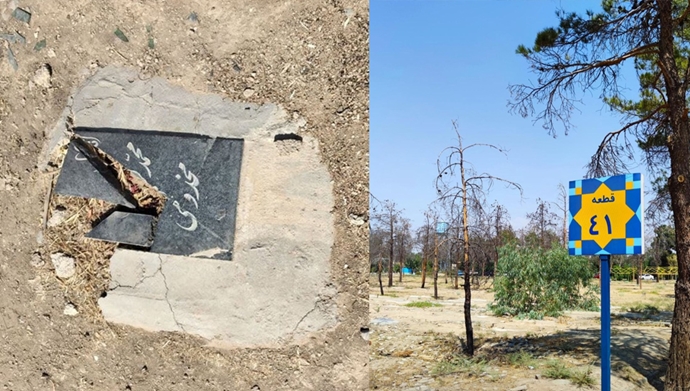

The Iranian regime is engaged in a ghoulish and systematic campaign to destroy the graves of its political victims. This is not random vandalism but a state-sanctioned strategy to erase history and conceal its crimes. From a legal standpoint, the destruction of the graves of victims of political executions is a continuation of a crime against humanity. By bulldozing these final resting places, the regime in Tehran reveals not its strength, but its profound and unshakable fear of its main opposition, the People’s Mojahedin Organization of Iran (PMOI/MEK), and the enduring legacy of its martyrs.
A confirmed crime against humanity
International human rights organizations have unequivocally condemned this practice as a grave violation of international law. In April 2021, Amnesty International issued a statement, declaring that the Iranian authorities’ destruction of mass graves is a criminal attempt to “eliminate crucial evidence of crimes against humanity, denying truth, justice and reparation to the families.” The organization stated that by concealing the fate of the victims and tormenting their families, the authorities are committing ongoing crimes of “enforced disappearance, torture and other inhumane acts.” The message is clear: these mass graves are crime scenes that must be protected, not desecrated.
The fear behind the bulldozers
The regime’s campaign of executions and desecration is driven by fear. As 26 prominent American dignitaries noted in a recent statement condemning the execution of PMOI members Behrouz Ehsani and Mehdi Hassani, “The regime’s ongoing atrocities reflect not strength, but the panic and fear of long-lost legitimacy.” Tehran is escalating its repression because it fears its true adversary: the organized Resistance and a populace demanding an end to religious dictatorship. The statement affirms that while all dissidents are at risk, the “primary targets are members and affiliates of the National Council of Resistance of Iran (NCRI) and the MeK.” The regime knows that these graves are not just sites of mourning but symbols of defiance that can inspire future generations to join the struggle for freedom.
The final step in a genocidal campaign
The destruction of these graves is the final, desperate act in a decades-long campaign of genocide against the PMOI. As former UN Special Rapporteur Javaid Rehman stated in his 2024 report, the charge of “Moharebeh” (waging war against God) was used to kill tens of thousands of PMOI members for no other reason than their belief that Islam is compatible with full political rights and gender equality. Mr. Rehman concluded this to be genocide. By attempting to erase every physical trace of these victims, the regime is trying to complete this genocide—first by taking their lives, and now by attempting to extinguish their memory.
The martyrs’ legacy inspires resistance
The regime’s fear is well-founded. For decades, the PMOI has been the driving force exposing the regime’s most sinister secrets, including its nuclear weapons program. This has made the regime ever more hostile toward the Resistance. But the PMOI and the NCRI do more than expose; they offer a clear, democratic alternative articulated in a Ten-Point Plan for a future Iran based on secularism, human rights, and popular sovereignty.
And this idea is gaining increasing momentum among Iranian youth, who are joining the ranks of the PMOI Resistance Units in growing numbers. This the regime fears more than anything else as an organized resistance is the ultimate force that will bring down the tyrannical rule of the mullahs.
The international community must recognize that the path to a free Iran lies not in appeasing the current dictatorship but in supporting the organized Resistance. This means holding the regime to account for its ongoing human rights abuses, including the desecration of the graves of PMOI martyrs, and recognizing the Iranian people’s right to resist and topple the despotic regime of the mullahs.