


Last updated: October 1, 2025
Iran stands at a pivotal moment in its history, poised on the brink of profound transformation. The long-cherished dream of fundamental change has never seemed more attainable. Between December 2017 and January 2022, six nationwide uprisings swept across the country, illuminating the Iranian people’s burning desire to overthrow the clerical regime and establish a democratic republic in its place.
These protests were remarkable not only for their scale and frequency but also for the boldness of their message. In cities and towns across Iran, thousands of demonstrators voiced their discontent through powerful slogans that cut to the heart of the nation’s political future. Chants of “No to Shah, No to mullahs” reverberated through the streets, rejecting both the monarchy of the past and the current theocratic rule. The cry “Down with the mullahs’ rule” directly challenged the foundational concept of the Iranian regime. Most daringly, protesters called for “Death to Khamenei,” targeting the regime’s Supreme Leader himself.
The depth of frustration and determination was palpable in declarations like “For 40 years we shed bloodied tears, enough is enough, we’ll take a stand.” These impassioned words encapsulate decades of struggle against oppression and a renewed resolve to forge a different path forward.
These slogans are more than mere rhetoric; they represent the Iranian people’s profound yearning for freedom and democracy. This desire has persisted and grown despite 45 years of brutal repression, including widespread torture and executions aimed at crushing dissent. The tenacity of the Iranian spirit in the face of such sustained adversity is truly remarkable.
However, past protests and experience have shown that the regime will not fall through people’s protests alone, but requires an organized resistance leading these demonstrations. A critical question now faces Iran and those observing its struggle: Which force, strategy, and course of action can successfully topple the current regime and guide Iran toward a democratic future?
In the past seven years, a new phenomenon has emerged that has significantly impacted protests across the country. The “PMOI Resistance Units,” a network of activists supporting the Iranian opposition movement, the People’s Mojahedin Organization of Iran (PMOI/MEK), have played an increasingly visible role. These units represent an organized and motivated force within the broader landscape of Iranian dissent, potentially offering a structured approach to challenging the regime’s authority.
The Emergence of PMOI Resistance Units
The concept of Resistance Units is deeply rooted in the Iranian Resistance’s long-held belief that genuine change in Iran must come from within, driven by the Iranian people themselves. This grassroots approach has proven remarkably effective in mobilizing dissent and organizing protests despite the regime’s relentless efforts to crush any form of opposition.
The idea gained significant traction in 2017 when Iran witnessed its first major nationwide uprising in years. As protests spread across the country, it became clear that a more organized and structured form of resistance was necessary to sustain the momentum and channel the people’s anger into effective action. Thus, the PMOI Resistance Units were born, emerging as a network of small, nimble groups of activists ready to challenge the regime’s authority at every turn.
Who Are the Resistance Units?
The Resistance Units are composed of small cells of Iranian activists who have taken a bold stand against the current regime. Led and organized by the PMOI’s extensive network inside Iran, these groups of determined individuals operate in cities and towns across the country, from the bustling streets of Tehran to the remote regions of Baluchestan, from the oil-rich province of Khuzestan to the mountainous terrain of Azerbaijan.
What sets the Resistance Units apart is their diversity and broad reach. Their ranks include Iranians from all walks of life – students, workers, professionals, and even former regime insiders who have become disillusioned with the system. They come from different ethnic backgrounds, representing Iran’s rich cultural tapestry. What unites them is a shared vision: the overthrow of the theocratic dictatorship and the establishment of a democratic, secular republic that respects human rights and individual freedoms.
The Resistance Units operate under extremely dangerous conditions. The Iranian regime, known for its brutal suppression of dissent, has made targeting these activists a top priority. Members of the Resistance Units face the constant threat of arrest, torture, and execution. Yet, despite these risks, their numbers continue to grow, a testament to the Iranian people’s yearning for change and their willingness to sacrifice for freedom.
The Resistance Units: Activities and Impact on Iran’s Protest Movement
The Resistance Units play a crucial role in Iran’s ongoing struggle for democracy and freedom. These groups engage in a wide range of activities aimed at undermining the regime’s authority and inspiring hope among the Iranian people. Their actions are diverse, creative, and often daring, designed to keep the flame of resistance burning bright even in the darkest times.
Key activities of the Resistance Units include:
- Organizing and Leading Protests: The Units coordinate demonstrations, plan routes, communicate gathering points, and work to ensure protesters’ safety. They provide tactical guidance and help maintain the momentum of protests.
- Spreading Messages of Resistance: Through leaflets, banners, and street activities, they promote slogans of freedom and democracy, breaking the atmosphere of fear imposed by the regime.
- Commemorating Martyrs: They honor those who have sacrificed their lives for Iran’s freedom through ceremonies, memorial posters, and social media campaigns.
- Targeting Regime Symbols: During protests and separate operations, they focus on destroying images and statues of regime leaders, demystifying the regime’s supposed invincibility.
- Amplifying Opposition Voices: They spread messages from Iranian Resistance leaders, particularly Maryam Rajavi’s 10-point plan for a democratic and secular Iran.
- Documenting and Reporting: In a country with restricted independent journalism, they capture and share footage of demonstrations, human rights violations, and daily life under the regime.
The impact of the Resistance Units has been particularly evident in shaping Iran’s protest movement since 2017. They have played a pivotal role in sparking and sustaining protests, maintaining a state of continuous unrest that can quickly escalate into larger demonstrations. Their consistent promotion of slogans like “No to Shah, No to mullahs” has helped shape the discourse of the protest movement.
One of their most significant achievements has been breaking the barrier of fear that the regime has long relied upon. By consistently challenging the regime despite severe risks, they inspire others to join the struggle. Their diverse composition allows them to connect with various segments of Iranian society, bridging divides between different social, ethnic, and economic groups.
In the face of brutal repression, the Resistance Units have not only persevered but grown stronger. During the 2022 protests, over 3,600 members were arrested or disappeared. However, their ranks continue to grow, demonstrating their resilience and the widespread support for their cause.
The widespread activities of the Resistance Units and their dedication to a democratic future for Iran were powerfully demonstrated during the Free Iran 2024 Summit, where they sent more than 20,000 messages supporting the Iranian Resistance and endorsing Maryam Rajavi’s Ten-Point Plan.
In 2025, this defiance reached new levels: Resistance Units used innovative tactics such as small hidden loudspeakers to broadcast anti-regime slogans across cities, ensuring that the voice of dissent resonated even in tightly controlled public spaces. These actions, reported by state-run Mehr News Agency in July 2025, forced regime officials to openly acknowledge that the “voice of the hypocrites” was drowning out their propaganda of national unity.
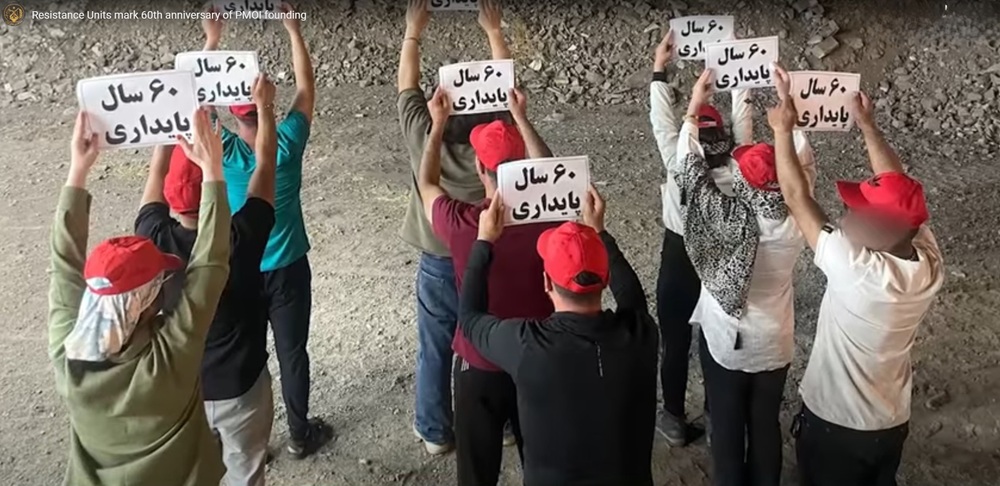
The widespread activities of the Resistance Units and their dedication to a democratic future for Iran were vividly displayed in 2025. Compared to previous years, their daily operations grew significantly, with actions carried out every single day in cities across the country. These activities ranged from burning regime symbols and posting banners to broadcasting protest slogans with hidden loudspeakers. At the same time, on every major national or political occasion, Resistance Units organized wide-scale campaigns, turning each anniversary or regime-orchestrated event into an opportunity for defiance. The peak of these efforts came during the 60th anniversary of the PMOI in September 2025, when Resistance Units appeared in large organized groups in major cities such as Tehran, Karaj, Isfahan, Shiraz, Mashhad, Zahedan, and Kermanshah. Their collective street presence—effectively marching through urban neighborhoods—represented a new stage of resistance activity that shook the regime to its core. With slogans like “Sixty Years of Glorious Steadfastness,” “No to the Shah, No to the Mullahs,” and “Death to the oppressor, be it the Shah or the Supreme Leader,” the Resistance Units demonstrated both their continuity with six decades of struggle and their expanding role as the backbone of a nationwide democratic movement. These campaigns also reinforced the NCRI’s political alternative, prominently highlighting Maryam Rajavi’s Ten-Point Plan for a free and democratic Iran.
Through their activities, the Resistance Units have also played a crucial role in internationalizing the struggle. Their documentation and reporting provide invaluable evidence of the regime’s human rights abuses and the Iranian people’s desire for change, helping to garner international support for the cause of Iranian freedom.
In essence, the Resistance Units serve as the backbone of Iran’s pro-democracy movement, continuously challenging the regime’s authority, inspiring hope among the populace, and working tirelessly towards the goal of a free and democratic Iran.
The Iranian Regime’s Growing Fear of PMOI Resistance Units
The Iranian regime’s escalating concern over the PMOI Resistance Units has become increasingly evident through official statements and state media coverage. This mounting apprehension speaks volumes about the critical role these units play in sparking and guiding uprisings against the regime, potentially paving the way for its eventual overthrow.
The regime’s Supreme Leader Ali Khamenei’s repeated warnings about the PMOI’s influence underscore the regime’s recognition of the threat posed by these organized resistance efforts. In January 2018, Khamenei explicitly identified the PMOI as a key force behind nationwide protests, stating they were “the third side of a triangle that created the uprising that they had prepared since months earlier.”
The regime’s anxiety is not limited to top leadership. State-run media outlets have also acknowledged the PMOI’s growing impact. In August 2018, the publication Baharestaneh noted the PMOI’s “infiltration” across various social classes, from truckers to teachers, highlighting the broad appeal of the resistance movement. The article warned of the Resistance Units’ ability to “multiply and replace the leaders of the scene,” indicating the regime’s fear of losing control of this organized opposition.
The 2022 nationwide uprising further solidified the regime’s perception of the PMOI as an existential threat. Despite the arrest or disappearance of over 3,600 Resistance Unit members, their influence continued to grow. This resilience in the face of severe repression demonstrates the deep-rooted support for the PMOI within Iranian society.
Recent admissions from regime-affiliated “experts” during a roundtable discussion organized by the state news agency IRNA reveal the depth of the regime’s concern. Participants acknowledged that the PMOI’s enduring influence stems not from foreign support, but from its resonance with the Iranian people, particularly the youth. This recognition of the PMOI’s domestic support base is a stark admission of the regime’s failing grip on power.
Importantly, the regime’s fear is not merely rhetorical. It has manifested in concrete actions that reveal the depth of their concern. A prime example is the recent sham trial in absentia of 104 PMOI members. This theatrical performance, far from being a legitimate legal proceeding, is a clear expression of the regime’s fear and desperation.
On May 28, 2024, during this mock trial, the presiding judge made a telling statement: “We warn the countries hosting the accused that hosting these defendants is considered a crime under international conventions against terrorism!” The judge then continued with a threatening tone toward countries hosting PMOI members, calling for their extradition. This attempt to intimidate other nations into complying with the regime’s wishes underscores the perceived threat the PMOI poses to the Iranian regime’s stability.
The regime’s reaction to the Resistance Units goes beyond mere rhetoric and show trials. The implementation of harsh measures, including mass arrests, torture, and executions, reflects a desperate attempt to quell a movement that threatens the very foundations of clerical rule. However, these brutal tactics have only served to strengthen the resolve of the Resistance Units and their supporters.
In June 2025, senior cleric Ahmad Khatami, a member of the Assembly of Experts and Guardian Council, delivered a panicked speech before Basij members in Varamin, where he explicitly described Resistance Unit tactics such as writing anti-regime slogans and photographing them for distribution. This confession, unprecedented in its detail, confirmed the decentralized and organized nature of the PMOI’s underground network. Khatami even admitted that the unrest was aimed at a “swift overthrow,” inadvertently validating the Resistance Units’ strategy.
The regime’s fear has translated into massive new repression programs. In mid-2025, Tehran’s mayor, Alireza Zakani, announced a sweeping surveillance project in cooperation with the IRGC University to place the capital under “permanent” drone and satellite monitoring. At the same time, President Masoud Pezeshkian launched a so-called “neighborhood-based management plan,” consolidating control around the Basij by forming 30,000 new “councils.” In reality, these measures represent the building of a surveillance panopticon to suffocate dissent—an admission that the clerical regime no longer trusts its own ability to control the streets.
The PMOI’s ability to unite various segments of Iranian society under a common cause of freedom and democracy has clearly rattled the regime. As one regime expert conceded, “Our main issue in the country is the PMOI, and we must address it.” This statement encapsulates the central challenge the Resistance Units pose to the continuation of theocratic rule in Iran.
Resistance Units and the 60th Anniversary of the PMOI
On September 3–4, 2025, the PMOI celebrated its 60th anniversary, and Resistance Units across Iran marked the occasion with dozens of daring activities. From Tehran, Karaj, Isfahan, Shiraz, and Mashhad to Zahedan, Kermanshah, and Ahvaz, activists displayed banners, painted slogans, and distributed posters honoring six decades of sacrifice.
What set this anniversary apart was not only its nationwide scope but also its form. For the first time, Resistance Units appeared as large organized groups in major Iranian cities, effectively staging symbolic marches through urban streets. This new level of public presence represented a qualitative leap in their activities, transforming symbolic acts into mass demonstrations of defiance that terrified the regime.
Slogans such as “Sixty Years of Glorious Steadfastness” and “Sixty Years of Infinite Sacrifice” emphasized the continuity of the movement, while bold statements like “No to the Shah, No to the Mullahs” and “Death to the oppressor, be it the Shah or the Supreme Leader” underlined the Resistance’s democratic vision: the categorical rejection of all forms of dictatorship.
In multiple cities, Resistance Units honored the founders of the PMOI by laying flowers at their birthplaces or execution sites. In Tabriz, activists commemorated Mohammad Hanifnejad; in Isfahan, Asghar Badizadegan; and in Tehran, Chitgar square where early members were executed under the Shah. These symbolic acts not only rejected tyranny but also connected the current generation of activists to the legacy of the founders.
The anniversary actions also spotlighted the NCRI President-elect Maryam Rajavi’s Ten-Point Plan. Banners read “Our choice: Maryam Rajavi,” “We can and we must,” and “Separation of religion and state, freedom of religion.” By linking resistance to a democratic alternative, the Units highlighted that their struggle is not only about removing the mullahs but about building a secular, free republic.
Equally important, the anniversary revealed another defining feature of today’s Resistance Units: their daily rhythm of activity. These are not occasional operations but sustained, ongoing campaigns. Each day, in cities across Iran, Resistance Units expand their operations—hanging posters, burning symbols of the regime, projecting slogans, or broadcasting protest chants—ensuring that the voice of defiance never falls silent. This daily expansion demonstrates both the resilience of the network and the impossibility for the regime to suppress a movement that regenerates itself constantly.
This national campaign occurred only weeks after the execution of PMOI supporters, proving that repression has failed to extinguish the Resistance. Instead, the anniversary served as a demonstration of resilience and defiance, showing that the PMOI’s underground network remains the beating heart of Iran’s democratic aspirations.
Resistance Units: The Force Exposing Iran’s Regime’s Deceptions
For years, the Iranian regime has propagated a narrative that the PMOI lacks popular support within the country. This claim, often echoed by regime sympathizers and some Western policymakers, has been used to justify continued engagement with the current theocratic regime. However, a closer examination of the activities of PMOI Resistance Units and the regime’s own actions reveals a starkly different reality – one that exposes the depth of the regime’s fear and the true extent of the PMOI’s influence.
The expansion of PMOI Resistance Units across Iran tells a compelling story that contradicts the regime’s narrative. Perhaps the most telling indicator of the PMOI’s popular support is the Iranian regime’s own response to their activities. The sheer scale and intensity of the regime’s propaganda campaign against the PMOI speak volumes about the perceived threat. Within Iran, the regime has produced an astounding volume of anti-PMOI material, including nearly a thousand book titles, hundreds of hours of films and television series, and numerous “exhibitions” in cities, universities, and mosques across the country.
This domestic propaganda machine is complemented by a sophisticated international disinformation network. The regime has invested millions of dollars in placing anti-PMOI articles in Western media outlets and has cultivated a cadre of “friendly journalists” to propagate its narrative globally. The recent exposure of the “Iran Experts Initiative” revealed a coordinated effort to strategically place regime agents within Western think tanks, advisory groups, and media organizations.
The question that naturally arises is: Why would the Iranian regime invest such enormous resources in demonizing a group that it claims lacks popular support? The answer lies in the regime’s existential fear of the PMOI and the National Council of Resistance of Iran (NCRI), of which the PMOI is a main constituent.
The regime’s extensive efforts to demonize and suppress the PMOI reveal its recognition of the PMOI, the main constituent of the NCRI as a viable alternative and a significant threat to its continued rule.
Beyond War and Appeasement: The Third Option
The developments of 2025 also underscored the global significance of the Resistance Units. As conflicts flared in the region, NCRI President-elect Maryam Rajavi reiterated the “Third Option”: neither foreign war nor appeasement, but regime change by the Iranian people and their organized resistance. Speaking at the European Parliament in June 2025, she reminded the world that she had warned decades earlier that appeasement would only embolden Tehran and lead to conflict. Today, the reality has proven her right.
This position highlights why Resistance Units are more than domestic actors. They embody the bridge between the Iranian people’s struggle and international recognition of a viable democratic alternative. Their continued defiance gives credibility to the NCRI’s democratic program and makes clear that lasting peace in the region depends on supporting the Iranian people’s right to resistance.
The Future of Iran’s Resistance Movement: A Catalyst for Change in a Powder Keg Society
As Iran teeters on the brink of widespread social upheaval, the role of the PMOI Resistance Units has become increasingly pivotal. The Iranian society, aptly described as a powder keg ready to explode at any moment, finds itself with a powerful catalyst in the form of these organized resistance cells spread across the nation.
The strategic positioning of PMOI Resistance Units throughout Iran’s diverse social fabric provides a unique advantage. These units serve as the connective tissue that can rapidly transform localized protests into national uprisings. Their presence in various sectors of society – from urban centers to rural areas, within universities, factories, and neighborhoods – allows for swift communication and coordination of protest actions.
This widespread network presents a significant challenge to the regime’s suppressive forces, including the IRGC. Unlike spontaneous protests that can be easily quelled, the Resistance Units provide structure and continuity to opposition movements. Their ability to sustain prolonged campaigns of protest severely hampers the regime’s capacity to restore order through brute force alone.
The decentralized nature of the Resistance Units makes them particularly resilient to suppression efforts. As these units are dispersed across the country and deeply embedded within different social strata, the regime faces an uphill battle in attempting to neutralize their influence. Traditional methods of cracking down on opposition – such as targeting specific leaders or organizations – prove ineffective against this grassroots network.
Moreover, the Resistance Units serve as a beacon of hope and a source of tactical knowledge for the broader population. They demonstrate that organized resistance is possible and effective, even in the face of severe repression. This inspiration can be a powerful force multiplier, encouraging more Iranians to join the struggle for freedom and democracy.
As the Resistance Units continue to set the stage for larger uprisings, they are effectively laying the groundwork for a potential overthrow of the current regime. Their actions erode the regime’s authority, expose its vulnerabilities, and galvanize public opinion against the status quo. Each successful act of defiance, each coordinated protest, serves as a stepping stone towards the eventual establishment of a democratic republic.
The Iranian regime’s evident fear of the PMOI and its Resistance Units is perhaps the clearest indicator of their potential impact. The regime’s increasingly desperate measures to suppress and discredit the movement only underscore its recognition of the threat posed to its continued rule.
Looking to the future, the role of the Resistance Units is likely to become even more crucial. The path to a free and democratic Iran is undoubtedly challenging, fraught with risks and potential setbacks. However, the presence of a well-organized, deeply-rooted resistance movement provides a clear roadmap for change. The PMOI Resistance Units, with their widespread presence and unwavering commitment to democratic values, stand ready to guide Iran through this transformative period.