

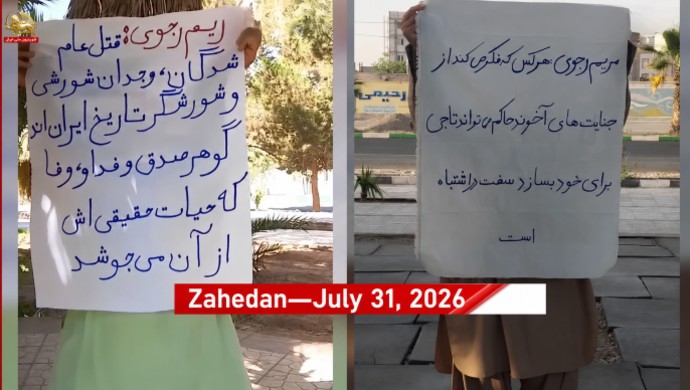

On July 31, PMOI/MEK Resistance Units in the southeastern city of Zahedan resumed their weekly public activities, defying the Iranian regime’s pervasive apparatus of execution and suppression.
Marking the anniversary of the 1988 massacre of more than 30,000 political prisoners, the activists took to public spaces despite intense threats from state security forces. They held placards spreading a message of steadfast resistance, declaring: “The 1988 massacre, despite all its agony, marked the beginning of an ongoing struggle—one that will ultimately intertwine the destiny of Iranian society with freedom.”
The overarching message from the streets of Zahedan is clear: the regime of massacre will ultimately be overthrown by the Iranian people and their organized Resistance Units to establish a democratic republic.
July 31—Zahedan, southeast Iran
PMOI/MEK Resistance Units resume weekly activities, defying the regime's apparatus of execution and suppression to spread the message of resistance and freedom. Marking the anniversary of the 1988 massacre of more than 30,000 political prisoners,… pic.twitter.com/yWm5xGkKx5— People's Mojahedin Organization of Iran (PMOI/MEK) (@Mojahedineng) August 1, 2026
To truly grasp the significance of these courageous acts, one must look back to the bloody summer of July 1988. At that time, then-regime supreme leader Ruhollah Khomeini issued a fatwa ordering the purge of all prisons of political prisoners who supported the PMOI.
In a span of just a few months, more than 30,000 prisoners were hanged. Their fates were sealed in minutes-long sham court sessions, where a single refusal to renounce their support for the PMOI meant an immediate trip to the gallows.
The regime buried the victims in secret, unmarked mass graves, keeping families in the dark and forbidding them from holding funerals. Yet, the prisoners who went to the gallows defying the regime laid a historic foundation for today’s struggle. As the Zahedan Resistance Units noted in one of their placards, “The victims of the massacre are the rebellious conscience of Iranian history.”
"The massacre of PMOI and dissident political prisoners was a bloody clash between medieval tyranny and the generation of tomorrow." pic.twitter.com/7bg18JV10e
— People's Mojahedin Organization of Iran (PMOI/MEK) (@Mojahedineng) August 1, 2026
Today, the legacy of those who laid down their lives in 1988 beats in the hearts of Iran’s rebellious youth, who refuse to back down in the face of ongoing atrocities. The Resistance Units directly challenged the regime’s current wave of executions, intended to instill public fear following the massive January 2026 uprisings.
Last week alone, the regime executed PMOI member Mehdi Khanaki and publicly hanged two protesters from the January uprising in Isfahan. In response, activists held signs reading: “The execution of rebels only demonstrates the ongoing uprising of the Iranian people and their brave youth against religious fascism.”
Furthermore, the Units exposed the regime’s tactic of using foreign conflict as a cover for domestic suppression. Noting the regime’s recent post-ceasefire attacks in the region, they declared: “Peace is a noose around the regime’s neck; if forced to choose, it would prefer war a hundred times over peace.” They emphasized that “with or without nuclear capability, whether drinking the poison of agreements [with the U.S.] or not, the struggle of Iran’s brave youth will rage on until the oppressors are completely eradicated.”
"The execution of rebels only demonstrates the ongoing uprising of the Iranian people and their brave youth against religious fascism." pic.twitter.com/NM0XoTvfQ3
— People's Mojahedin Organization of Iran (PMOI/MEK) (@Mojahedineng) August 1, 2026
A central theme in the Zahedan activities was the outright rejection of any return to monarchical tyranny. The people of Iran, backed by their organized resistance, refuse to trade one dictatorship for another.
The Resistance Units held placards reading, “From Zahedan to Tehran, down with the oppressor, be it the shah or the supreme leader,” and “A dictator is a dictator, whether with a turban or a crown.”
They warned that recent efforts by remnants of the ousted Pahlavi dynasty to slander the 1979 anti-monarchical revolution directly serve the survival of the current oppressive clerical regime.
"The PMOI's struggle against both tyrannical, bloodthirsty regimes—the Shah and the mullahs—has endured for 61 years and will press on by any means until the ultimate overthrow of the heinous mullahs' regime." pic.twitter.com/sDvPzFIoX1
— People's Mojahedin Organization of Iran (PMOI/MEK) (@Mojahedineng) August 1, 2026
Reaffirming the doctrine of “Neither Shah nor mullahs” as the historical evolution of Dr. Mossadegh’s “Negative Equilibrium,” the Units made it clear that anyone attempting to fashion a crown from the current regime’s atrocities is gravely mistaken. The PMOI’s 61-year struggle against both tyrannical, bloodthirsty regimes continues by any means necessary until freedom is won.