

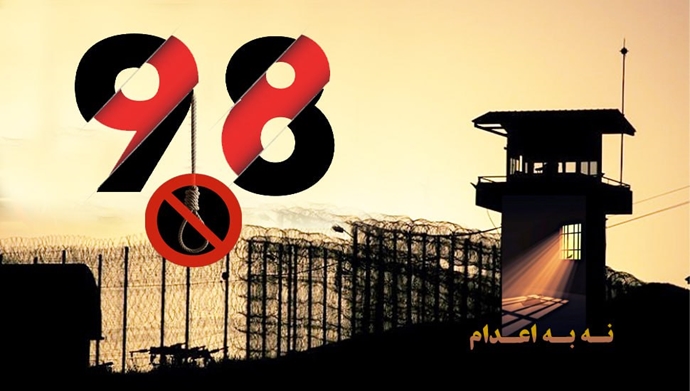

On Tuesday, December 9, 2025, political prisoners in 55 facilities across Iran launched a hunger strike marking the 98th week of the “No to Executions Tuesdays” campaign. This coordinated act of defiance comes as the Iranian regime accelerates its use of capital punishment, with reports indicating that over 200 executions were recorded in the first 17 days of the Persian month of Azar (November 22—December 8).
In their weekly statement, the striking prisoners highlighted a dramatic escalation in state violence, noting that in the past week alone, 95 individuals, including two women, were sent to the gallows. The statement also drew attention to the new death sentence issued for political prisoner Karim Khojasteh in Lakan Prison, Rasht. furthermore, the prisoners addressed the “suspicious death” of Khosrow Alikordi, a prominent human rights lawyer who defended detainees of the 2022 nationwide protests. Describing him as a committed advocate for justice and a supporter of the campaign, the statement extended condolences to the legal community for the loss of a defender who was a “refuge for families seeking justice.”
The participating prisoners condemned the regime’s tactics, asserting that the surge in hangings serves a singular political purpose: “suppressing society and blocking uprisings and popular revolts.” In a direct challenge to the judiciary’s legitimacy, the statement declared: “Today, the issue of execution in Iran is not a punishment, but an organized crime and a systematic violation of the right to life.”
In tandem with the prison strikes, solidarity protests were reported in dozens of cities, including Tehran, Tabriz, Shiraz, Rasht, and Mashhad. Coinciding with Iran’s Student Day (December 7), demonstrators focused on the plight of students facing the death penalty. Protesters held placards demanding the release of Ehsan Faridi, a 22-year-old student, as well as graduates Vahid Bani-Amerian and Pouya Ghobadi, whose death sentences have recently been upheld.
Some of their slogans included, “This is the last message, if you execute, there will be an uprising,” “Student, imprisoned, Ehsan Faridi must be freed,” and “A regime of executions will not have a peaceful sleep.”
December 9—Iran
In tandem with the 98th week of the "No to Executions Tuesdays" campaign, families of political prisoners on death row held rallies, calling for an end to executions.#StopExecutionsInIran pic.twitter.com/gA9oTYKEqu— People's Mojahedin Organization of Iran (PMOI/MEK) (@Mojahedineng) December 9, 2025
Families of political prisoners and victims of the regime’s crackdowns also held gatherings, calling for a halt to executions.
Since its inception in January 2024, the “No to Executions Tuesdays” campaign has evolved from a reaction to specific hangings into a cohesive social movement. According to rights activists, the persistence of the campaign, now supported by the Iranian diaspora and the general public, signals a qualitative shift in Iranian society where the demand for justice has superseded the culture of revenge.