

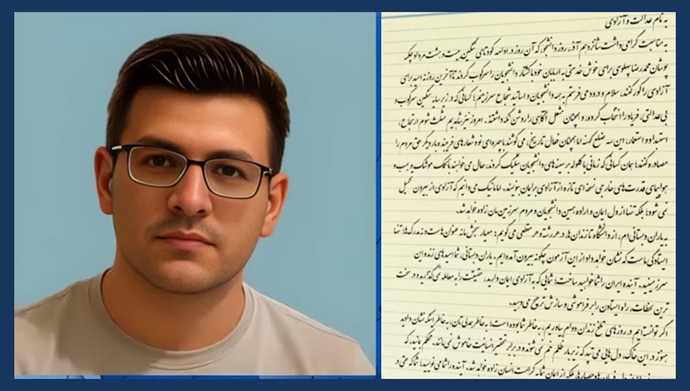

On Iran’s Student Day, a day seared into the nation’s collective memory as a symbol of the struggle against dictatorship, a powerful message of defiance has emerged from the depths of the clerical regime’s dungeons. Ehsan Faridi, a student activist sentenced to death and held in Tabriz Central Prison, has sent a statement that serves not as a plea for his life, but as a resounding call to resistance for the youth of Iran.
His message affirms that true freedom will not be handed down by foreign powers but will be forged by the unbreakable will of the Iranian people themselves. Faridi’s voice from behind bars is a testament to the regime’s complete failure to extinguish the spirit of resistance that defines Iran’s future leaders.
The enduring legacy of student day: a bastion of resistance
For the international community to grasp the weight of Faridi’s words, it is crucial to understand the significance of December 7. This day commemorates the murder of three students in 1953 by the Shah’s security forces for protesting against tyranny. Since then, the university has always been a “stronghold of resistance and protest” against both the monarchical dictatorship and the clerical regime that followed.
https://twitter.com/en_simayazadi/status/1997764851993858080
The date is not merely a historical footnote; it is a living symbol of the courage of Iran’s students, who have consistently been the first to cry out whenever freedom is under siege. Faridi’s message consciously connects this legacy of struggle to the present, reminding the world that the fight for a free Iran continues unabated.
A voice from the dungeons: Ehsan Faridi’s call to the nation
In his message, Faridi salutes the “brave students and professors” who have chosen to raise their voices against injustice. With remarkable political clarity, he warns against the “sinister triangle of reactionism, tyranny, and colonialism,” which he says is attempting to hijack the people’s righteous struggle with “deceptive slogans.”
He pointedly rejects any solution imposed from outside the country, a cornerstone of the Iranian Resistance’s platform. “We know well that freedom is not imposed from the outside,” Faridi declares. “Rather, it will be born only from the faith and will of the students and people of our land.” This statement is a powerful rebuke to any who believe Iran’s future can be determined by anyone other than Iranians themselves.
“Steadfastness is our only measure”: a message to Iran’s youth
Addressing his fellow students, whom he calls his “schoolmates from university to prisons,” Faridi offers a standard of integrity that stands in stark contrast to the corruption of the ruling theocracy. “Our measure is not titles or degrees; only our steadfastness will show how we have emerged from this test,” he writes. This is not just a personal reflection but a guiding principle for a generation battling a regime that fears their intellect and integrity. He credits these students as the “living hopes of this land,” whose solidarity has given him and other prisoners the strength to endure. His words build a bridge between the prisons and the universities, uniting them as two fronts in the same battle for Iran’s soul.
Ehsan Faridi’s death sentence is a clear indicator of the regime’s profound fear of Iran’s conscious and educated youth. They are the antithesis of the medieval ideology the mullahs seek to impose. Yet, as his message proves, the regime’s campaign of executions and imprisonment has utterly failed to silence them. Faridi’s voice, echoing from behind prison walls, shows that resistance is not just a political act but an “ethical choice.” He concludes with a defiant promise that encapsulates the spirit of the Iranian Resistance: “The future will be written by you; you who, even in captivity, are freer than those who have imprisoned the people’s freedom.”