

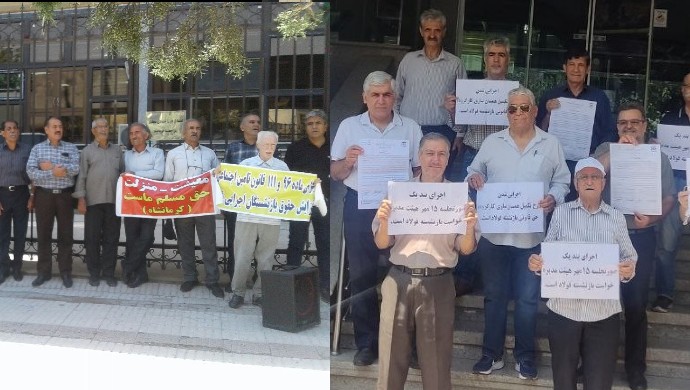

A wave of protests swept across Iran on Sunday, July 14, reflecting deep unrest among retirees, working populations, and families grappling with welfare issues. From the capital, Tehran, to cities such as Isfahan and Yasuj, demonstrators from various sectors took to the streets to express their frustrations and demand change. The protests come a week after the regime has declared its new president, Massoud Pezeshkian, an indication that the population is disillusioned with any government will solve their problems.
More footage of the protest rally by retirees of the steel industry in Isfahan.#IranProtestspic.twitter.com/HVsk9OILdX
— People's Mojahedin Organization of Iran (PMOI/MEK) (@Mojahedineng) July 14, 2024
In Isfahan and Tehran, steel industry retirees rallied to demand better pensions in response to rising living costs. According to the regime’s own laws, the government is required to adjust their pensions according to the costs of living. But as prices and inflation continue to skyrocket, their pensions have not caught up and they are struggling to make ends meet.
“Shout for your rights!” protesters were chanting in Isfahan.
The protesters also called out the regime for claiming to follow the guidance of Islam while steeling from the people. “We will only obtain our rights in the streets,” they chanted.
July 14—Tehran, #Iran
Retirees of the steel industry hold protest rally, demanding higher pensions and other basic rights.#IranProtests pic.twitter.com/aMjJi6nmLV— People's Mojahedin Organization of Iran (PMOI/MEK) (@Mojahedineng) July 14, 2024
In Shush and Kermanshah, retirees from the Social Security Organization took to the streets, chanting slogans denouncing the incompetence of the government. Their grievances primarily focus on the need for higher pensions and the meeting of basic needs.
In Kermanshah, the protesters also called for the release of Sharifeh Mohammadi, a labor activist from Rasht who has been sentenced to death by the regime.
According to the regime’s own laws, the government is responsible to provide the basic needs of retirees and adjust their pensions according to the costs of living. But as the rial continues to depreciate, inflation soars, and prices skyrocket, the regime refuses to raise their pensions and attend to their needs.
“Sharifeh Mohammadi must be released,” the protesters chanted.
July 14—Shush, southwest #Iran
Retirees of the Social Security Organization hold rally, demanding higher pensions and other basic needs. They also call for the release of Sharifeh Mohammadi, an activist sentenced to death by the regime.#IranProtestspic.twitter.com/ziEitKREB9— People's Mojahedin Organization of Iran (PMOI/MEK) (@Mojahedineng) July 14, 2024
In Yasuj, southwest Iran, people of the surrounding towns held a rally to protest water shortages. In the past weeks, people from different cities across the country have been protesting the regime’s destructive polices and poor management of the country’s resources, which have led to the lack of proper access to water and electricity.
July 14—Yasuj, southwest #Iran
Protests by residents of towns that are suffering from water shortages.#IranProtestspic.twitter.com/dziC6Hi8YS— People's Mojahedin Organization of Iran (PMOI/MEK) (@Mojahedineng) July 14, 2024
Meanwhile, oil workers continue their strikes in different parts of the country. Strikes that began in late June continue in 123 companies across the country and include more than 24,000 workers.
The workers demand the immediate implementation of a 35% salary increase at all wage levels and including the 45% inflation rate in this increase. 14 days of work, 14 days of rest and removal of contractors are other demands of the striking workers.
July 13—#Iran
24th day of nationwide strike by contract workers of the oil sector. Strikes have spread to 123 companies across the country and includes 24,000 workers.
The workers demand the immediate implementation of a 35% salary increase at all wage levels and including the… pic.twitter.com/IRcHNDrDHj— People's Mojahedin Organization of Iran (PMOI/MEK) (@Mojahedineng) July 13, 2024
As the economic crisis deepens, it is clear that the Iranian regime is facing mounting pressure from its citizens, who are demanding that their basic rights and needs be met. The continued protests across the country suggest that the regime’s grip on power may be weakening, and that the people of Iran are increasingly willing to take to the streets to voice their discontent.