

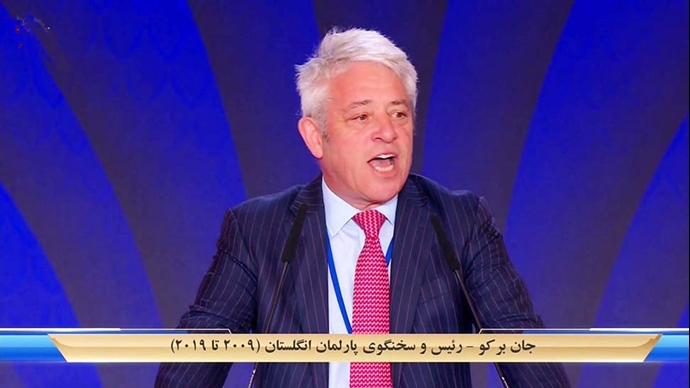

“The people of Iran have sussed this regime. The people of Iran have shown it by their mass abstentionism from the parliamentary and the presidential elections. The reason why they’ve gone for mass abstentionism and boycott is not that they are in a state of undiluted bliss about this regime, but because they feel utter undiluted, unreserved contempt for the way in which the regime abuses its own people,” said, John Bercow, Former Speaker of the UK House of Commons, at the Free Iran 2024 World Summit.
Bercow, who held one of the most important political positions in the UK for ten years, made several important points in his speech.
He began by addressing the “mass abstentionism from the parliamentary and the presidential elections.” According to numerous clips, films, documents, and evidence, these elections were boycotted and ignored by most of the Iranian people. Major international news agencies and media outlets reported these facts and pointed out to the record-low turnout in the regime’s elections.
Mr. Bercow then debunked the censorship of the Iranian Resistance and the alternative to the regime. He spoke of the existence of an “alternative” with competent leadership and a clear program.
It was already clear that for the 4,000 parliamentarians who supported Maryam Rajavi’s ten-point plan and the National Council of Resistance of Iran’s democratic alternative, all the regime’s conspiracies in demonizing, discrediting, spreading lies, and attempting to erase the names Iranian Resistance and PMOI to wipe out the issue of the regime’s overthrow, had failed.
The pinnacle of Mr. Bercow’s remarks was when he shared one of his greatest political experiences: “I’ve been taking part in political meetings now for over 40 years since my late teens. In all the time that I’ve been involved in political activity, I have never come across a cause that enjoys such an extraordinarily broad and eclectic range of support in terms of geography and therefore of continents, but also in terms of political parties.”
Certainly, with his long experience in politics, he cannot be unaware of other resistance movements. He must have studied the history of many contemporary movements and been aware of the developments of revolutionary and fighting organizations worldwide, having seen and heard much about them. Especially due to the regime’s destructive role over the past few decades and its impact on promoting Islamic fundamentalism globally and international terrorism, he must have followed the news of opposition parties and forces. It was even one of his responsibilities to his constituents to find solutions against the storm of fundamentalism and terrorism. With all this knowledge, he saw “unique characteristics” in the Iranian Resistance:
“The only way we will discover for sure who is on the side of the Iranian people is by allowing the opportunity for free and fair expression of the public will. That’s what causes me to turn, if I may, to Maryam Rajavi’s Ten-Point Plan, the philosophy and intended policy program of the National Council of Resistance of Iran.
“It is in fact one of the most eloquent articulate, and comprehensive statements of alternative that any Democrat could wish to see.
“The National Council of Resistance of Iran has been making this argument time and time and time again with ever-increasing force and eloquence and manifest evidence of widespread public support, which the regime has chosen, therefore, not to respect, but to seek to crush. In seeking to crush it, they have unfortunately been aided and abetted by those more dimwitted members of the international community whose philosophy is appeasement.
“Let us support and equip those who want to fight for their freedom within Iran. Let’s make it clear to the mad mullahs that when they are ousted, they will be brought to book. That is what will happen.”