

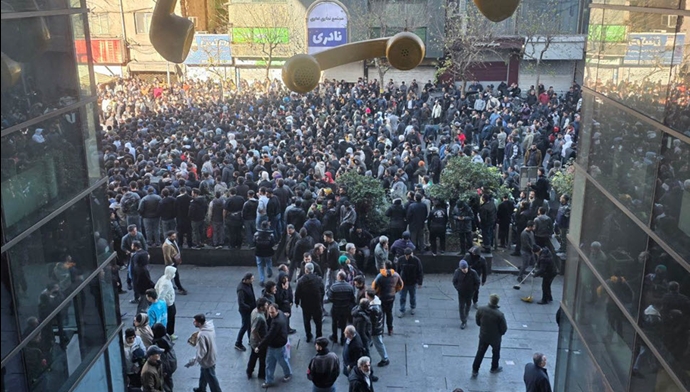

On Tuesday, December 30, 2025, the uprising in Iran entered a critical new phase. For the third consecutive day, the historic Grand Bazaar of Tehran remained shuttered, a strike that has now catalyzed a nationwide movement merging the traditional economic power of the merchants with the youthful energy of university students. What began as an outcry against a collapsing economy has swiftly metamorphosed into a political revolution targeting the entirety of Supreme Leader Ali Khamenei’s regime.
The protests, sparked by the plummeting value of the national currency and soaring inflation, have spread from the capital to major cities including Kermanshah, Shiraz, Isfahan, and Rasht. As the Iranian rial fell to a historic low of roughly 1.45 million against the US dollar, the chants on the streets shifted from economic grievances to calls for the overthrow of the theocratic dictatorship.
The bazaar strikes: breaking the regime’s economic backbone
On Tuesday, the heartbeat of Iran’s economy stopped. In Tehran, the strikes encompassed the Gold Market (Zargarha), the Iron Market, the Carpet Bazaar, and key districts such as Bein-ol-Haramein, Amin-Hozour, and 15 Khordad. Despite threats from security forces to force shops open, merchants kept their shutters down, declaring, “When the people’s bread is held hostage, the Bazaar will not remain silent.”
December 30—Tehran, Iran
Merchants in Tehran’s Grand Bazaar (jewelers’ market and Saboun-Nia bazaar in Shush, Saray-e Melli) mark third day of mass strikes in protest to deteriorating economic conditions, depreciating national currency, rampant inflation, high costs, etc.… pic.twitter.com/lOCskj68C4— People's Mojahedin Organization of Iran (PMOI/MEK) (@Mojahedineng) December 30, 2025
The strike was not limited to the capital. In Kermanshah, wholesalers and shopkeepers on Mossadegh Street and in major arcades ceased operations. Similar scenes were reported in the strategic port of Qeshm Island, the ceramic markets of eastern Tehran, and the commercial districts of Shiraz. The merchants’ message was clear: doing business is impossible when prices change hourly. “We sell a product, and two hours later we cannot buy the same item for the price we sold it,” one merchant in Tehran stated. “We are tired. Whatever we tried yielded no results.”
Strikes and protests continued in front of Saray-e Melli, on Valiasr St., and in Shadabad as merchants denounced soaring prices, inflation, and policies squeezing livelihoods and forcing businesses toward closure.#IranProtests pic.twitter.com/K8j9UH2SUk
— People's Mojahedin Organization of Iran (PMOI/MEK) (@Mojahedineng) December 30, 2025
Universities rise: “Reformist, principalist, the game is over”
In a historic show of solidarity, university students across Iran poured into campuses and streets to support the striking merchants. From the University of Tehran and Amir Kabir University of Technology (Polytechnic) in the capital to universities in Isfahan and Yazd, the student movement made it clear that they view the current crisis as political, not just economic.
At Beheshti University, students tore down the sign of the “Supreme Leader’s Representation” office, a direct challenge to Khamenei’s authority. Slogans echoed across campuses rejecting both factions of the regime, including the administration of Masoud Pezeshkian, who has been president for over a year. “Reformist, Principalist, the game is over,” students chanted, alongside “Poverty, corruption, injustice” and “No Gaza, no Lebanon, my life for Iran.”
December 30—Tehran, Iran
Amirkabir University students protested against dictatorship and repression, chanting: “Death to the dictator,” “A student may die, but won’t accept humiliation,” and “Basiji, Sepahi, you are our ISIS.” Locals report clashes between protesters and… pic.twitter.com/wusWBvqteS— People's Mojahedin Organization of Iran (PMOI/MEK) (@Mojahedineng) December 30, 2025
In a dramatic scene at the University of Tehran, students marching toward the main gates caused security forces to retreat and flee, shattering the regime’s aura of invincibility.
Economic collapse fuels political fire
The backdrop to this uprising is an economy in freefall. By December 2025, official inflation rates had exceeded 42 percent, with food prices surging by 72 percent. The regime’s removal of subsidies for millions of households and the tripling of gasoline prices earlier in the year have devastated the livelihood of ordinary Iranians.
However, the protesters know the root cause is not mere mismanagement but the regime’s systemic corruption and prioritization of proxy wars over national welfare. This was evident in the slogan heard at Amir Kabir University: “Basiji, Sepahi (IRGC), you are our ISIS.”
December 30—Tehran, Iran
Students at Khajeh Nasir University hold protest rally on the third day of expanding protests. The protests began in Tehran on December 28 in response to deteriorating economic conditions, rampant inflation, and the regime's destructive policies.… pic.twitter.com/Y4SwuueeEH— People's Mojahedin Organization of Iran (PMOI/MEK) (@Mojahedineng) December 30, 2025
Regime violence meets defiant resistance
As the protests expanded, the regime deployed heavy security forces, using tear gas and violence to disperse crowds in Tehran’s Grand Bazaar and Kermanshah. Reports indicate shooting incidents in Hamedan and the Shush market in Tehran. Yet, the suppression failed to quell the unrest. In many instances, the people fought back.
In the dormitories of Tehran University, despite a total blockade by intelligence agents, students chanted “Death to the Dictator” late into the night. In the cities of Ahvaz, Kerman, and Zanjan, youth took to the streets with the chant “This year is the year of blood, Seyyed Ali [Khamenei] will be overthrown.”
December 30—Iran
Protesters in Mashhad and Tehran resist repressive security forces dispatch to quell disperse their rallies.#IranProtestspic.twitter.com/mGSdCs8yJa— People's Mojahedin Organization of Iran (PMOI/MEK) (@Mojahedineng) December 30, 2025
The uprising has also drawn support from critical labor sectors. Truck drivers issued a statement declaring total solidarity with the bazaar strikes, warning that the “unity of the market and drivers is the only way to pass through this situation.”
As the sun set on the third day, the message from the streets of Iran was undeniable: the wall of fear has cracked, and the people are settling for nothing less than freedom.