


Analysis by PMOI/MEK
Jan. 26, 2019 – The more the fight over passing the four necessary bills to join the international anti-money-laundering body FATF continues between the Iranian regime’s Majlis (parliament), the Guardian Council, and Expediency Council, the more unclear its fate becomes.
Trying to persuade the members to pass the Palermo bill, Iranian regime president Hassan Rouhani sent his foreign minister, Javad Zarif, to the latest session of the Expediency Council, the body that arbitrates disputes between the Majlis. But with no avail. The Council decided to send the bill to specialized commissions for further review.
The Financial Actions Task Force (FATF) is the world’s de facto anti-money-laundering body and it also monitors and fights terrorism financing, both endeavors the Iranian regime is thoroughly entrenched in.
In order to comply with the FATF guidelines, countries need to pass appropriate bills that make its financial system transparent so that organized and large-scale terrorism-financing and money-laundering can’t go undetected.
This is very problematic for the Iranian regime and contrasts with its core beliefs and philosophy. But at a time when U.S. economic sanctions are snapping back, not complying with FATF standards will alienate the few remaining countries doing business with Iran that put petrodollars and short-term economic gains above everything else.
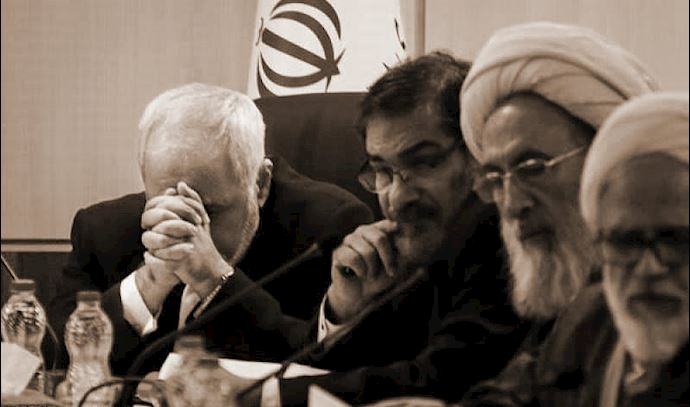
From left: Iranian regime foreign minister, Javad Zarif, and secretary of Supreme National Security Council of Iran, Ali Shamkhani in a meeting of the Expediency Council on January 19.
On January 22, Bahar website, close to Rouhani’s faction, published an article with the above picture of the Expediency Council meeting about the fate of a FATF bill with Zarif and Ali Shamkhani, the secretary of the Supreme National Security Council, in it and wrote: “When someone like Zarif, who during the difficult nuclear negotiations hasn’t been seen in a picture not smiling even once, is suddenly seen with such a long face in the Expediency Council, it shows that there is a huge challenge in the path of decision making.”
Ahmad Tavakkoli, former MP and current member of the Expediency Council and close to Iranian regime Supreme Leader Ali Khamenei, says: “Zarif didn’t manage to persuade the Council about the Palermo bill.”
When asked whether the climate in the Council is pro- or anti-Palermo and CTF bills he said: “It’s better to keep silent about this.”
On the other hand, Ali Motahari, deputy spokesperson for the Majlis, refers to the new secretary for the Council, Sadeq Larijani, and says: “Considering the changes in the Expediency Council, compared to the past, chances are higher that the two CFT and Palermo bills are passed,” Eghtesad Online reports on January 22.
Meanwhile, inter-factional quarrels between hardliners and so-called moderates about the fate of the bills are escalating.
Raja news website, close to Ali Khamenei’s faction, published an article titled, “There is pressure to force another JCPOA while old ministers have sent a letter to the revolution’s leader [Ali Khamenei] to accept FATF.”
The article is about a letter by Rouhani’s cabinet members to Khamenei and writes: “It is said that eight members of Rouhani’s cabinet headed by Mohammad Javad Zarif have signed the letter. This happens while Zarif has previously admitted in front of the parliament that accepting the commitments provided by the four bills does not guarantee that the sanctions related financial and banking difficulties are lifted.”
Etemad online, close to Rouhani’s faction, on the other hand, published an article titled, “100 SMSs have been sent to one member of the Expediency Council to not pass the CFT and Palermo bills.”
“[They] are still putting pressure so that CFT and Palermo are not passed and this time they are pursuing their goal with SMS pressure on Council members. We should wait and see whether these increasing pressures will impact the Expediency Council’s members, or the Council will think about expediency regardless of the pressure,” Etemad Online concludes.
Truth is that considering the nature of FATF, it runs against core beliefs and the philosophy of the Islamic Republic. And so, Iranian regime’s institutions and decision-makers find themselves between a rock and a hard place, virtually paralyzed.
In this context, both factions are looking up to Khamenei, who has the final say in every matter of importance to the state, to state his opinion, all the while trying to change his opinion in their favor.
Khamenei in turn knows very well that this is a decision that is very likely to backfire and tries to avoid any responsibility by playing the spiritual leader who doesn’t meddle in earthly endeavors.
Tehran has still about one month before the FATF ultimatum to pass the necessary bills, or it will be blacklisted by the world anti-money laundering body and its economic difficulties will double as countries like China and Russia won’t be willing to trade with it anymore.
It’s not clear what path Iranian regime leaders will choose to take regarding the bills, but either way, they’ll find themselves at a place not softer than their current one.