

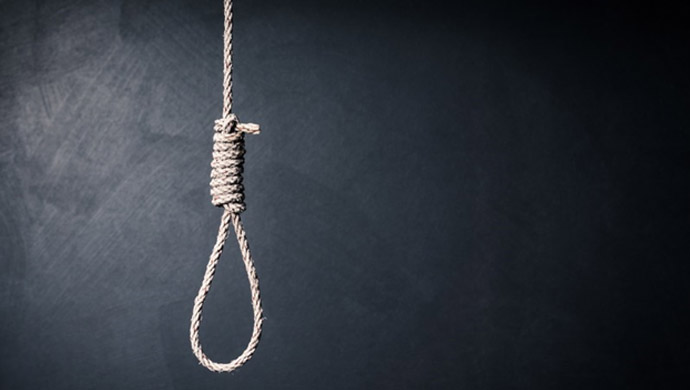

Iranian regime authorities have recently executed 14 prisoners in several cities across the country.
According to a report wired by the HRANA news agency, four inmates were sent to the gallows in the early morning hours of March 16 in Gohardasht Prison of Karaj, west of Tehran, and Dastgerd prison of Isfahan, central Iran.
One of the victims in Isfahan was an Afghan national by the name of Zobeid. The three inmates hanged in Gohardasht prison were Gholam-Ali Khargir, Abbas Khargir, and Mohsen Jandaghi.
On Tuesday, March 15, two inmates by the names of Peyman Babakhani and Mirali Hosseini were executed in Urmia Central Prison, and another inmate by the name of Mohammad Bozorgzadeh, 22, was executed in Bushehr Prison.
On Sunday, March 13, four inmates were executed in Adelabad prison of Shiraz, south-central Iran.
On Saturday, March 12, an inmate by the name of Alam Yar-Ahmadzehi, 48, was executed in Khash Prison.
#Iran – Eight executions in Karaj, Isfahan, and Shiraz
March 16 – Four inmates executed in Gohardasht prison of Karaj and Dastgerd prison of Isfahan
March 13 – Four inmates executed in Adelabad prison of Shiraz#HumanRights pic.twitter.com/DBXTsVpE9d
— People's Mojahedin Organization of Iran (PMOI/MEK) (@Mojahedineng) March 17, 2022
On February 22, Iranian regime authorities hanged two prisoners in the cities of Kashan and Mashhad, continuing an uptick of executions since Ebrahim Raisi began his presidency in Aug 2021. In January alone, the regime carried out 47 executions. At the same time, conditions in Iran’s prisons are deteriorating, causing deaths among prisoners. The regime is also increasing pressure against political prisoners. Two political prisoners died from lack of medical care from December to January.
Iranian regime authorities executed four prisoners in Ilam and Rasht prisons on January 20. On the same day, two other prisoners were hanged in Zabol and another in Zahedan. In the same week, another two prisoners were executed in Adel Abad prison, Shiraz. And a prisoner was hanged in Dehdasht on January 17.
On January 17, regime authorities hanged Velijan Rahimi, 56, in Qom prison, central Iran. Rahimi was from the city of Shabestar, East Azarbaijan province, and had spent seven years in prison. On the same day, Ghaffar Gargij, 34, was hanged in Zahedan prison after having spent seven years in prison.
Iran’s regime executed at least 12 executions in the previous week.
Reports also indicate a number of inmates have been transferred to solitary confinement to be executed on the verge of Nowruz, the Iranian calendar New Year (March 21).
This brings the number of executions from March 21, 2021, to this day to 355 inmates.
Back in December 2021, in its 76th session, the United Nations General Assembly adopted a resolution condemning the Iranian regime’s human rights abuses. Passed with 78 affirmative votes, this was the 68th UN resolution on the human rights situation in Iran since the mullahs rose to power in 1979.
The resolution expresses serious concern at the “alarmingly high frequency of the imposition and carrying-out of the death penalty,” “widespread and systematic use of arbitrary arrests and detentions,” “deliberately denying prisoners access to adequate medical treatment and supplies,” and “appalling acts committed by prison guards at Evin prison,” “harassment, intimidation, and persecution, including abductions, arrests, and executions, of political opponents, human rights defenders,” and “arbitrary arrest and detention, and torture and other cruel, inhuman or degrading treatment or punishment against peaceful protesters,” and “the use of torture to extract confessions, and cases of suspicious deaths in custody.”
The resolution reiterates “the importance of credible, independent and impartial investigations in response to all cases of serious human rights violations…including enforced disappearances, extrajudicial executions, and destruction of evidence in relation to such violations.”
The resolution UNGA also calls for an end to “impunity for such violations.”
The resolution comes at a time when the world is becoming more aware of flagrant human rights abuses in Iran. An ongoing court in Sweden is putting the spotlight on the massacre of 30,000 Iranian political prisoners in 1988. The regime’s new president, Ebrahim Raisi, is known for his role in the 1988 massacre and other atrocities against dissidents and ordinary Iranians, which has caused concern among human rights organizations and activists across the globe.
In response to the UNGA resolution, Kazem Gharibabadi, the secretary of the so-called “human rights staff” of the regime’s Judiciary, said, “This subject has no basis and is far from the truth… The constitution of the Islamic Republic not only bans the use of torture but also bans the extraction of confessions through torture.”
It is worth noting that there have been multiple confirmed reports of prisoners being tortured in prisons and forced to make incriminating confessions against themselves. Many of these prisoners have been executed based on these forced confessions.
Gharibabadi also defended the alarming rate of executions in Iran and said, “The resolution criticizes the volume of executions in Iran. But you must take note that the prohibition of execution is a Western notion. If Western countries have abolished capital punishment, does it mean that all other countries must follow suit and it must become a global standard?”
Gharibabadi also confirmed and stood by the regime’s record number of execution of juvenile offenders. “Another topic discussed in this resolution is the death penalty for people under 18 years of age,” he said. “You must take note that there is no international obligation that people under 18 should not sentence to death. One of the articles of the UN Convention on the Rights of the Child states that the age of children is 18 unless the national law of other countries states otherwise.”