

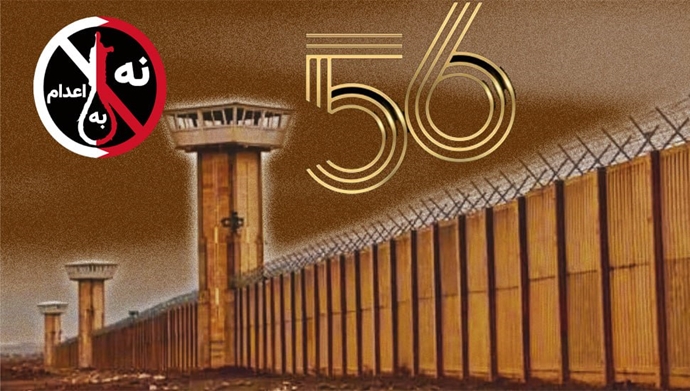

For the 56th consecutive week, political prisoners across Iran have launched a coordinated hunger strike as part of the No to Executions Tuesdays campaign, an initiative protesting the Iranian regime’s expanding use of the death penalty. This week, inmates at Dieselabad Prison in Kermanshah joined the campaign, bringing the total number of participating prisons to 36. The movement, which began in January 2024, continues to grow despite heightened repression against political detainees.
In a statement marking the latest week of the campaign, prisoners expressed their support for the ongoing Tehran University student protests and called on students nationwide to stand in solidarity. The statement denounced the regime for the suspicious death of Amir Mohammad Khaleqi, a 19-year-old Tehran University student, holding authorities accountable for his killing. “The regime is responsible for this crime,” the statement read. “We urge students across Iran to unite with their peers in Tehran and refuse to be intimidated into silence.”
The prisoners’ statement also condemned the Iranian regime’s escalating use of the death penalty, highlighting that in February alone, at least 62 individuals had been executed, including two women. The regime’s judiciary has also reinstated the execution order for Sharifeh Mohammadi, a political prisoner whose initial death sentence had previously been overturned by the Supreme Court. This reversal has sparked renewed outrage among human rights groups.
To protest Mohammadi’s case and other politically motivated executions, prisoners convicted of ordinary crimes at Lakan Prison in Rasht announced that they would be joining this week’s hunger strike alongside political prisoners from both the men’s and women’s wards.
Sharifeh Mohammadi: Her Death Sentence Has Been Reissued
Despite the Supreme Court’s prior annulment of Sharifeh Mohammadi’s death sentence, the Second Branch of the Revolutionary Court in Rasht has once again sentenced the imprisoned labor activist to execution.… pic.twitter.com/Uf5UoDsj2C— Women's Committee NCRI (@womenncri) February 13, 2025
The campaign’s statement sharply criticized the judicial system, stating: “These executions are not about justice; they are acts of political terror designed to crush dissent and instill fear among the Iranian people.”
Beyond capital punishment, the statement also denounced the Iranian regime’s broader campaign of violence, particularly in the city of Dehdasht, where security forces have brutally suppressed protests. According to reports, authorities have deployed live ammunition against demonstrators while carrying out mass arrests of young activists. The statement warned that despite these crackdowns, public anger continues to mount, and “society is on the verge of another uprising.”
The regime’s indifference to human suffering extends beyond repression. The statement referenced Ettela’at newspaper (February 14) in exposing how economic mismanagement and corruption have led to the deaths of children with cancer and rare diseases, as their families can no longer afford life-saving treatments. “The regime’s policies do not merely result in executions; they condemn thousands to slow, silent deaths through neglect and systemic corruption,” the prisoners wrote.
The No to Executions Tuesdays campaign has gained widespread support from activists, civil society groups, and families of death row prisoners. Last week, relatives of those facing execution staged protests outside the Evin Prison in Tehran and Saqqez Prison, demanding an end to the regime’s mass executions. Meanwhile, the Iranian Writers’ Association issued a statement condemning the systematic use of capital punishment and calling for international intervention.
https://twitter.com/en_simayazadi/status/1889425204029341851
The campaign welcomed these acts of solidarity and called for an expansion of protests outside prisons. “The Iranian people must continue to resist,” the statement read. “Every execution that goes unchallenged emboldens this regime. We must act now.”
Despite the Iranian government’s increased repression of political prisoners, the No to Executions Tuesdays movement continues to expand, becoming one of the most significant organized acts of resistance inside Iran’s prison system. This week’s hunger strike included prisoners from Evin Prison (women’s ward, wards 4 and 8), Ghezel Hesar Prison (units 3 and 4), Greater Tehran Prison, Khourin Prison in Varamin, Karaj Central Prison, Arak Central Prison, Khorramabad Prison, Dastgerd Prison, Isfahan Asadabad Prison, Sheiban Prison, Sepidar Women’s Prison, Ramhormoz Prison, Shiraz Adelabad Prison (men’s and women’s wards), Nezam Prison in Shiraz, Borazjan Prison, Bam Prison, Kahnuj Prison, Mashhad Central Prison, Jovein Prison, Qaemshahr Prison, Rasht Central Prison (men’s and women’s wards), Rudsar Prison, Ardabil Central Prison, Urmia Prison, Khoy Prison, Salmas Prison, Naqadeh Prison, Saqqez Prison, Baneh Prison, Marivan Prison, Kamyaran Prison, Tabas Prison, Rudsar Prison, Dieselabad Prison in Kermanshah, and Gonbad-e-Kavus Prison.
As Iran’s execution machine continues to operate at full speed, the No to Executions Tuesdays campaign stands as a formidable challenge to the regime’s oppressive rule. Whether this movement can sustain its momentum in the face of increasing state repression remains to be seen.
The prisoners ended their statement with a stark warning: “This is not just a fight for those behind bars. The regime’s violence affects every Iranian. The world must not wait until another life is taken. We must act before the next execution takes place.”