

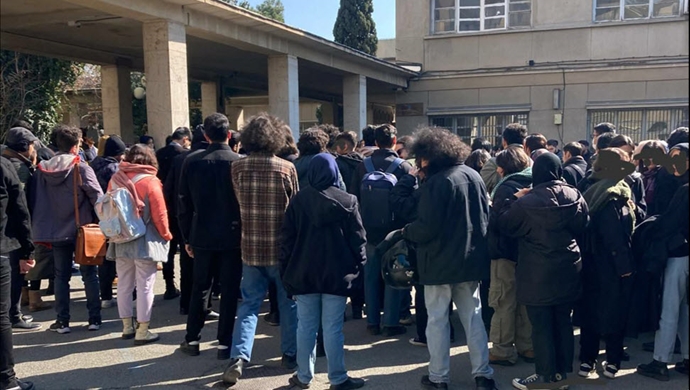

For the second consecutive day, Iran is witnessing a new wave of protests reflecting the country’s worsening economic and social conditions. Large segments of society, including workers, students, and retirees, have taken to the streets to reject the regime’s failed economic policies, which have led to widespread poverty, unprecedented inflation, and institutional corruption that continues to plunder the nation’s wealth. While citizens struggle with deteriorating living conditions, the regime continues to divert national resources to its oppressive security apparatus and regional military projects, deepening the domestic crisis.
Telecommunications retirees lead protests against the looting of their pensions
One of the most prominent groups protesting today was retired telecommunications employees, who took to the streets in multiple cities to denounce the regime’s misappropriation of their pension funds. Their anger was directed at the entities that have taken control of their retirement savings, with demonstrators chanting against corruption and government mismanagement.
More footage of the protest rally by TCI retirees in Tehran.
"Our enemy is right here, they lie that it's America," protesters chant.#IranProtestspic.twitter.com/DjKHcAIiPA— People's Mojahedin Organization of Iran (PMOI/MEK) (@Mojahedineng) February 17, 2025
In the capital, retired telecommunications workers organized a protest march against the systematic plundering of their pensions. They chanted: “Our enemy is here; they lie and say it’s America!”—a direct response to the regime’s long-standing narrative that external sanctions and foreign enemies are responsible for Iran’s economic woes. The protesters made it clear that their real grievances stem from internal corruption and the looting of public funds by institutions under the control of regime supreme leader Ali Khamenei.
February 16—Ahvaz, southwest Iran
Retirees of the steel industry hold protest rally in front of the provincial office of the Steel Retirement Fund, demanding higher pensions and better living conditions. #IranProtests pic.twitter.com/XdEO2j5P00— People's Mojahedin Organization of Iran (PMOI/MEK) (@Mojahedineng) February 16, 2025
In Ahvaz, despite a strong security presence and legal obstacles, retired telecommunications employees marched in protest, demonstrating their determination to demand their rights. The presence of police forces did not deter them but rather fueled their resolve to challenge the looting of their pension funds.
In Isfahan, retirees gathered in front of telecommunications offices, voicing their rejection of economic discrimination and corruption while demanding the return of their stolen pensions.
February 17—Isfahan, central
Iran Retirees of Telecommunication Company of Iran resume weekly protest rallies, demanding higher pensions and other basic rights and protesting the corruption of regime institutions that run the company.#IranProtestspic.twitter.com/gD1zNzT2se— People's Mojahedin Organization of Iran (PMOI/MEK) (@Mojahedineng) February 17, 2025
In Kermanshah, protesters carried banners denouncing the institutions responsible for looting their funds. They stressed that their rights were non-negotiable and warned that continued corruption would lead to even larger demonstrations.
In both Tabriz and Bijar, retirees gathered to demand their stolen rights, directing their anger at the Execution of Imam Khomeini’s Order (EIKO) and the IRGC Cooperative Foundation, two entities that have seized control of their pension funds.
February 17—Tabriz, northwest
Iran Retirees of the Telecommunication Company of Iran (TCI) continue protests as authorities refrain from addressing their demands. They are also protesting corruption caused by regime institutions such as Setad (EIKO) and the IRGC Cooperative… pic.twitter.com/oVvl5Hr4lK— People's Mojahedin Organization of Iran (PMOI/MEK) (@Mojahedineng) February 17, 2025
In Rasht, the protesters’ frustration was evident in their slogans, as they chanted: “We have seen no justice, only lies!”—a reference to the empty promises repeatedly made by regime officials with no real improvement in their situation.
In Sanandaj and Zanjan, protesters declared that the regime’s corruption and looting of pension funds were the primary causes of their worsening conditions, directing their anger at the institutions controlling the telecommunications sector.
February 17—Sanandaj, western Iran
Retirees of the Telecommunication Company of Iran (TCI) resume rallies to protest corrupt management decisions and demand higher pensions and other basic needs.#IranProtestspic.twitter.com/bQ1UapWjyC— People's Mojahedin Organization of Iran (PMOI/MEK) (@Mojahedineng) February 17, 2025
The looting of pension funds: The role of EIKO and the IRGC Cooperative Foundation
The retirees’ anger is primarily fueled by the systematic plundering of their pension funds by two major institutions under Khamenei’s control:
The Execution of Imam Khomeini’s Order (EIKO): Originally established after the 1979 revolution to confiscate the assets of regime opponents, this entity has transformed into a massive financial empire controlling key sectors of the Iranian economy, including telecommunications. It invests retirees’ money without providing them with their rightful pensions.
The IRGC Cooperative Foundation: This organization serves as the financial arm of the IRGC, seizing control of major corporations, including telecommunications, and diverting profits toward domestic repression and funding militias abroad.
Other protests across different sectors
February 17—Tehran, Iran
Students of Tehran University continue rallies in protest to the murder of a student by security forces and lack of accountability by regime officials.#IranProtests pic.twitter.com/dA70dV6bcu— People's Mojahedin Organization of Iran (PMOI/MEK) (@Mojahedineng) February 17, 2025
For the third consecutive day, students at Tehran University continued their demonstrations against security forces’ negligence in the case of their fellow student Amir Mohammad Khaleqi, who was killed under suspicious circumstances. Students at the Faculty of Literature marched in protest, accusing the regime of failing to protect students while aggressively enforcing personal restrictions such as mandatory hijab laws.
February 17—Borujerd, western Iran
Since Saturday, workers of Borujerd textile factory are on strike, protesting officials' lack of response to their demands.#IranProtests pic.twitter.com/QcOAOcTmHf— People's Mojahedin Organization of Iran (PMOI/MEK) (@Mojahedineng) February 17, 2025
Since Saturday, workers at Borujerd Textile Factory have been on strike after the administration refused to pay their overdue wages for more than three months. Additionally, their health insurance was suspended, leaving them and their families without access to essential medical services.
Analysis: Protests on the brink of explosion
These protests reveal that the Iranian regime is increasingly struggling to contain public outrage despite its security crackdowns and legal intimidation. The growing participation of diverse social groups indicates that the regime is facing an unprecedented crisis—one even acknowledged by some of its own officials.
One security analyst within the regime recently warned: “The streets of Iran are soaked in gasoline; any spark could set them ablaze at any moment.”
February 17—Rasht, northern Iran
Retirees of the Telecommunication Company of Iran (TCI) resume rallies to protest regime corruption and low pensions.
"We have only heard lies, we haven't seen justice," protesters chant#IranProtestspic.twitter.com/g1ui3vRIAi— People's Mojahedin Organization of Iran (PMOI/MEK) (@Mojahedineng) February 17, 2025
The persistence and expansion of protests across multiple cities suggest that the Iranian people have realized that the only way to reclaim their rights is through mass demonstrations. There is no longer any hope for internal reform within the regime. With every new protest, it becomes increasingly clear that the people are not willing to surrender—and that the battle between the people and the regime is moving toward a decisive confrontation.