


On February 18, Iran witnessed another day of protests reflecting the country’s deepening economic crisis, worsening living conditions, and the intensifying repression targeting various segments of society. From students to workers and retirees, Iranians have taken to the streets in defiance of the regime’s failed policies, which have led to economic collapse and blatant violations of fundamental rights. As the authorities continue to ignore public demands, the protests are expanding, fueling growing tensions across the country.
Student Protests: A Powerful Statement Against the Regime’s Repression
At Allameh University in Tehran, a memorial service for Amir Mohammad Khaleqi, a student killed under suspicious circumstances, turned into a powerful demonstration against the regime. During the ceremony, a student read a statement condemning the security forces’ role in suppressing dissent, emphasizing that Khaleqi’s death was not an isolated incident but a direct consequence of the regime’s failure to ensure genuine security for its people.
February 18—Tehran,
Students at Allameh Tabataba'i University gathered on the central campus to honor the memory of Amir Mohammad Khaleqi, a University of Tehran student who was recently killed under suspicious circumstances. Participants sang songs and read statements… pic.twitter.com/K2WDdDKXAv— People's Mojahedin Organization of Iran (PMOI/MEK) (@Mojahedineng) February 18, 2025
The statement declared: “Because of this lawlessness, we lost one of our fellow students. But his murderers were not just street criminals. The real killers are those in power—those who have turned security into a tool to safeguard their rule rather than protect the people. These so-called security institutions have long abandoned their true mission and have become instruments of oppression against society.”
It further criticized Iran’s security agencies, stating that they no longer serve the public but rather act as the regime’s enforcers: “Amir Mohammad Khaleqi’s death is not just a tragic incident; it is a symbol of a failed system that prioritizes its survival over the well-being of its people, leaving citizens vulnerable to violence and lawlessness.”
The statement ended with a clear message of defiance: “We will not remain silent in the face of this injustice, nor will we allow this crime to be buried in silence. Enough is enough! This regime cannot continue to take innocent lives with impunity.”
This bold declaration underscores the growing awareness among Iranian students of the repression and authoritarian rule they live under. Instead of addressing real issues, the regime has relied on heavy-handed security measures to suppress dissent and silence any opposition.
Worker Strikes and Protests Against Poverty and Labor Violations
February 18—Borujerd, western Iran
Workers of Borujerd textile factory continue their strikes that began on Saturday, protesting officials' lack of response to their demands.#IranProtestspic.twitter.com/Kz9fhaYOo3— People's Mojahedin Organization of Iran (PMOI/MEK) (@Mojahedineng) February 18, 2025
For the third consecutive day, Borujerd Textile Factory workers continued their strike, halting production to demand their overdue wages. Workers gathered outside the factory, expressing their frustration over months of unpaid salaries, deteriorating living conditions, and the management’s failure to address their grievances.
In Mahshahr, workers at the Mahshahr Petrochemical Company went on strike, protesting their worsening financial conditions and the authorities’ failure to improve their wages and working conditions.
February 18—Mahshahr, southwest Iran
Workers of Bandar Mahshahr Petrochemical Company go on strike, protesting poor conditions and unpaid wages.#IranProtestspic.twitter.com/19Bmfpci0o— People's Mojahedin Organization of Iran (PMOI/MEK) (@Mojahedineng) February 18, 2025
Elsewhere in Mahshahr, workers of Petro Niroo Saba, responsible for the Haiko Petrochemical Project, staged a protest over three months of unpaid wages, exacerbating their financial hardships.
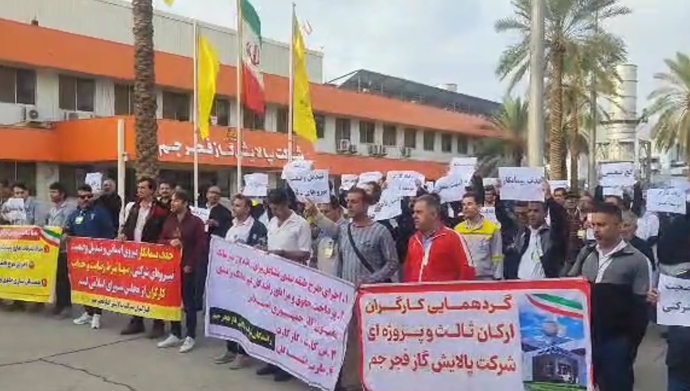
In Bushehr, contract workers at Fajr Jam Gas Refinery rallied to demand the elimination of subcontracting practices, fair wages, and full-time employment status to end systemic job discrimination.
February 18—Bushehr, southern Iran
Contract workers of Fajr Jam Gas Refinery staged a protest, demanding better wages and working conditions.#IranProtests pic.twitter.com/0U0yDXljn3— People's Mojahedin Organization of Iran (PMOI/MEK) (@Mojahedineng) February 18, 2025
Workers at the Negin Makran Petrochemical Plant in Chabahar went on strike after not receiving their wages for four months. Protesters noted that this was not the first time they had to strike due to persistent salary delays.
Employees at Iranian Telecommunications Manufacturing Company (ITMC) staged a demonstration against five months of unpaid wages, with CEO Khoda Bakhshi refusing to take responsibility for their salaries. Growing frustration among the workforce has led to escalating tensions within the company.
Analysis: A Nation Trapped Between Poverty and Oppression
These protests highlight the worsening conditions in Iran, where citizens are grappling with a suffocating economic crisis, institutional corruption, and relentless suppression of freedoms. The Iranian regime has shown no ability to resolve these crises and instead relies solely on heavy-handed security tactics to stifle dissent.
Even figures within the regime are beginning to express concern. A government-affiliated analyst recently warned: “The streets of Iran are soaked in gasoline—any spark could ignite them at any moment.”
This statement confirms that the regime itself fears that these protests could spiral into a full-scale uprising. The growing public outrage is no longer limited to economic demands but is evolving into a broader rejection of corruption and authoritarian rule.
Given this reality, Iranians increasingly recognize that street protests are their only viable means of reclaiming their rights, as the regime responds only to force and direct confrontation.