

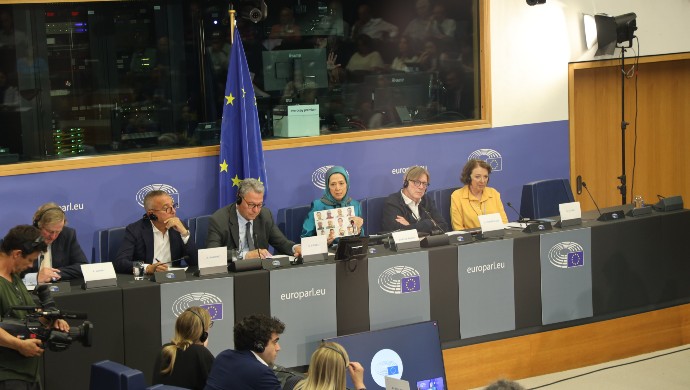

On June 18, 2025, a conference at the European Parliament in Strasbourg brought together a broad, cross-party coalition of Members of the European Parliament (MEPs), former prime ministers, and distinguished legal experts to discuss the situation in Iran and the path forward. They gathered to hear from Mrs. Maryam Rajavi, the President-elect of the National Council of Resistance of Iran (NCRI), who presented her vision for a democratic, secular, and non-nuclear republic. The event underscored a powerful consensus on the need for a fundamental policy shift away from appeasement and toward supporting the Iranian people’s aspiration for freedom and democratic change.
Mrs. Maryam Rajavi Outlines Vision for a Free Iran
In her keynote address, Mrs. Maryam Rajavi defined the 44-year struggle of the Iranian people against the ruling theocracy as the “primary war.” She presented the “Third Option”—rejecting both foreign military intervention and appeasement of the clerical regime—as the only viable solution, advocating instead for democratic change led by the Iranian people and their organized Resistance. Highlighting the regime’s brutal wave of executions, she affirmed that such repression would not quell the people’s desire for freedom. “Our goal is to guarantee freedom, democracy, and the Iranian people’s free choice—no matter the cost,” Mrs. Rajavi said.
Broad Support for the NCRI’s Democratic Platform
Throughout the conference, speaker after speaker from diverse political backgrounds voiced strong support for the NCRI’s democratic platform, particularly Mrs. Rajavi’s Ten-Point Plan for the future of Iran. This plan, which includes commitments to a secular republic, gender equality, abolition of the death penalty, and a non-nuclear Iran, was repeatedly hailed as a credible and comprehensive roadmap.
Petras Auštrevičius, a Lithuanian MEP, recalled a previous conference where the plan was presented, stating, “I will never forget when Madam Rajavi presented her Ten-Point Plan, which is, to my mind, very concrete, real, and a good solution for the country, for Iran’s future.”
Spanish MEP Javier Zarzalejos elaborated on its significance, describing it as “not only the hope but also a practical roadmap for rebuilding a free, secular, and democratic nation.” He listed its core tenets, including “popular sovereignty, free elections, and political pluralism… separation of religion and state; gender equality; an independent and impartial judiciary.”
This sentiment was echoed by Francisco Assis, a Portuguese MEP, who praised the plan’s proposal for “a democratic republic based on the separation of religion and state,” calling it “an essential and fundamental condition for the existence of a truly democratic society.”
MEP Antonio López‑Istúriz White from Spain highlighted a unique and powerful element of the NCRI’s platform: its commitment to dissolving itself once a constituent assembly is democratically elected. “An organization says, I will dissolve immediately when democracy… and the parliament and the assembly is elected. That gives reassurance,” he noted, emphasizing that it proves the movement’s genuine democratic intentions.
Rejection of All Dictatorships: “No to the Shah, No to the Mullahs”
A recurring theme was the emphatic rejection of any return to past dictatorships, encapsulating the popular Iranian slogan, “No to the Shah, No to the Mullahs.” Speakers stressed that the Iranian people’s century-long struggle for freedom would not accept the replacement of one form of tyranny with another.
In a passionate speech, prominent French lawyer Dominique Attias dismissed the notion of a monarchist alternative. “It’s unbelievable to hear on television that if the mullahs go, it will be chaos,” she declared, before directly addressing the idea of restoring the monarchy. “Iranian men and women will not let anyone impose false alternatives on Iran.”
MEP Leoluca Orlando from Italy agreed, warning against “the illusion that the neo-fascist monarchists, led by the son of the Shah, offer a viable alternative.” He referenced the 2022 uprising, where “Iranians made their position clear. You clearly expressed this position. Chants of ‘Down with Khamenei’ and ‘No Shah, No Mullah.’ They rejected both the Shah’s and the mullahs’ dictatorships.”
Former Vice-President of the European Parliament Ryszard Czarnecki framed his long-standing support in these terms: “I have done everything I could to support Madam Rajavi’s movement for a democratic and secular republic, rejecting both the undemocratic ideas of the Shah’s dictatorship and the religious dictatorship of the mullahs.”
The Role of Organized Resistance and the PMOI
Speakers emphasized that a successful, stable transition to democracy requires an organized, coherent internal force. The People’s Mojahedin Organization of Iran (PMOI/MEK) and its network of Resistance Units inside the country were identified as this crucial element, capable of channeling the popular will for change.
Latvian MEP Reinis Pozņaks, drawing on his own country’s experience with Soviet occupation, stated, “I am especially moved by the courage of the Iranian people—particularly women, the youth, and the organized resistance… I fully support the activities of the Resistance Units of the PMOI inside Iran. These brave individuals have played a key role in organizing and expanding nationwide protests.”
Insightful remarks by @EndaKennyTD: I am happy that Mrs. Rajavi wants to overthrow the regime with the help of the Iranian people. #FreeIran2025#Iran pic.twitter.com/lDaQyFsbS1
— SIMAY AZADI TV (@en_simayazadi) June 26, 2025
Former Irish Prime Minister Enda Kenny analyzed historical regime changes and concluded that “the one thing that was common to all of those movements and all of those changes was coherence.” He praised Mrs. Rajavi’s commitment to an Iranian-led overthrow, stating, “I am very happy, madam Rajavi, to hear you say that what you want to do as the president-elect is to overthrow this regime by the people of Iran. You are not looking for any other entity to come in and sort it out for you.”
Mrs. Rajavi herself detailed the movement’s capabilities, describing it as “a well-organized movement with a nationwide network of thousands of Resistance Units across Iranian cities.”
A Call for a Firmer EU Policy and IRGC Designation
A strong consensus emerged on the failure of the West’s long-standing policy of appeasement toward Tehran. Panelists called for a new strategy of engagement with the Iranian people and decisive action against the regime, beginning with the terrorist designation of the Islamic Revolutionary Guard Corps (IRGC).
Former Belgian Prime Minister Guy Verhofstadt was unequivocal: “The war with that regime is proof of one thing: the failure of the strategy of appeasement that the US and Europe have followed for far too long.” He outlined a new four-point strategy, declaring, “The first element is that, as the first step, we must, as fast as possible under the current circumstances, [designate] the IRGC—the Islamic Revolutionary Guard Corps—as a terrorist organization in Europe and in the United States of America.”
This call was echoed by Javier Zarzalejos, who pointed out the glaring inconsistency in current EU policy: “Meanwhile, the Islamic Revolutionary Guard Corps, the regime’s main instrument of repression and terrorism, still remains absent from the European Union’s list of terrorist organizations. This is no longer sustainable.”
Spanish MEP Isabel Benjumea directly addressed the EU’s governing body, pledging “to do everything in our power within this house to keep putting pressure into the European Commission to be even stronger on the sanctions against the regime.”
A Future Built on Freedom and Democracy
The conference concluded with a unified message of hope and solidarity. The speakers asserted that the Iranian people, with their rich history and resilient spirit, are not doomed to live under tyranny but are on the cusp of reclaiming their destiny. The event served as a powerful testament to the growing international recognition that the path to peace and stability in the Middle East runs through a free and democratic Iran.
As Italian MEP Nicola Procaccini eloquently reminded the audience, the regime’s four-decade rule is but a brief and dark chapter in a long history. “This is truly a very small fraction of time compared to the thousands of years in which your people, your nation, have been synonymous with freedom, tolerance, art, poetry, and culture. You have illuminated the entire world, and I am certain you will continue to do so again very soon.”