

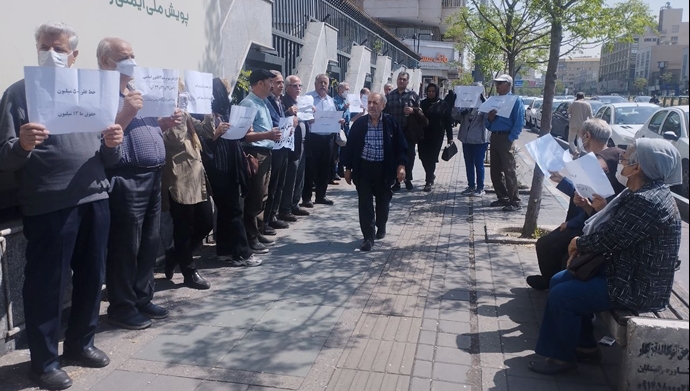

In recent days, Iran has witnessed a renewed wave of social protests, reflecting the depth of economic crises and a growing sense of injustice among various segments of society. From retirees in the south, to workers and bakers in the west, to landowners in the northwest, the voices of discontent are unified in demanding dignity, justice, and long-denied rights. On April 6, 2025, several demonstrations broke out across different cities, illustrating that public anger is no longer confined to a single group or region.
More footage of the protest rally by retirees of the Social Security Organization in Ahvaz.
Protesters chant: "Poverty and corruption is here, officials' children are in the US"#Iran #IranProtestspic.twitter.com/TCZ7MtPVzW— People's Mojahedin Organization of Iran (PMOI/MEK) (@Mojahedineng) April 6, 2025
In Ahvaz, retirees from the Social Security Organization gathered in front of the provincial office of the organization in Khuzestan, protesting the disastrous living conditions, skyrocketing prices, and the government’s disregard for their long-standing demands. Protesters chanted against corruption and denounced the state’s abandonment of those who spent their lives serving the country. Among their slogans: “No handouts, no charity—give us our rights with dignity.”
April 6—Shiraz, southern Iran
Workers of the telecommunications sector rally to protest the unfair dismissal of several workers who have more than 10 years of experience.#IranProtestspic.twitter.com/BiaTBZ95dh— People's Mojahedin Organization of Iran (PMOI/MEK) (@Mojahedineng) April 6, 2025
In Shiraz, protests by employees of Iran’s telecommunications equipment factories entered their second day. Demonstrators condemned unjust layoffs that have affected many experienced staff. They emphasized that such dismissals are a betrayal of years of dedicated service, calling for the reinstatement of workers and job security amid deepening economic hardship.
April 6—Kermanshah, western Iran
Bakers rally in front of the governorate to protest poor economic conditions.#IranProtests pic.twitter.com/QNcKGBullG— People's Mojahedin Organization of Iran (PMOI/MEK) (@Mojahedineng) April 6, 2025
In Kermanshah, bakers gathered outside the provincial governorate to protest rising production costs and the authorities’ neglect of their worsening situation. They also announced plans for a nationwide demonstration on April 9, warning that the sector is on the verge of collapse if urgent action is not taken.
April 6—Shush, southwest Iran
Workers of Haft-Tappeh Sugarcane Company rally to protest low water rations for sugarcane fields.#IranProtests pic.twitter.com/DdsQaFNwTZ— People's Mojahedin Organization of Iran (PMOI/MEK) (@Mojahedineng) April 6, 2025
In the Haft-Tappeh sugarcane complex, workers staged a protest in response to a sharp decrease in water allocations for the region’s sugarcane farms. The workers warned that the water shortage threatens both agricultural output and the livelihoods of thousands of families, calling for immediate intervention to prevent a looming environmental and economic disaster.
In Shush, retirees from Shush, Haft-Tappeh, and Karkheh gathered in front of the local governor’s office, protesting high inflation, lack of healthcare, and the regime’s exploitation of religion to mask corruption and oppression. One of their chants was especially revealing: “They cry ‘Hussein,’ but all they do is lie and steal.”
April 6—Shush, southwest Iran
Retirees of the Social Security Organization resume their protests as regime officials refuse to address their demands for higher pensions and basic services.#IranProtestspic.twitter.com/gESzfZNbLH— People's Mojahedin Organization of Iran (PMOI/MEK) (@Mojahedineng) April 6, 2025
In Zanjan, several landowners from the Kawazank region demonstrated in front of the provincial government building. They condemned the authorities’ failure to honor past commitments to allocate land in the area. Recently, officials proposed exchanging their plots for land elsewhere, a move the landowners see as an affront and a breach of their rights.
In Arak, workers at the Arak Machinery Manufacturing Company (Sanaye-e Alat) staged a protest demanding overdue payments, including educational allowances for their children and other promised benefits. The workers highlighted the employer’s long-standing failure to fulfill financial obligations. They also called for the re-establishment of the workers’ council, which had been dissolved last year under pressure from management. “Do not trample our professional rights,” they declared. “We have the right to be heard and to see our demands fulfilled.”
These expanding protests reveal that Iranian society is standing on the edge of a social volcano. With deepening economic suffering and collapsing public trust in state institutions, there is a growing possibility that these scattered demonstrations may soon evolve into a broad popular uprising—unless the regime offers genuine and immediate responses to the people’s legitimate demands.