

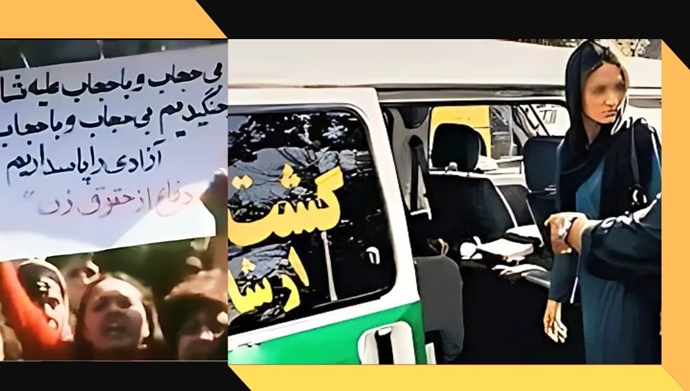

On April 5, 2025, the state-run newspaper Etemad, referencing the infighting among regime factions over the implementation or suspension of the criminal mandatory hijab law, warned of the danger of a “spark” turning into a “blaze” of uprisings that could engulf the entire regime.
This state-run newspaper wrote: “According to hardliners, in a situation where public dissatisfaction has increased due to economic problems, a single protest spark could create widespread dissent and put the government in checkmate.”
A few days earlier, on March 30, Azar Mansouri, head of the regime’s so-called reformist faction, warned in an interview with Didar News website that “the social fabric and the demands and expectations of the people have made the country highly susceptible to unrest and increased tensions between the state and society.” She also said: “Dissatisfaction is growing, people’s anger and despair are increasing, and God forbid that this anger and dissatisfaction increase so much that it overcomes fear.”
The next day, a regime figure named Mohammad Mohajeri, fearing the consequences for the regime, called the dispersed gathering of Hezbollahi plainclothes agents demanding the implementation of the mandatory hijab law a “Masjed Zarrar” (a historical reference to a mosque built by hypocrites, implying the gathering was harmful despite appearing pious). He also attacked members of the rubber-stamp parliament who supported the gathering outside the Majlis, saying: “The representatives mentioned have the same duty as Liakhov the Russian, who bombarded the parliament. Expel these artillerymen so that peace can return” (Khabar Online, March 31). (Colonel Vladimir Liakhov bombarded the Iranian parliament under Tsarist Russian orders in 1908).
When the regime agents’ gathering in front of the parliament and their attacks on Mohammad Bagher Ghalibaf, the Speaker of Parliament, were dispersed, Ghalibaf’s advisor, Amir Ebrahim Rasouli, announced that the illegal sit-in in front of the Majlis had ended after “kind patience.” The regime’s governor in Tehran stated that any call for unauthorized open-air gatherings or sit-ins would be dealt with.
On the other hand, the IRGC-run Fars News Agency reported on the handling of this sit-in: “A group of women who had staged a sit-in near the parliament faced an unexpected crackdown by police forces. The sit-in ended with police intervention using physical methods. Several participants reported being beaten, forcibly transferred in police vehicles to the outskirts of the city, and abandoned in the middle of the night.”
Cleric Hamid Rasaee, a member of the regime’s parliament, also said: “Dispersing the protesters in front of the parliament, whoever made the decision and from whatever position, was due to either foolishness or infiltration!”
In contrast, cleric Mahmoud Nabavian, who himself was one of the proponents of the criminal mandatory hijab law, reminded Rasaee and his cohorts why they fail to understand the desperate situation of the regime after the collapse of the regime’s strategic depth and the downfall of the hated Assad dynasty in Syria on December 8, 2024.
Nabavian said: “When we approved the Chastity and Hijab bill, it was before the fall of Syria, before the martyrdom of Seyyed Hassan [Hezbollah leader Hassan Nasrallah, who died in September 2024], and under conditions whose history you know… But based on the concern that the enemy might want to ‘Syrianize’ Iran, the Secretariat of the Supreme National Security Council said anything causing polarization should be temporarily stopped… Friends asked during these days, ‘Mr. Nabavian, didn’t you approve it yourself?’ Yes, we were the ones who approved the Chastity and Hijab bill, but as I said initially, due to the existing problems in the country, the country should not be set on fire.”
The swamp of internal crisis and fear of uprising has engulfed not only the parliament, Ghalibaf, Nabavian, and Rasaee, but also their rivals. Recently, political analyst Abbas Abdi, acknowledging the dwindling support around regime president Masoud Pezeshkian, said: “The president promised to lift internet filtering and said he could do it, so he should do it. If he can’t, he should pack up and leave.” Abdi added: “Economic protests have occurred among the lower classes, and cultural and social protests have occurred among women. Now all these have merged. The next protests will be very widespread” (Khabar Online, March 28).