

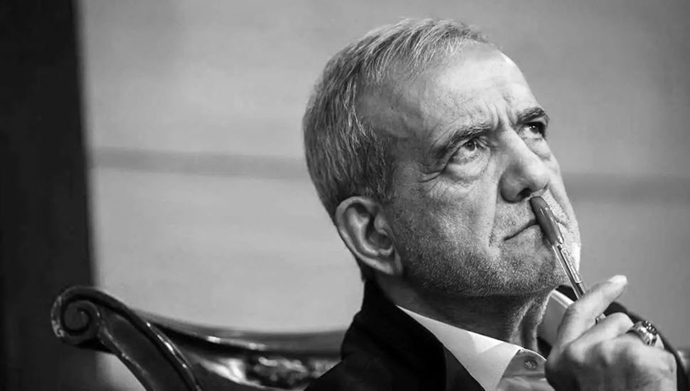

Iranian regime President Masoud Pezeshkian, in his speeches over the past five months, has presented the notion that his audience consists of newborns who have no memory, observation, or experience of the past 46 years, with their minds as blank slates. He consistently imagines himself addressing elementary school children, showing them dreams of the future and interspersing his speeches with moral and civic lessons. He strives hard to instill in his audience the idea that the present and the future are completely disconnected from the past and that the genesis of Iran as a nation coincides with his presidency. For these reasons, he never revisits, critiques, or explains the path leading to the current state.
The foundation of the current regime is built on maximum poverty and inflation, maximum child labor and school dropouts, maximum brain drain and social migration, and, as Pezeshkian himself repeatedly calls it, maximum “imbalance,” as well as maximum executions and incarceration of political opponents. During the “Conference on Developing Investment Opportunities in the Chabahar Free Zone” on January 9, Pezeshkian envisioned a shining future built on this history of extreme crises, describing it as a paradise on a highway of wind: “The vision says what? It says Iran is a developed country, ranking first economically, scientifically, culturally, and administratively in the region. Number one, inspiring, a model.”
As is evident, Pezeshkian starts his lofty claims from scratch. His words inadvertently acknowledge that nothing significant has been accomplished in this country and that he is the ultimate savior.
In all his statements, Pezeshkian essentially disregards the past and the present. He overlooks the current struggles of teachers, retired educators, and workers, choosing not to address their issues. Instead, he continues constructing his gilded utopia on the winds: “We want to see a model, a vision that represents the best, the greatest. To prepare ourselves, our children, our schools, and our managers for such a place.”
Pezeshkian’s ambiguous rhetoric highlights his alignment with regime’s ideology, as seen in the statement that echoes the regime founder Ruhollah Khomeini’s declaration in Paris: “Islam is itself the law!” An assertion that led to nothing but widespread atrocities. Similarly, Pezeshkian claims, “Law is the program,” which, under the mullah’s regime, has amounted to maximum plunder, state terrorism, environmental degradation, moral decay, and a new level of crimes in Iran and the region, alongside pervasive misogyny. Consider his statement:
“In this election, they asked me, ‘What do you intend to do? What is your program?’ I said we don’t have a program. Our programs are the general policies, the Supreme Leader’s vision. Law is the program.”
When Pezeshkian addresses the issue of brain drain and mass social and professional migration, he is careful not to discuss the root causes of this human crisis or its political and economic impacts, which stem fundamentally from the regime’s political monopolization and religious authoritarianism. Instead, he reduces the crisis to a matter of personal character and morality:
“If they have skills and abilities, they should dedicate them to their people, their country, and their land—not get angry and leave. Even if they are beaten, they should not abandon their country.”
Pezeshkian amplifies his chant-like illusions into a tangled mass that, when unraveled, leaves nothing tangible for the Iranian people, not even a two-day outlook: “Wherever anyone is, they should worship the God who is the best, the greatest, the mightiest. We are the best, the greatest, the mightiest in our lives, our behavior, our efforts. We must show this.”
Even when he acknowledges “hardships,” Pezeshkian avoids mentioning the excruciating daily struggles of the Iranian people or their causes, settling instead for lamenting the “turmoil” within the regime: “We are caught in difficulties—sanctions, disputes, and disagreements among ourselves, narrow-minded views. We have created turmoil within ourselves.”
When analyzed carefully, all Pezeshkian’s speeches reveal nothing but the decapitation of words, stripping them of meaning and their connection to political and social realities. Even when addressing real and tangible issues in Iran, which have pitted society against the ruling regime, he truly “has no plan,” relying only on the repetitive invocation of “the Supreme Leader.” With each statement, he further proves that he has never represented most of the Iranian people.