

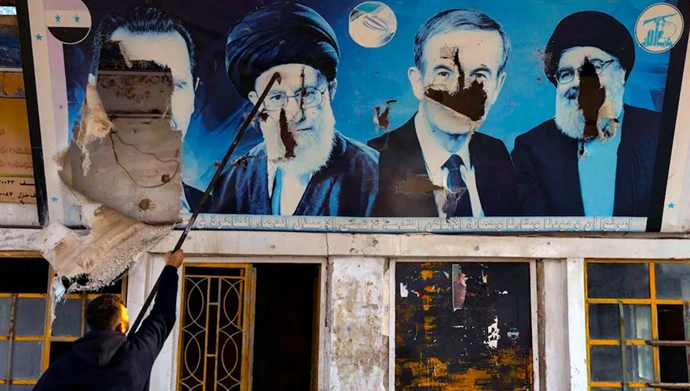

Throughout its existence, the clerical regime in Iran has faced deadlock-inducing crises in dealing with domestic, regional, and global developments, ultimately resulting in strategic failures. A notable example of this was its loss of expansionist dominance in Syria. This defeat, in addition to causing political tensions within the regime’s structure, has led to intense internal turmoil, manifesting in severe conflicts between factions preserving wealth and those seizing power.
Syria was a strategic focal point for Iran’s regime to ensure its survival. However, the fall of Bashar al-Assad has inevitably triggered self-inflicted punitive measures against the regime’s existence. Over the past week, infighting amont regime factions has intensified. Each faction is striving to strengthen its position, seizing the opportunity to blame rivals for Assad’s downfall and inflicting harm upon them. Matters have escalated to the point where whispers of prosecuting former presidents Hassan Rouhani and Mahmoud Ahmadinejad have surfaced in state-run media.
The state of the regime’s officials, particularly among Friday prayer leaders and senior officials, is encapsulated in words like fear, astonishment, doubt, suspicion, anticipation, hopelessness, nightmares, and indecision. These terms reflect a regime in crisis, increasingly desperate to find a way back to its favorable past conditions. However, these efforts merely highlight the deadlock and confusion plaguing the regime after the devastating strategic blow.
Following the fall of Bashar al-Assad and the failure of the regime’s strategy of exporting war and terrorism, state media have been unable to logically analyze the situation. Instead of providing fact-based analyses, they attempt to deceive and censor public opinion, trying to convince themselves and society that nothing has happened. This lack of logical analysis has driven the general atmosphere among regime officials toward confusion, disarray, and nightmares.
In its December 14th issue, the Ebtakar newspaper noted parallels between the Iranian regime’s situation and Bashar al-Assad’s, warning of a repetition of his fate: “Assad’s fall resulted from internal collapse. Corrupt structures, incompetence, and mismanagement among officials could lead to similar outcomes.”
On the same date, the state-run Setareh Sobh newspaper made an interesting observation and an even more revealing admission. It acknowledged that the regime and its media understood Bashar al-Assad’s regime was “decayed and corrupt.” It also pointed out that Iran’s regime and his three branches of power have, for years, sustained “decay and corruption” at the cost of the Iranian people’s lives and environment: “The decayed and corrupt Syrian regime collapsed with just a gust of wind or a storm. Iran was an ally of Hafez al-Assad and Bashar al-Assad.” The newspaper then highlighted the consequences of sustaining “decay and corruption” within the regime: “Today, Iran’s routes to Lebanon are blocked. The regional situation has turned against Iran.”
understand is the harsh reality that Assad’s fall signals significant and purposeful changes in the regional and international landscape. In this context, the clerical regime is ensnared in a vortex of strategic turbulence. Assad’s fall not only delivered a major blow to the regime’s regional coalition core but also heralds the onset of a new era of super crises, both domestic and international. Repeated defeats over the past seven months, escalating and uncontrollable internal divisions, insoluble economic and livelihood crises, and now monumental regional changes have placed the regime in a state of accelerated decline—a decline they themselves cannot clearly envision a way out of, as systemic laws dictate. Strategic defeat inherently entails the emergence, intensification, and peak of strategic crises.