

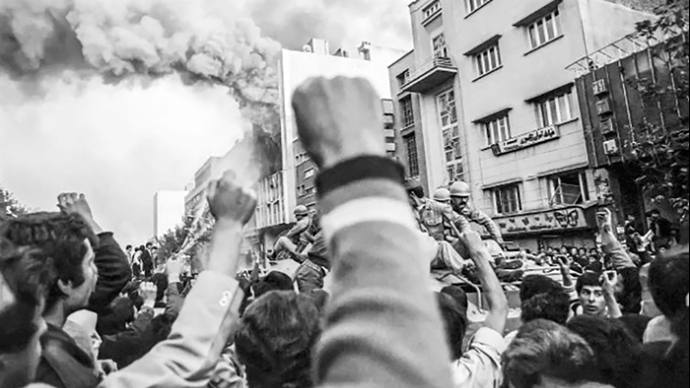

In the past decades, Iran’s 1979 revolution has been subject to the most scrutiny and criticism. There is no doubt that the destructive, corrupt, and chaotic rule of the clerics who seized power after the 1979 revolution has cast a shadow over the authenticity and reality of that revolution. However, if we cast aside the ambiguity, we witness an undeniable, unique and national movement against dictatorship in Iran.
February 11, 1979, was the peak of demand for national and social prosperity in Iran—whether political, economic, or cultural. In Iran, a country that had long suffered under dictatorship, this prosperity was primarily defined under the banner of “freedom.” However, Khomeini’s political and religious monopoly, combined with his untouchable aura of sanctity at the time, strangled freedom before the revolution’s fledgling hopes could take flight.
After February 11, no one dared to demand answers about freedom from Khomeini, as he and his sworn loyalists did everything they could to erase the word “freedom” from the vocabulary of the revolution. After the revolution, Khomeini attached the adjective “Islamic” to the word “revolution,” making the erasure of freedom the litmus test for loyalty to his rule.
In reality, the revolution was the result of the widening class divide, which was one of the key drivers of the anger against the Shah’s rule. This anger, alongside the demand for freedom and equality, was one of the strongest motivations for the 1979 revolution. According to surveys and studies on the annual growth of income during the final years of the Shah regime, at the time, Iran was one of the few countries where the top 10% of earners claim more than 50% of the national income. Until the end of 1980, this group’s average share had been 54% of the national income.
The spirit of the 1979 Revolution was tied to the rejection of the entrenched dictatorship in Iran’s history. However, the revolution itself did not create an institution to preserve this spirit. The reason is clear: on one hand, the Shah’s full-scale repression of organized forces—keeping them imprisoned or in exile until just three weeks before February 11—and on the other hand, Khomeini’s lack of historical and intellectual competence left no room for an institution to solidify a post-revolutionary system resistant to dictatorship.
Thus, from the day after February 11, the spirit of the revolution became the battleground between freedom seekers—most notably the People’s Mojahedin Organization of Iran (PMOI/MEK) and their broad coalition of allies—and Khomeini. Nothing was more deeply targeted than the concept of freedom under Khomeini, who subjected it to slander, demonization, persecution, imprisonment, executions, and mass killings.
The Relationship Between the Truth of the Revolution and the Nature of Its Forces
Every revolution manifests its truth through its markers—such as its demands and goals. This truth is not conditioned by the revolution’s past or future but is defined by the time frame from its beginning to its conclusion. The truth of the 1979 Revolution is marked from the spring of that year until February 11. The defining markers of the revolution have already been outlined above.
Therefore, the truth of the 1979 Revolution should not be measured by the state of governance that followed it, but rather by the demands, path, and markers of the revolution up until its victory. The truth of a revolution itself serves as the standard for evaluating the quality and nature of the forces associated with it.
The regime based on the concept of Velayat-e Faqih (Guardianship of the Islamic Jurist) was born after February 12. Ironically, due to its reliance on the absolute rule of the supreme leader, it bears no connection to the revolutionary movement that was fundamentally against absolutism and dictatorship. This regime has no roots, foundation, or link to the freedom-seeking demands that existed before February 12. Its annual political and economic record confirms this fact, with even government-affiliated experts acknowledging that each year, the regime grows more class-divisive and authoritarian.
Those who erase the goal of freedom from the essence of the 1979 Revolution and tie its fate to the totalitarian rule of the clerical regime undoubtedly negate their own commitment to freedom, both historically and philosophically. It is no coincidence that only the so-called “reformists” within the regime and the remnants of the ousted Shah regime—who, despite their differences, share a common mindset—stand opposed to any form of social revolution aimed at overthrowing the mullahs’ rule.
It is evident that the demands of the 1979 Revolution have not changed; they have only deepened, matured, and become clearer over time. The concept of freedom has become an all-encompassing necessity in present-day Iran, a shining diamond capable of shattering the fragile glass of the mullahs’ rule.
The concept of equality has turned into a grand national battleground against a misogynistic regime.
The anti-dictatorship stance—initially aimed at the Shah until February 11—evolved after experiencing theocratic dictatorship. This led to a complete realization of the historical alliance and alignment between the Shah and the mullahs against Iran’s national interests.
All these demands have found tangible and nationwide expression in the anti-dictatorship uprisings of the past two decades. What has now been definitively settled is the Iranian people’s will for the eradication of all forms of dictatorship and tyranny. And this is best symbolized in the slogan that unites Iranians throughout the country and across the globe: “Down with the oppressor, be it the Shah or the mullahs.”