

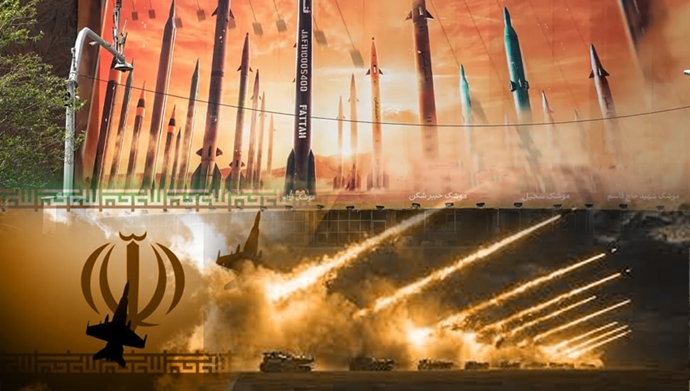

One of the key pillars of the Iranian regime’s survival is “exporting the revolution.” The establishment of a terrorist force called the Islamic Revolutionary Guard Corps (IRGC) and the creation of proxy forces using Iran’s national wealth serve this strategy. Slogans like “War, war until all sedition in the world is removed,” “Defending the Shrine of Zaynab (The eldest daughter of the Islamic prophet Muhammad),” and “Liberating Jerusalem” have promoted and propagated this strategy.
But after a year of stoking the fires of war in the region, these grandiose slogans have faded, replaced by humiliating and desperate maneuvers by the regime.
In the early days of the war in Gaza, Iranian regime media boasted about the readiness of “martyrdom-seeking” forces and registration for deployment to Palestine. Hossein Amir-Abdollahian, Ebrahim Raisi’s foreign minister, boastfully claimed that all hands were on the trigger. He compared the region to a powder keg that could explode at any moment. However, after a year of warmongering, we now see different approaches within the ruling establishment.
After the regime’s latest missile attack on October 1, foreign minister Abbas Araghchi has resorted to desperate diplomatic tours across the Middle East. He visited Lebanon, Syria, Saudi Arabia, Qatar, Jordan, Oman, Egypt, and Turkey, touting the message of “regional security.” During his visit to Turkey, he told reporters that regional countries share an understanding of the danger of a regional war.
What he didn’t mention was why the regime is now concerned about preventing the spread of war to the region. Wasn’t it this very regime that laid the groundwork for this war and boasted about it?
Didn’t regime founder Ruhollah Khomeini say, “War is a divine blessing”?
According to Khomeini, “Without hardships, suffering, wars, killings, and the other effects, man will not emerge from the stagnation and comfort that is inherent in him. These are the blessings of the hardships and unpleasantness of war, even if it was a just war. It is a divine gift that God, without human intervention, has bestowed upon us, and we must appreciate this blessing” (Sahifeh, vol. 14, pp. 203-204).
Didn’t the regime Supreme Leader Ali Khamenei define the IRGC’s responsibility as maintaining strategic depth and say: “The political and strategic depth of the Islamic Republic lies within Islamic countries, from North Africa to East Asia”? (Source: Khamenei’s website, February 3, 1998)
Didn’t he passionately defend the regime’s “regional presence,” a euphemism for the regime’s terrorist interventions, in response to his opponents?
“Regarding our regional presence, which they constantly question, asking why Iran is present in the region, the Islamic Republic is obligated to act in a way that strengthens its friends and supporters in the region. Therefore, our regional presence is certain; it must exist, and it will continue to exist” (Khamenei’s website, January 8, 2021).
Wasn’t it emphasized that maintaining strategic depth is one of the “most important duties”:
“Do not lose sight of this broad geographical perspective of resistance; do not lose this trans-border perspective. Let us not be content with our own region… This broad trans-border perspective, this extension of strategic depth, is sometimes more necessary than even the most crucial duties of the country…”
But now, in addition to Araghchi’s tours and begging around the region, some regime newspapers write:
“In difficult times, we are not struggling solely because a strong, cunning, and mercenary enemy stands before us. That is hard, but even harder is the situation that some insiders create. At a time when the wall of security should be strengthened with brotherhood and love, with malevolence and backbiting, some are trying to pull people from the ranks, which should be as solid as a fortified wall. It’s difficult because some speak boastfully of war, without it being clear how many days they have actually worn the uniform. They speak of war, even if it means half the people will die, but it’s not clear where they themselves will stand in this battlefield” (Jomhouri, October 21, 2024).
“War is poison, and history shows us this. War wounds society, and if a country becomes involved in a pointless war, the wound becomes even deeper” (Source: The state-run Ham-Mihan newspaper, October 21).
“These days, the country’s diplomatic capacity should not be limited to the Foreign Minister’s comings and goings. Various delegations representing the country should join this process and share a unified, coherent, peace-seeking policy through constructive initiatives with other regional and global parties. A great evil has engulfed the region, and the only wise way to confront it is to use diplomatic capacities with bold and innovative action” (Source: The state-run Shargh newspaper, October 21).
The reality is that what this regime calls “strategic depth” is now on the verge of collapsing, and in some places, it has reached the point of no return. The regime is now more exposed than ever to the world. The self-destructive consequences of warmongering and terrorism have now caught up with the main instigator of the conflict.
The regime’s survival has depended on ruthless repression, terrorism, and several major wars, including the Iran-Iraq War, the Gulf War, the U.S. occupation of Iraq, and proxy wars in the region from Syria and Iraq to Yemen and Lebanon. Throughout all these stages, international appeasement and backroom deals have kept the regime standing. Now, that policy no longer works. If we combine the regime’s economic bankruptcy and Pezeshkian’s calls for painful reforms with its entrenchment in the quagmire of warmongering, everything points to the ticking of a clock signaling the approach of a major transformation.