

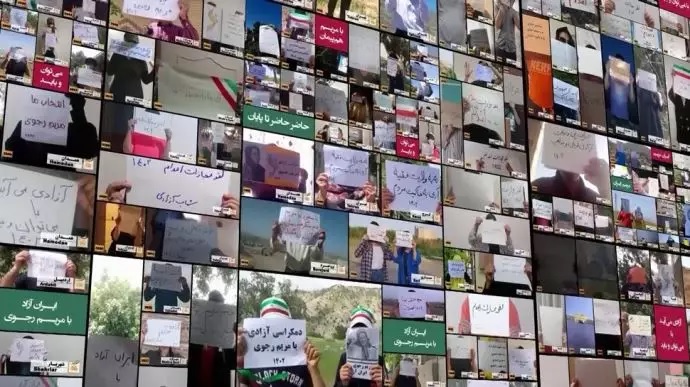

During a speech in Mashhad, Habibollah Sayyari, the deputy of the Islamic Revolutionary Guard Corps’ (IRGC) Intelligence Organization, referred to a war that has been ongoing for over four decades between the Iranian regime and the People’s Mojahedin Organization of Iran (PMOI/MEK). He mentioned the initial phase of this war and said, “Forty years ago, in this very Mashhad, the PMOI initiated large-scale demonstrations”.
Habibollah Sayyari then acknowledged the role of the PMOI in uprisings against the Iranian regime and said, “The enemy’s objective over the past four decades has been the overthrow of the regime, and during this time, its objective has not changed. What has changed is its strategy, method, and approach”.
This is not the first time, over the course of more than four decades, that figures like Iranian regime supreme leader Ali Khamenei and others within the regime have acknowledged PMOI and the organized resistance’s central role in uprisings and the unending battle between the people and religious fascism ruling Iran.
In July 2019, Mostafa Pourmohammadi, a minister in the governments of Ahmadinejad and Rouhani, said, “Can hostility towards the PMOI get any worse? They have tarnished the image of the regime worldwide. No destruction [against the regime] has occurred in these 40 years except when led by [PMOI]. We have not settled the scores yet.”
It is worth noting that Pourmohammadi is one of the key figures in the 1988 massacre of more than 30,000 political prisoners, most of them members and supporters of the PMOI.
On June 24, 2022, Kazem Gharib Abadi, the Deputy for International Affairs of the regime’s judiciary, said, “There isn’t a meeting in which we don’t discuss the PMOI issue. In the high-level session of the Human Rights Council, I spoke about the PMOI for at least two to three minutes out of a six to seven-minute speech. For a while, the belief was that there was no need to mention the PMOI by name. But that is not our opinion”.
This very issue was emphasized and reiterated in a roundtable discussion with the regime’s theoreticians, where the regime’s so-called experts warned, “Our main concern in the country is the PMOI, and we must address them.”
Journalist Mohammad Quchani, one of the participants in this roundtable, also emphasized that, “We have to know that the Mojahedin-e Khalgh issue is the issue of our day and it is not just a historical issue… wherever the people’s rightful protests were diverted, the organization was involved… So the issue of the PMOI is today’s issue.”
Prior to that, Abbas Salimi Namin, another so-called expert, had said in an interview, “Contrary to some who believe that the PMOI in Albania will face problems and be destroyed, they will not be destroyed! This is a movement that is changing its methods… In this matter, we have not studied and worked as much as we should have, and we have been seriously negligent… These are the strongest formations against Iran” (Source: Ensaf News – July 10).
In a televised interview, Javad Moghuyi, a documentary filmmaker for the Iranian regime, attacked the regime’s policy of silence about the PMOI and said, “There were policies on television in the 1990s that you wouldn’t talk about the PMOI anymore, and those policies are over; they completely reconstructed themselves in the 2000s in the public consciousness. What was the issue with the 2017 elections? The executions of 1988!” (Source: Etemad Online – July 18).
The head of the judiciary Gholam-Hossein Mohseni-Eje’i states that “if we lack the necessary awareness regarding the combined warfare [the uprisings] we will be hit from a place that we would not know where and in what manner we have been struck.”