

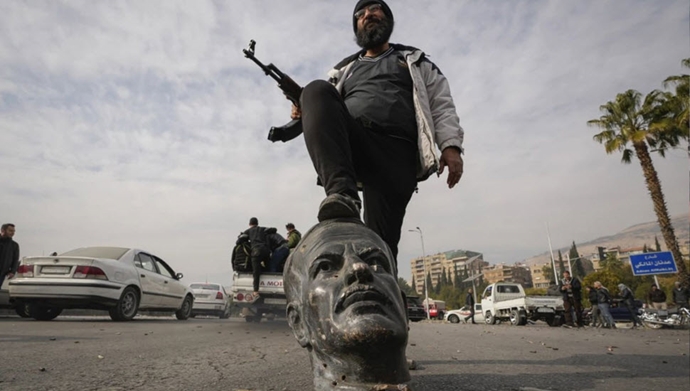

As a result of the severe political shifts sparked by the fall of Syrian dictator Bashar al-Assad, the political landscape and balance of power in the tumultuous Middle East underwent an irreversible transformation. Some have described this development as the most significant geopolitical shift in the region since 1979, when the monarchy in Iran was overthrown. In this transformation, the Assad family dictatorship, which had ruled Syria for over 50 years through repression, violence, a vast military and intelligence apparatus, and a network of prisons and torture centers, melted away like snow within days and disappeared.
The consequences of this historic event have manifested most prominently in Iran, shaking the clerical regime to its core. Bashar al-Assad’s dictatorship was more than just a political ally; it was a strategic anchor and crucial position for the Iranian regime. Supreme Leader Ali Khamenei repeatedly described Syria as a strategic point for his regime and, during a meeting with Bashar al-Assad on April 3, 2023, stated: “The relations between the two countries are deep and inseparable.”
Khamenei, the architect of this strategic alliance, has, over the past 14 years, used all means at his disposal to suppress and crush the Syrian people’s revolution and to keep Bashar al-Assad’s dictatorship in power. This included the massacre of 500,000 Syrians, displacing 7 million people (one-third of the population), spending $50 billion in the 2010s alone, and deploying 60,000 Revolutionary Guards (IRGC) and proxy forces to Syria.
But now, all of these efforts have been obliterated. The effects of the massive political earthquake in Syria are manifesting as a series of aftershocks in Iran, with the regime’s media and officials stunned and fearful, raising questions that Khamenei must address.
On December 9, the state-affiliated newspaper Ham-Mihan, under the headline “The End of Assad, a Beginning for Us” wrote, “First and foremost, let’s clearly and straightforwardly answer: Where was the mistake, and how much did we pay for it?”
On the same day, the newspaper Shargh wrote, “Support for Bashar al-Assad over the past decade came at financial, political, human, and reputational costs, and the rapid and comprehensive collapse of the Assad regime requires multifaceted analyses.”
On December 10, the newspaper Ebtekar, under the headline “How the Al-Aqsa Storm Changed the Middle East,” questioned what Khamenei once considered his greatest achievement and victory, writing, “The successive and interconnected developments following the Al-Aqsa Storm can be seen as paving the way for today’s developments in Syria and the fall of Bashar al-Assad’s government.”
Even within the Khamenei-aligned Majlis (Parliament), critical voices can be heard. “After sacrificing about 6,000 Defenders of the Shrine and spending billions, we handed Syria over to the Takfiris within just one week,” MP Mohammad Manan Raisisaid on December 9, adding, “If this is not divine wrath, then what is?”
Amid mounting questions and concerns within the regime, regime officials are making futile attempts to justify the current situation. In a contradictory and ludicrous justification during a televised interview, Foreign Minister Abbas Araghchi said, “The speed of developments surprised everyone. The speed of developments astonished everyone; we must say it was unexpected. However, there was planning, and complete information on this was shared with Syrian officials.”
A “former field official” also offered baseless justifications, claiming, “The Turks and some Arab countries deceived us; they gave assurances two months ago that nothing would happen in Syria.”
However, the state-affiliated newspaper Shargh mocked this statement, writing, “How can a country with numerous research and strategic centers be so easily deceived by a western neighbor and fail to deeply monitor and analyze the regional military, political, and field developments?”
Amid the regime’s internal turmoil, terrified cries over the dark future looming for the regime are louder than other voices. The aftershocks of the collapse of the regime’s strategic position were described by Shargh (December 9) as follows: “The country is grappling with a lengthy list of internal, regional, and international issues.”