

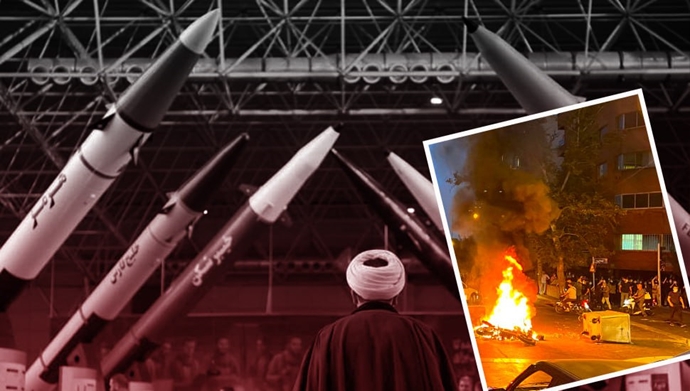

The clerical regime is facing serious challenges rooted in its lack of social support. The economic and livelihood crisis that has affected a significant portion of society has put additional pressure on the regime, undermining its legitimacy day by day. Under such circumstances, the clerical regime, to maintain its power, not only ignores the basic demands of the people and fails to improve their living conditions but also pursues repressive and fear-inducing measures such as executions.
In a press conference on November 28, the Speaker of the Majlis (Parliament), Mohammad Bagher Ghalibaf, said, “Our power does not lie in missiles; it lies in having the people’s hearts with us.” This remark reflects his awareness and acknowledgment of the depth of the legitimacy crisis. However, the glaring contradiction between this claim and the regime’s fear-driven policies is noteworthy. He emphasizes the importance of public approval on one hand, while on the other, the regime remains focused on advancing missile programs and engaging in proxy wars in the region.
This contradiction reveals that the regime is currently trapped in both domestic and international deadlocks. Under pressure from internal and external forces, it is compelled to constantly acknowledge the importance of the people’s unmet satisfaction. Simultaneously, its reliance on power-seeking and military institutions prevents it from abandoning authoritarian policies. The result of this duality is the adoption of contradictory and inefficient strategies that not only fail to address existing problems but also exacerbate them.
Ghalibaf suggests that the regime relies solely on military power and repression while admitting that domestic problems are extremely acute and explosive. He essentially states that the development of missile programs has not only failed to enhance national security but has also imposed heavy economic burdens on the country, exacerbating public discontent.
The ongoing protests by various social groups in different cities attest to the widespread dimensions of the economic and livelihood crisis, one of the regime’s most significant challenges. Runaway inflation, uncontrolled price hikes, the devaluation of the national currency, and the spread of poverty and unemployment have turned people’s daily lives into street protests. Official statistics on inflation, commodity prices, and the poverty line starkly reflect the regime’s ineffectiveness and the accelerating erosion of its social base.
The legitimacy crisis of the regime is a multifaceted phenomenon spanning politics, economics, and society. Resolving this crisis has placed the regime in a decisive dilemma between prioritizing the people or missiles.
The reality is that the only sustainable solution to overcome this multilayered crisis is the collective will and solidarity among all segments of society for fundamental change, which entails rejecting the regime in its entirety. Only through unity and mutual support toward this goal can one hope for a brighter future and achieve it.
When a regime official like Ghalibaf acknowledges that the regime has no foundation in society other than missiles, it signifies that Iran is undergoing a historical experience—one that underscores that no regime can withstand the demands and will of a justice-seeking nation. The people of Iran, by moving beyond the entirety of this regime, embody such a desire across the country.