

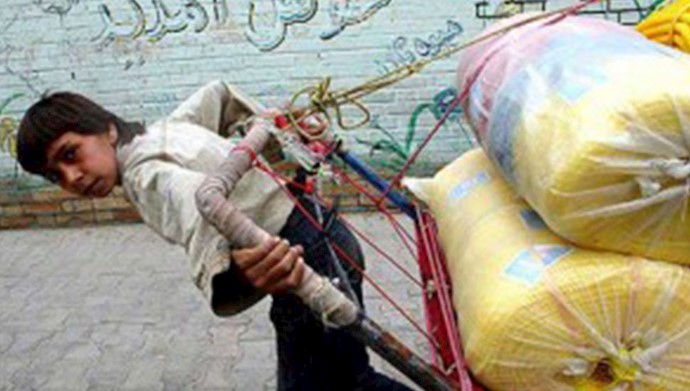

What will be the fate of a child born in Iran under the rule of the mullahs? Will it be love, beauty, prosperity, and a bright future, or poverty, hunger, and a collapsing roof? Will the child long for education on street corners, in underground workshops, and alongside the streets, carrying the burden of the family’s livelihood?
Hungry children, gluttonous rulers
Regime statistics show that absolute poverty affects at least 30% of Iran’s population. That means 25 million people do not have sufficient income to provide for food, living expenses, and especially shelter. More than half of the country’s households are unable to provide adequate and suitable food for their children.
On January 4, 2024, the state-run Donya-ye Eqtesad newspaper reported that there are over 14 million children under the age of 18, 9 million children under the age of 12, and 3.5 million children under the age of six in Iran. The per capita income of the country has decreased by more than 34% over the past decade, and the consumption of essential goods has even decreased more than that. The household expenditure basket for tenants increased by 37% in 2022. In such conditions, children are the most vulnerable and are at risk of malnutrition, exposing this population group to short- and long-term harm.
Indeed, in such reports, the educational decline of children from impoverished families is also mentioned, which has now become a black mark on the image of Iran’s regime in the eyes of the international community.
The decline in students’ educational performance, the decrease in the enrollment rate of students from low-income households, and the forced increase in the dropout rate from education, followed by a tangible increase in the number of child laborers, child waste pickers, and innocent girls selling flowers on the streets. The statistics on this tragic aspect are not readily available, but it is reported that around 1.5 million children in the country are at risk of dropping out of education, and there are over half a million children who have been deprived of education.
These are just a few glimpses of the alarming evidence of the situation of hungry and deprived children in Iran. The widespread nature of this inhumane situation is reflected in the majority of the population being impoverished according to the regime’s own statistics.
On January 4, the state-run Donya-ye Eqtesad newspaper wrote, “In the current circumstances, all the evidence indicates that up until the ninth decile, they are facing economic difficulties and daily income shortfalls, and 30% of the population is living in absolute poverty.”
Children who have not had a childhood
In the field of economic literature, the employment of child labor is carried out by families who are forced to send their children to work due to livelihood difficulties.
On January 4, the state-run Donya-ye Eqtesad newspaper wrote, “The main demanders of child labor are workshop owners who employ children. Children are cheap and, of course, less troublesome labor for them. They receive lower wages, are more obedient, lack insurance, and have no voice of protest. In the midst of this, the existence of various laws, from the constitution to labor laws, has had no effect on the elimination of child labor. This is because the issue has its roots in unequal relationships, relationships that have a significant influence on power.”
The deceitful culprits
For some time now, the “Child Labor Organization” plan has been put into action for the thirtieth time. The municipality intends to cleanse the face of the city from the misery created by the rulers and hide child labor from public view, dragging them into positions filled with corruption and destruction.
On December 22, 2023, Entekhab newspaper wrote, “In recent days, the mayor of Tehran promised child laborers in the capital would be gathered by the end of this year… and added, Let’s cleanse the face of Tehran from this harm, let’s close the file on these visible damages in our city by the new year.”
This is while even state-run media are rejecting the possibility of any such thing happening. On December 31, 2023, Fararu website wrote, “Quick-fix plans for gathering child laborers have had no other benefit than incurring expenses and causing further harm to the children… the increase in economic pressures in recent years has led to a rise in the number of child laborers in the city.”
A vicious cycle
On December 31, Tejarat newspaper quoted the head of the Social Workers Association as saying, “The factors that contribute to individuals becoming child laborers still exist… My prediction is that in the future, the trend of street children, abandoned women, the elderly, the mentally ill, and disabled individuals living on the streets will increase. Because poverty is growing. One of the manifestations of growing poverty is precisely these child laborers and street addicts, homelessness, vices, and so on.”