

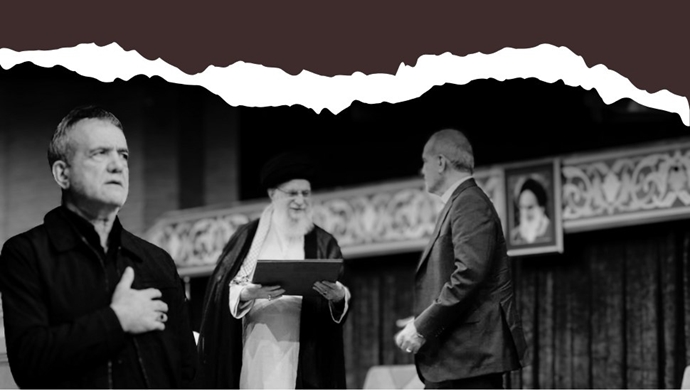

On July 30, Iranian regime president Massoud Pezeshkian, in his inauguration ceremony at the Majlis (parliament), in addition to signing the pledge document, repeatedly emphasized the implementation of regime Supreme Leader Ali Khamenei’s programs in his speech. Like his endorsement ceremony, he began his remarks with praise for Regime founder Ruhollah Khomeini, former IRGC Quds force commander Qassem Soleimani, and former regime president Ebrahim Raisi, and emphasized “pursuing the policies dictated by Khamenei.” He also repeatedly affirmed his commitment to the regime’s constitution and the vision document crafted by Khamenei.
Khamenei, both in the endorsement decree and in his speech at Pezeshkian’s endorsement ceremony, gave him numerous instructions summarized in one word: subservience. And that according to Raisi’s model. Khamenei’s appointees also constantly warned the new president of the regime not to overstep his bounds. They advised him to focus on economic issues and avoid creating trouble by engaging in cultural matters like hijab and internet censorship.
In foreign policy, Pezeshkian also followed Khamenei’s lead and the policy of using Palestine as a spearhead to carry out the regime’s policies in the region, chanting the desired slogans of the Supreme Leader and, in Khamenei’s style, using it as a bulwark to respond to the human rights condemnations against the regime.
These statements garnered the approval of the regime’s parliament speaker, Mohammad Bagher Ghalibaf, who also reminded that the parliament’s support for Pezeshkian’s government was conditional upon adherence to these principles.
Pezeshkian’s bowing and declarations of subservience to the Supreme Leader and all the dictated lines and orders of the regime’s constitution come as some of his supporters remind him of the fate of previous subservient presidents.
On July 29, in an article, the Jahan-e Sanat news website referred to “problems and crises that have reached the brink of explosion… and have put the system’s ship at risk of grounding and sinking.” Then, in a tone of advice and solution-seeking to the president, the article says: “He should undertake a fundamental and life-saving surgery in the way of managing the country’s affairs domestically and internationally and remove the barriers that have been created over the years in the way of the country’s relations with the outside world. He should put an end to the long-standing, very costly, and back-breaking isolation that the country has fallen into, because without this, any promises made to the people about solving economic problems will find the least guarantee of implementation.”
The article then reminds Pezeshkian that “he will have no more than two paths ahead.” One path is “to find a way to overcome the obstacles and roadblocks of the constitution in a not-too-long period by resorting to various methods and experiences he has gained from the countless weaknesses in the way of managing the country during his long years as a parliament representative.” The second path is that if he sees that “he is getting nowhere and is beating a dead horse, he should declare his inability to overcome the structural and constitutional obstacles and, with the permission of the regime’s leadership and other main decision-making authorities, return to the sacred profession of medicine.”
The author of this article apparently has not heard Pezeshkian’s oath of subservience to these very “structural and constitutional obstacles” and does not know that the new regime president has said nine times out of ten that his candidacy in the election show was “to preserve the regime” and, with heartfelt belief and practical commitment to Khamenei, he was approved and became the regime’s president. The new handyman of the state is not at a crossroads; in the quagmire of subservience, there is no path but sinking to the depths of the swamp.