

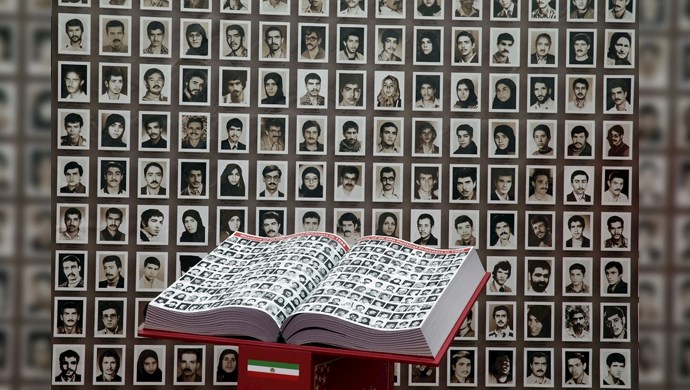

In the summer of 1988, one of the most horrific atrocities in modern history unfolded across Iran. The Iranian regime, under the leadership of then-Supreme Leader Ayatollah Ruhollah Khomeini, orchestrated the massacre of more than 30,000 political prisoners. The majority of the victims were members and supporters of the People’s Mojahedin Organization of Iran (PMOI/MEK), the leading opposition group to the Iranian regime.
The Death Decree: Khomeini’s Fatwa of Annihilation
The catalyst for this bloodbath was a chilling fatwa issued by Khomeini. In a short yet devastating decree, Khomeini declared that all prisoners who remained loyal to the MEK were “waging war on God” and thus should be executed without hesitation. His directive was simple but brutal: “Those who are making the decisions must not show any mercy.”
To carry out this sweeping death sentence, Khomeini created “death committees” across the country, including one in Tehran. These panels of clerics and officials, operating with extraordinary speed, summoned prisoners one by one, asking a single question: “What is your political affiliation?” If the answer was “Mojahed,” the individual was immediately sent to the gallows. If a prisoner denounced the MEK and used the derogatory term “Monafeq” (meaning hypocrite), they might be spared — but only to face further imprisonment.
The death committees’ interrogations often lasted mere minutes, leading to the swift execution of thousands. The majority of these prisoners had already been serving sentences for their political activities, and many had even completed their terms, yet their loyalty to the MEK sealed their fate.
The Role of the Death Committee and Key Perpetrators
The Tehran death committee, which played a pivotal role in these executions, included figures who have since risen to positions of power within the Iranian regime. Among them were Hossein-Ali Nayyeri, a sharia judge, Morteza Eshraqi, the regime’s prosecutor, and Ebrahim Raeesi, deputy prosecutor and former president of Iran. These men, along with Mostafa Pourmohammadi, a representative of the Ministry of Intelligence, carried out Khomeini’s deadly orders with cold efficiency.
In an audio recording released in 2016, Khomeini’s former heir, Hossein-Ali Montazeri, condemned the actions of the death committee in a meeting that took place on August 15, 1988. Montazeri, who was subsequently removed from his position for opposing the massacre, described the mass executions as “the greatest crime committed during the reign of the Islamic Republic” and warned the committee members that history would remember them as criminals.
The Waves of Carnage
The massacre unfolded in several distinct waves. The initial executions took place in Tehran’s Evin and Gohardasht prisons, where the majority of MEK members were held. These early killings were the most visible, and reports of the atrocities began to trickle out, despite the regime’s efforts to maintain absolute secrecy.
Soon, the executions spread to over 100 cities across Iran, with local death committees purging political prisoners nationwide. Former prisoners who had been released prior to the fatwa were re-arrested and executed, along with Marxists and other leftist activists. Even prisoners whose political affiliations were unclear were not spared, as Khomeini issued follow-up orders to ensure no opposition remained.
The massacre also extended beyond prison walls. Individuals who had been arrested for aiding the National Liberation Army, the armed wing of the MEK, were summarily executed in makeshift trials. By early 1989, the killing finally subsided, leaving behind a nation scarred by the loss of thousands of political dissidents.
The Justice-Seeking Movement and the Struggle for Accountability
For decades, the Iranian regime denied the existence of the 1988 massacre, going to great lengths to cover up the mass graves where thousands of bodies were buried. But despite these efforts, the memory of the massacre has not been erased. Survivors, families of the victims, and members of the Iranian Resistance, led by the National Council of Resistance of Iran (NCRI) and its president-elect Maryam Rajavi, have worked tirelessly to bring international attention to this crime against humanity.
In recent years, the Justice-Seeking Movement has gained momentum. A growing body of evidence, including testimonies from survivors and documents smuggled out of Iran, has helped build the case for prosecuting those responsible for the massacre. In 2024, Javaid Rehman, the UN Special Rapporteur on Human Rights in Iran, issued a groundbreaking report calling for an international investigation into the 1988 executions. He called the massacre “atrocity crimes” and “genocide,” underscoring that those responsible for these crimes remain in positions of power in Iran today.
Rehman’s report also highlighted the ongoing suffering of the victims’ families, many of whom still do not know the fate of their loved ones or the location of their remains. The report identified these continued acts of enforced disappearance as crimes against humanity and urged the international community to take action.
A Legacy of Resistance
The massacre of 1988 stands as one of the darkest chapters in the history of the Iranian regime, yet it is also a testament to the unbreakable spirit of those who resisted tyranny. The prisoners who faced Khomeini’s death committees knew that disavowing the MEK could save their lives, but the vast majority chose to remain loyal to their beliefs. Their courage in the face of certain death has inspired generations of Iranians to continue the struggle for freedom and justice.
The fight for accountability is far from over. While the Iranian regime has tried to bury the truth, the resilience of the Justice-Seeking Movement ensures that the victims of the 1988 massacre will not be forgotten. As the international community slowly awakens to the scope of this atrocity, the hope for justice grows stronger with each passing year.
The 1988 massacre of political prisoners in Iran is a crime that still demands justice. More than 30,000 people were executed in cold blood, their only crime being their resistance to a brutal regime. As survivors and activists continue their fight for recognition and accountability, the world must not turn a blind eye to this dark chapter. Holding those responsible accountable is not just a matter of justice for the victims; it is a necessary step toward ensuring that such atrocities are never repeated.