

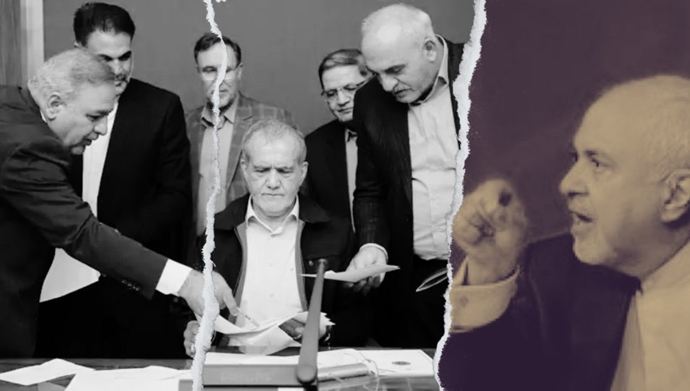

The Iranian regime’s new president Massoud Pezeshkian had explained his running for office as such: “I came because I saw the system in danger…” (Source: Jamaran website – July 19).
However, it seems that with given the regime’s unpopularity and the deepening rifts within the system, the threats facing the crisis-stricken clerical regime have only increased.
The proof of this reality is the infighting and conflict that erupted in the Majlis (parliament) and among the regime’s rival factions immediately after Pezeshkian introduced his cabinet on August 11.
In a letter about the political and social consequences of this cabinet, the so-called reformists front warned Pezeshkian: “Your government should symbolize change and reform in the country’s policymaking and management, not a continuation of the same” and “The failure of your government will bring no benefit to the government in terms of bridging the gaps and divisions between the government and the people.”
The nominal head of this front, Azar Mansouri, in expressing disappointment with Pezeshkian’s cabinet composition said, “The coalition government has no owner, and in the current situation, its formation not only does not solve the governance crisis but will also create a wave of despair in society and among the supporters of the fourteenth government” (Source: Reform Front Telegram – August 10).
Some disillusioned reformists have said, “We have no expectation of even relative change and transformation from this cabinet!” Others have written, “Unfortunately, the mechanisms designed for selecting ministers faced a significant failure, and various factors led to the constant changing of options and strange confusion in the president’s thinking” (Source: Zamaneh Analysis – August 11).
On the other hand, the so-called hardline faction is demanding an even larger share and is threatening to sabotage Pezeshkian’s government.
Referring to the grumbling of parliamentarians during the reading of the cabinet names by the speaker of parliament Mohammad Bagher Ghalibaf, MP Hossein-Ali Haji Deligani said, “I think at least six people will not receive a vote of confidence or will be on the edge. We witnessed the representatives’ emotions towards the proposed ministers’ names being read in parliament.”
Former MP Ahmad Hakimipour also said, “The hardliners in parliament have already rolled up their sleeves to obstruct the government in any way they can.” Another member of the parliament said, “At least four of Pezeshkian’s proposed ministers will not get a vote of confidence.”
Kayhan newspaper, Khamenei’s mouthpiece, also unleashed a barrage of insults towards former foreign minister Mohammad Javad Zarif’s advisory council, describing its members as “corrupt and unworthy individuals” who “belong in courtrooms and on trial benches, not in groups proposing cabinet members.”
In describing Pezeshkian’s associates, Kayhan wrote: “The president was surrounded by circles called cabinet selection working groups and the advisory council for cabinet member selection, some of whom had dark backgrounds, including individuals opposed to the Islamic Revolution, agents of the U.S., U.K., and Israel in the 2009 sedition, supporters of election boycotts, creators of dissatisfaction, and deliberate inefficiency in [former president Hassan] Rouhani’s government!”
Thus, the newly appointed president of the regime, before even taking the first step in introducing his cabinet, has already sparked such a conflict among regime’s crisis-stricken loyalists with a concoction of Ebrahim Raisi’s and Rouhani’s governments.
Regarding the state of the regime, Maryam Rajavi, the President-elect of the National Council of resistance of Iran (NCRI) summarized it well in her statement: “Masoud Pezeshkian, the regime’s new president, found himself positioned midway between Rouhani and Raisi. His cabinet represents a blend of criminal and corrupt elements from both Raisi’s and Rouhani’s administrations. From the outset, he claimed that his involvement stemmed from his concern over a looming threat to the regime—a threat that has intensified with the growing internal strife among the regime’s warring factions.”