

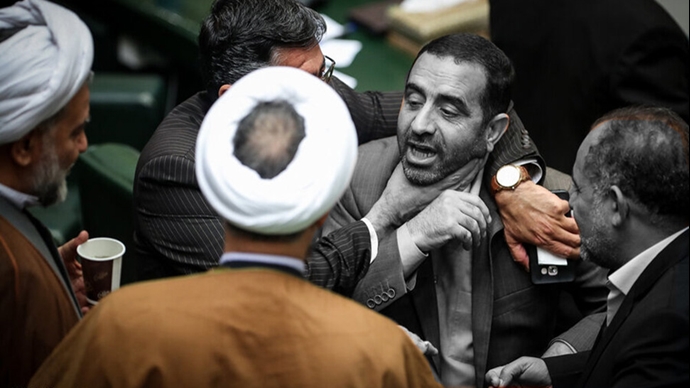

The religious fascism governing Iran, following a series of strategic defeats in the region, now finds itself in a position of extreme vulnerability and fear in the face of economic, social, and political crises at home.
Regarding this, on January 23, Reuters reported that the recent stance of Donald Trump, the U.S. president, on the surrender and retreat of the regime without encountering military attacks on its nuclear facilities has created a new situation.
This issue had been debated among regime factions even before Trump took office. The so-called reformist faction glorified negotiations with the U.S. over the nuclear deal.
On January 21, the state-run Shargh newspaper quoted politician and economist Mohammad Salamati, as saying: “Since Trump is a businessman, he considers profit and loss and knows this is not the time to reap maximum benefits from maximum pressure. Iran is an 80-million-strong market with regional influence.”
On January 24, the state-run Entekhab news website quoted regime analyst Abbas Abdi as saying: “Iran can negotiate but may not reach an outcome, just like Hamas’s talks eight months ago, which initially failed but are now accepted. Without those fruitless talks, there would be no ideas for agreement today.”
Kazem Gharibabadi, deputy for legal and international affairs at the Ministry of Foreign Affairs, also stated: “The Islamic Republic of Iran, as in the past, is ready to initiate and resume talks on lifting sanctions. We have always had this will, and if other parties also show this will, we believe negotiations will take place and yield results.”
Meanwhile, Kayhan newspaper, a known mouthpiece of regime supreme leader Ali Khamenei maintains its stance.
On January 14, Hossein Shariatmadari, the managing editor of Kayhan, had written regarding remarks by the deputy communications officer of Pezeshkian’s office on “honorable negotiations”: “Sending constant and one-sided signals for negotiations with the Trump administration, in its true sense, is passivity and begging, not an initiative for honorable negotiations.”
Kayhan also reiterated Ahmad Khatami, the interim Friday prayer leader of Tehran, as saying: “The world should know that the regime’s stance on the U.S. aligns with the position of the Imam [Khomeini] and the Supreme Leader [Khamenei]. The Imam said America is the Great Satan. The Supreme Leader has reiterated this position many times. Our message to supporters of negotiations is that America wants negotiations to confront the revolution.”
Different factions within the regime are attempting, on one hand, to conceal the regime’s fragility and, on the other, to project the image that the U.S. needs negotiations with Iran and is intimidated by the regime’s military capabilities.
It is evident that the regime has faced numerous challenges in recent years that have significantly influenced its political and strategic decisions.
One of the main factors driving the regime’s need to reduce tensions is the failure of the policy of appeasement, which was previously pursued through the nuclear agreement (JCPOA). The regime reached this agreement during Obama’s presidency, but this policy failed when Trump assumed office in 2017 and withdrew the U.S. from the JCPOA.
Moreover, the fruitless European JCPOA, which was continued by the European Union in a limited manner, failed to alleviate the economic and sanction pressures on the regime.
The implementation of the first round of new U.S. sanctions and the intensification of pressure, particularly in the oil and economic sectors, are additional factors driving the Iranian regime toward negotiation and tension reduction with the U.S.
The sanctions have severely damaged the regime’s economy, causing a significant decline in the value of the national currency.
On the other hand, the international balance of power has shifted significantly against the Iranian regime. Khamenei’s strategic defeats in Syria and Lebanon, the loss of regional depth, and the regime’s growing international isolation have pushed it toward adopting a negotiation posture or sending signals of readiness for talks. This situation has intensified internal crises and widened divisions at the top of the regime.
The Options Ahead
Given the economic, social, and international crises, the regime faces two main options: escalating tensions and engaging in terrorist adventures using Yemen’s Houthis as a shield, or yielding to negotiations and surrendering to the U.S.
Escalation and Terrorist Adventures
One of the options the regime might pursue is escalating tensions with the U.S. and engaging in terrorist activities.
This option might be viewed as a tactic to unify internally and counter the explosive societal situation and intensifying uprisings.
The inability of the regime to withstand sanctions under the current economic conditions is among the reasons that make this option less viable. The regime’s economy is heavily dependent on oil revenues and foreign trade, and the continued pressure of sanctions can easily bring the regime to its knees. Furthermore, the expansion and intensification of popular uprisings, triggered by the regime’s economic mismanagement and internal corruption, show that any escalation of tensions at the international level would not resolve internal issues but might instead exacerbate protests and spark social uprisings.
Negotiations from a Position of Weakness
Another option for the regime is negotiating with the U.S. This option could be perceived as surrendering to external economic and political pressures. Accepting such negotiations could lead to a series of concessions and acceptance of successive “chalices of poison,” as the regime would negotiate not from a position of mutual benefit but from a place of imposed, harsher conditions designed to break it. The first loser in this scenario would be the regime itself.
Even by adopting tactics such as stalling to neutralize the snapback mechanism, the regime cannot sustain this approach. Such maneuvers are already futile.
This situation not only makes the regime more vulnerable to uprisings but also exacerbates internal divisions within the ruling establishment. Khamenei, who has consistently opposed negotiations with the West, could face serious internal crises and even significant rifts within the regime if this option is pursued.
Most importantly, such a policy might lead to further erosion of Khamenei’s position and that of other regime leaders. Factions within the establishment that have always opposed negotiations with the West would strongly protest this course of action.
Regime Overthrow: The Choice of the Iranian People and Organized Resistance
The regime, relying on the hegemony of the Supreme Leader, faces deadlock no matter which way it turns. Neither option can save the regime from the crises engulfing it. In both scenarios, whether escalating tensions or negotiating—the regime’s fate is its overthrow.
It is the Iranian people and their organized resistance who can overthrow the religious fascism and bring freedom, democracy, and lasting peace to Iran.