

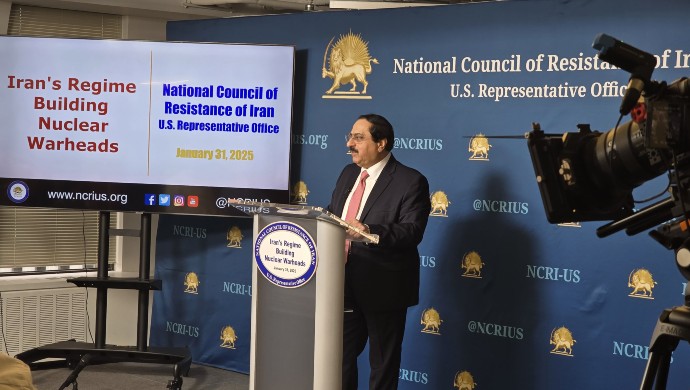

On Friday, January 31, 2025, the U.S. office of the National Council of Resistance of Iran (NCRI) held a press conference revealing the Iranian regime’s covert activities in its nuclear bomb-making program.
At the conference, attended by journalists from U.S. media outlets and international news agencies, Soona Samsami, the NCRI representative, stated: “Now we have documented evidence showing that the missile sites in Shahrud and Semnan are fully coordinated with the regime’s nuclear weaponization body SPND.”
SPND, which is the Persian acronym for “the Organization for Advanced Defense Research,” is the entity created to consolidate the nuclear bomb activities of Iran’s regime.
NCRI-US Reveals Intelligence on Tehran’s Nuclear Warhead Development | Jan 31, 2025, 11 am EST #Iran #NuclearThreathttps://t.co/0zkgQBqaDl
— People's Mojahedin Organization of Iran (PMOI/MEK) (@Mojahedineng) January 31, 2025
According to a classified internal memo, the regime is attempting to buy time for completing its weapons program by negotiating with European countries to maintain the status quo. The memo also reveals the regime’s concern over the possible activation of the “snapback mechanism” and its intention to preserve the current situation for the next six months.
During the conference, Alireza Jafarzadeh, the deputy director of the NCRI U.S. office, exposed a covert plan by the Iranian regime to develop nuclear warheads for solid-fuel missiles with a range of over 3,000 kilometers at the Shahrud and Semnan missile sites.
According to reports from the Defense and Strategic Research Commission of the NCRI and the People’s Mojahedin Organization of Iran (PMOI/MEK) from inside the country, these two sites, which are officially presented as missile launch centers and space satellite facilities, are in close collaboration with SPND.
SPND was first exposed by the Iranian Resistance in 2011. SPND has been focused on developing nuclear warheads for the Qaem-100 missile, which is equipped with a mobile launch platform, and in recent months, it has accelerated its work on nuclear warhead development at the Shahrud and Semnan sites. Information disclosed during the NCRI conference shows that both sites are heavily militarized with very limited access and have expanded their facilities in recent years.
https://twitter.com/NCRIUS/status/1885902380966809984
The Geophysics Group of SPND, which conducts research on underground nuclear testing and explosion power, has been secretly continuing its activities at the Semnan site.
At the Washington, D.C., conference, the NCRI representative in the U.S. reviewed the Iranian regime’s history of nuclear deception and manipulation, stating that since August 2002—when the Iranian Resistance exposed the regime’s secret nuclear sites in Natanz and Arak—the world has witnessed a consistent pattern of deceit in the regime’s negotiations with the West. For over two decades, Tehran has used negotiations and Western leniency solely as tools to advance its nuclear program. As an example, after the 2015 nuclear deal (JCPOA) was signed, Ali Akbar Salehi, the former head of the Atomic Energy Organization of Iran (AEOI), detailed how the regime, with Supreme Leader Ali Khamenei’s knowledge, misled the International Atomic Energy Agency (IAEA) regarding the Arak heavy water facility.
Samsami warned that the Iranian regime’s pattern of deception remains an ongoing threat. “The regime in Iran has never been so weak, so desperate as it’s today. For this reason, it needs a nuclear bomb more than ever before to alter the balance of power in the region. And this regime, widely rejected by its own people and weakened by the fall of the Assad dictatorship, has intensified domestic repression inside Iran extensively on execution, and on the other side, accelerated its nuclear weapons development.”
The NCRI representative in the U.S. highlighted the regime’s human rights violations and brutal repression inside Iran, pointing out that over 1,000 executions took place in 2024. She stated: “As long as this regime is in power, it will never abandon its nuclear program, even if it makes some technical concessions.”
What should the international community do? The NCRI suggested three key measures. First, the snapback mechanism must be activated to reinstate the six UN Security Council resolutions against Iran’s regime.
“Lifting sanctions has only emboldened the Iranian regime and provided resources to accelerate its nuclear weapons program,” Samsami said.
Second, all nuclear related sites of the Iranian regime, including all uranium enrichment capabilities, must be shut down.
“The IAEA must be granted unrestricted access to all of Iran’s nuclear facilities, both declared and undeclared. Anything less would render inspections meaningless,” Samsami said.
Third, the regime must face severe consequences for any further violations.
“Diplomatic overtures without accountability have only encouraged the regime’s deceptions more and more,” Samsami concluded.