

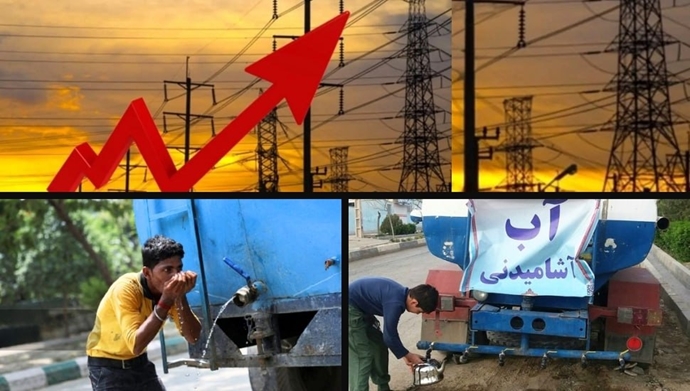

Iran is not in a good state. For several decades, the country has been plagued by the disaster and misery brought about by religious fascism that hijacked the 1979 revolution. The mullahs’ regime adheres to no principles or rules. During the pandemic, the mullahs even refused to allow the import of vaccines, resulting in the deaths of thousands. Tragically, the country’s resources were spent on exporting fundamentalism and terrorism, while hospitals, overwhelmed by COVID-19 and power outages, became death traps for many citizens. Three years ago, around this time, power cuts in hospital ICUs led to a disaster that cost thousands of lives.
On July 5, 2021, Hamshahri news website wrote: “Power outages in hospitals are catastrophic. An ICU specialist stated: During the interval between the power cut and the connection of the ventilator to emergency power, the lives of COVID-19 patients are in danger, and they may even die. In the ICU, the power has gone out, and patients are dying one by one without any available devices. By the time medical staff can restore oxygen, COVID-19 patients sometimes die.”
Even recalling these bitter memories is heartbreaking, but from that time until today, the shortage and outage of electricity continue to torment the lives and minds of the oppressed people of Iran. And there is no hope for change under the rule of the mullahs.
Electricity shortages in temperatures above 45 degrees
After the end of the sham presidential election, voices of protest and criticism re-emerged over the deterioration and destruction of the country are heard from all sides. However, power outages in the summer heat have become unbearable for many.
On July 8, ISNA news agency reported, “The head of the Parliamentary Construction Commission said: Today, the electricity shortage has reached the point where household power is cut off in temperatures above 45 degrees Celsius. While the Minister of Energy of the thirteenth government claimed the possibility of exporting electricity and earning foreign exchange from this, today the electricity imbalance in the country has reached a level where, due to reduced electricity production, not only is industrial power cut off, but household power in the southern provinces is also being cut off.”
Household power cuts are happening while the electricity shortage has also caused problems for industries, and agriculture has not been spared from this disaster. The electricity imbalance, along with other imbalances such as water and the energy needed for the continuation of production and consumption of vital products, has made the future resemble a dark past.
Eight Billion dollars losses for steel industry due to power outages
If we consider the damage caused by power cuts in just one industry and repeatedly hear about the shortage of foreign currency, we can guess the extent of the disaster brought by the clerical regime upon Iran.
The Deputy Secretary General of the Chamber of Commerce said: “The cost of disruption in the stable supply of electricity for the country is practically incalculable. For example, the loss and damage to the steel industry due to blackouts in the first four months of last year are estimated at over $8.3 billion, which is an irreparable loss for the country’s economy” (Source: The state-run Ham-Mihan newspaper, April 29, 2024).
On the other hand, electricity producers are also trapped in government debt.
On May 4, Econegar news website wrote, “A board member of the Syndicate of Electricity Producers reported the Ministry of Energy’s debt of 900 trillion rials to private power plants by the end of 2023.”
This is the situation of producers who supply 60 percent of the country’s electricity. This comes at a time when the CEO of Tavanir, the organization for Management of Electric Power Generation and Transmission in Iran, has promised to reduce the electricity deficit from 14,000 megawatts to about 10,000 to 11,000 megawatts.
The lifeline of vital resources is being severed
Power cuts in summer, gas cuts in winter, lack of drinking water in the villages of southern Iran, especially Baluchestan, air pollution throughout the year… What other calamity is left to befall the people of Iran under the rule of mullahs? Recently, electricity shortages have shut down 15 provinces in the country.
Regime energy expert Hashem Orouei said: “If urgent action is not taken, in five years, we will face a crisis in all energy carriers. Last year, we had a deficit of 12,000 megawatts, which has increased to 18,000 megawatts this year. At this rate, next year we will have a deficit of 24,000 megawatts. To put this in perspective, supplying 18,000 megawatts of electricity requires more than 25 power plants equivalent to Bushehr, which this regime neither has the capacity nor the money to build, nor the equivalent power plants.
The mullahs’ regime constantly repeats that people should conserve electricity. However, household electricity consumption accounts for about 31 percent, which is a normal and natural figure. Household electricity consumption in Turkey is 35 percent higher than in Iran. The main reason for this crisis is the lack of electricity production.
On July 15, German’s Deutsche Welle reported: “The most important cause of Iran’s electricity deficit is the government’s disregard for the program to increase electricity production by 7 percent annually since the beginning of the last decade. None of the governments since 2011 have adhered to this program, and only half of the production growth targets have been achieved. Another point is that according to the Ministry of Energy’s own estimates, 13 percent of the country’s electricity is lost in the transmission and distribution stage; an amount equivalent to 40 percent of the total household electricity consumption.”
The clerical regime of Iran is a world leader in nurturing incompetent and inept managers. The super crises of economic and political issues, and even more disastrous social calamities, leave no room for further compromise and missed opportunities. Various governments come and go, each worse than the last, and the people of Iran remain trapped in poverty and misery. The solution is only to overthrow this regime and replace it with a democratic republic that actually cares for the people’s well-being and future.