

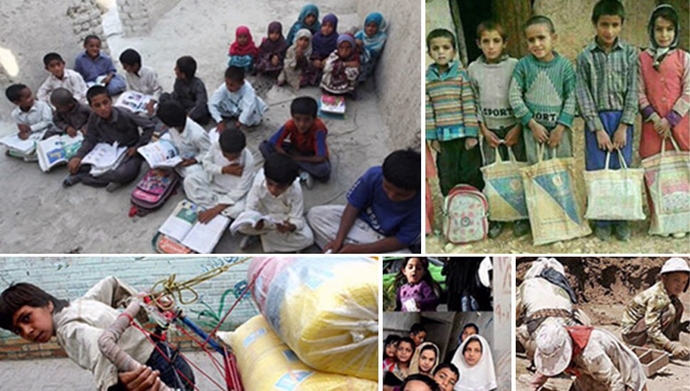

Poverty has gripped Iranian parents so tightly that they can no longer provide school supplies and other necessities for their children. The cost of just purchasing a school uniform, shoes, and a basic bag is so high that many parents refrain from sending their children to school, leading to a new wave of child labor.
For years, the end of summer has signaled the start of concerns and worries for parents about buying school supplies and accessories, but the issue goes beyond that. Elementary education was supposed to be free, but that promise now seems like a bitter joke. No one is surprised anymore by the illegal and mandatory fees being imposed on parents in Iran.
In the 2021-2022 school year, over 2 million students were deprived of education and couldn’t even attend first grade. In the 2023-2024 school year, more than 1.2 million students dropped out, and now, according to the state-run Tasnim news agency, 790,000 students have not been registered for the new academic year.
Sixteen million students and over 1.1 million teachers and staff in the country’s 96,000 schools can feel the incompetence, plunder, and the deceptive tricks of mullahs’ regime. The issue is no longer just about the declining quality of educational programs but a larger problem: there’s no money to provide water, electricity, repair classrooms, or maintain heating and cooling systems. These issues add an additional burden on parents every year.
Aside from the dilapidated and underfunded public schools, “private schools” for the wealthy have been established for years, with exorbitant tuition fees. “Shahed schools” are reserved for families loyal to the regime, and their budget comes from public funds, designed to train the regime’s next obedient agents. Additionally, “home schools” have become a trend. Extremely wealthy families hire experienced teachers to school their children at home, and at the end of the year, their children take official exams as external candidates.
In contrast, in Sistan and Baluchestan province, children attend tent schools, in rural areas of Kerman and southern parts of the country, students study in dilapidated trailers, and in impoverished provinces, classrooms are set up in tattered tents and worn-out mats on barren land. This stark contrast illustrates the inequalities under the rule of the mullahs.
The disaster of final exam grades and educational quality
Beyond the blatant and shameful inequality of the class-based school system, the quality of education is evident from the lies, distortions of social and historical events, superstition, religious rituals, and altered documents that students are forced to study and accept.
On the other hand, the results of the national university entrance exams and statistics on students’ academic performance show that Iran’s educational system is in a very poor state. “In provinces like Khuzestan, West Azerbaijan, and Sistan and Baluchistan, the average score for 12th-grade students is about 10 [out of 20]; this reflects the low quality of education in the country and is a serious alarm for the education system. As mentioned, this is an average, meaning many students had scores below 10. In provinces like Sistan and Baluchistan, Kerman, Hormozgan, Fars, Bushehr, Kohgiluyeh and Boyer-Ahmad, Chaharmahal and Bakhtiari, Lorestan, Ilam, Kermanshah, Kurdistan, West Azerbaijan, Gilan, Golestan, North Khorasan, and Khuzestan, the average score for final exams across all theoretical disciplines is below 10” (Farhikhtegan, July 26, 2024).
Last year, the Minister of Education highlighted some of the disparities in the education system: “We are short 200,000 teachers. Four weeks of classes were held without a teacher. There are 17,600 classrooms with more than 40 students. About 15,000 schools are facing shortages…” (Shargh, November 2, 2023).
Child laborers; students who were poor
Every year, tens of thousands of children across Iran are deprived of education due to poverty or to help cover their families’ living expenses. As if the soaring costs of living and rent weren’t enough, now the expenses for education are added to the burden.
“A 50-sheet spiral notebook costs 193,000 rials – a 40-sheet drawing book costs 109,000 rials – a pencil with eraser costs 90,300 rials – an eraser costs 62,900 rials – a pencil sharpener costs 49,000 rials – a Kian pen costs 42,900 rials – a red pencil costs 85,800 rials – a black pencil costs 23,800 rials – a small simple sharpener costs 21,500 rials…” (Badr Iran).
According to official statistics, at least 30% of Iran’s population lives in absolute poverty. Even if education is free, the additional costs lead many families to forgo their children’s schooling. Today’s child laborers are the same students who dropped out of school in the past, and this cycle will continue as long as the mullahs’ regime remains in power.