

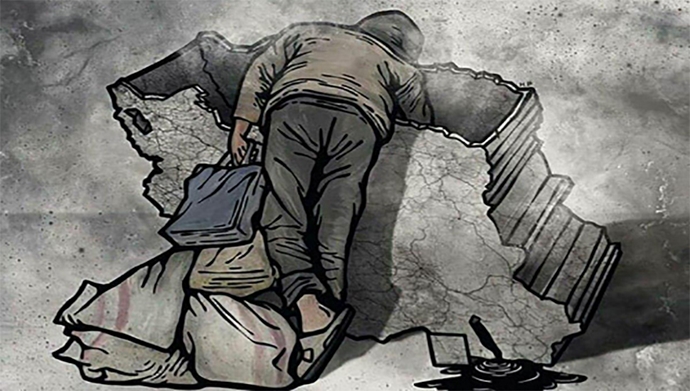

Today, as Iran’s research centers and statistics institutions report that one-third of Iranians live below the poverty line, it appears that a technique of normalizing destitution and hardship is underway.
Research centers have presented shocking statistics on poverty. On October 25, the state-run Donya-ye Eghtesad newspaper wrote, “The poverty rate in 2023 reached 30.1 percent of Iran’s population. This figure is 0.4 percent higher than the previous year. The poverty rate was around 20 percent at the beginning of the 2010s; however, since 2019, with rising inflation and economic stagnation, the poverty rate has surged to 31 percent. Over the last five years, there has been no miracle to reduce poverty, and one-third of the Iranian population continues to live in poverty.”
This means that a third of Iranians cannot meet their basic needs. Over the past five years, the poverty rate has remained stable at 30 percent. Although government statistics show a 4.5 percent economic growth in 2023, this growth has not affected poverty reduction and has been driven solely by the sale of oil and the country’s underground resources. State subsidies have also failed to have any significant impact in preventing poverty from worsening; it’s said that perhaps these subsidies have only prevented starvation-related deaths.
Examining the root cause of corruption in Iran
Low, unstable economic growth dependent on oil and other raw exports has been influenced by the oil market, the regime’s international isolation, and the effects of its futile warmongering. Thus, any industrial production with minimum standards and a sales market has become impossible, and consequently, no income is generated for distribution.
On October 25, Jahan-e Sanat news website wrote, “The severe drop in Iran’s per capita income during the 1990s was due to declining global oil prices and foreign exchange revenue, combined with rising foreign debt, which led to a reduction in imports and domestic production. Since 2010, as international sanctions intensified, the country’s per capita income has resumed a downward trend. These events indicate the Iranian economy’s extreme dependency on oil revenues.”
The budget bill is not for poverty reduction
Speaking about regime president Massoud Pezeshkian’s budget approach to reducing poverty, economist Vahid Shaqaqi said, “As long as the country does not have sustained and high economic growth, and the economic pie does not expand, and if the tax system is not fair and unable to distribute wealth, a tangible reduction in poverty will not be seen. These issues are not addressed in the budget bill, and the current bill contains no significant action to reduce poverty” (Source: Jamaran website, October 24).
Economy on the verge of collapse
On October 25, in a report titled “Iran’s Economy Is on the Verge of Collapse,” Tejarat News website wrote, “This is a phrase we hear these days from many economists and economic activists. But the question is why Iran’s economy, in the fourth decade of the revolution, despite seven development programs and numerous slogans about uplifting the poor, has reached this state. We have not managed to empower the downtrodden of society, but with our actions, we are impoverishing the middle class.”
Economist Kamal Athari also comments in this report, “Iran’s economy is suffering from a structural crisis. For example, non-productive sectors like housing have completely overwhelmed other sectors, and what we have is called crony capitalism or neo-feudalism, based on rent-seeking. This crisis has been present since the start of the revolution because we lacked a development model… This society will either collapse or lead to a revolution.”
A study from the Parliament’s Research Center shows that economic growth in 2024 and 2025 will be 2.5 and 2.8 percent, respectively, which falls far short of the eight percent target set in the Seventh Plan. Consequently, poverty will further engulf the people of Iran.
On September 10, the state-run Donya-ye Eghtesad newspaper wrote, “Since 1979, the poverty rate has steadily increased, reaching 20 percent in 2011 and then 30 percent. Over the past decade, the number of poor people in Iran has increased by 10 million, and now 26 million Iranians live below the poverty line. The steady poverty rate in recent years indicates that change is not easily achievable, and the possibility of people escaping poverty is diminishing. Ultimately, it can be said that poverty has deepened in Iran over the past few years.”