

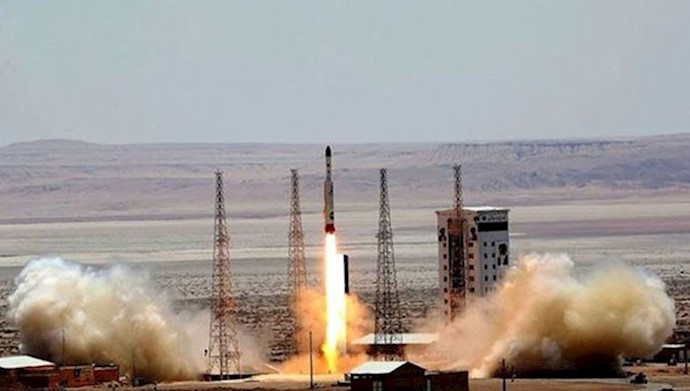

While presenting the 2025 budget bill to the Majlis (parliament), Iranian regime president Massoud Pezeshkian stated, “The budget figures have been structured to prioritize strengthening the country’s defensive capabilities.”
The term “priority” was further explained by Ata’ollah Mohajerani, Pezeshkian’s government spokesperson, who said, “All efforts have been directed toward fulfilling the country’s defense requirements; hence, we have observed an over 200% increase in the military budget” (Regime TV, October 30).
The 200% increase in the military-security budget gains greater significance when contrasted with the 20% salary increase for workers and government employees, particularly when the official inflation rate is about 40%.
However, this is not the complete story. On October 27, the state-run newspaper Etemad quoted an economic expert who noted, “The budget includes the planned delivery of crude oil valued at 510 trillion tomans to the armed forces and 126 trillion tomans to other authorized executive bodies.”
In other words, the armed forces—which is mainly the Revolutionary Guards (IRGC)—not only secured a 200% increase in their official budget but also received substantial amounts of crude oil, allowing them to sell it independently and retain the profits. Additionally, crude oil worth 126 trillion tomans is allocated to “other executive bodies” (e.g., the police force and the Ministry of Intelligence).
The allocation of crude oil to the armed forces is a distinctive policy of the Iranian regime, and reportedly, Pezeshkian’s administration tripled the quota in comparison to the levels during Ebrahim Raisi’s presidency. No other nation, including military-led ones, grants such resources to the armed forces for independent sale, bypassing the Ministry of Oil. This policy has even drawn criticism from within the regime. Gholamreza Tajgardoun, head of the Parliamentary Budget Integration Commission, said, “Why are we treating the armed forces as sellers of gasoline, buyers of gasoline, and sellers of oil?” (Parliament – October 29).
The reason is clear: to provide the IRGC, the primary enforcer and protector of the Iranian regime, with sufficient motivation to carry out its designated missions—suppressing domestic dissent and facilitating the export of war and terrorism abroad.
The IRGC’s acquisition and sale of significant crude oil volumes constitute only part of the official usage of these resources. On October 14, the government-affiliated Arman Melli newspaper quoted a regime analyst who said, “We consume 120 million liters of gasoline daily; only 70 million liters of this is legitimate consumption, and the rest is smuggled… The estimated daily smuggling amounts to 50 million liters, implying that almost half of the country’s gasoline is smuggled out. This figure far exceeds estimates from the Ministry of Oil and security and monitoring agencies… This volume of fuel corresponds to several hundred or even thousands of truckloads. It is certainly not conducted by porters or minor fuel smugglers but rather represents an organized, state-operated scheme.”
Furthermore, approximately 70% of the country’s economy is under the control of the IRGC, operating on behalf of regime supreme leader Ali Khamenei. It manages many profitable holdings and companies, including those in the petrochemical, steel, and mining sectors, allowing it to generate billions of dollars without paying taxes or being accountable to anyone.
Consequently, the IRGC functions as a state within a state, which, as former regime president Hassan Rouhani noted, controls money, weapons, and media. This quasi-government extracts vast amounts from Iranian public resources through official budgets and unofficial means, such as oil and currency smuggling, to finance the suppression and killing of the Iranian people.