


More than a year into his presidency, Masoud Pezeshkian has openly admitted to the regime’s role in engineering the economic collapse that has engulfed Iran. On November 14, 2025, Pezeshkian acknowledged the “intentional cycle of poverty production,” stating, “A budget deficit means printing money, and printing money means inflation. Until we fix this, nothing will be fixed.”
This admission follows a similarly shocking statement made just days earlier on November 5, where he remarked with startling brazenness: “When the government has a deficit, it is forced to print money. When they print money, high prices emerge, and the pressure of inflation falls on the necks of the deprived and the poor.”
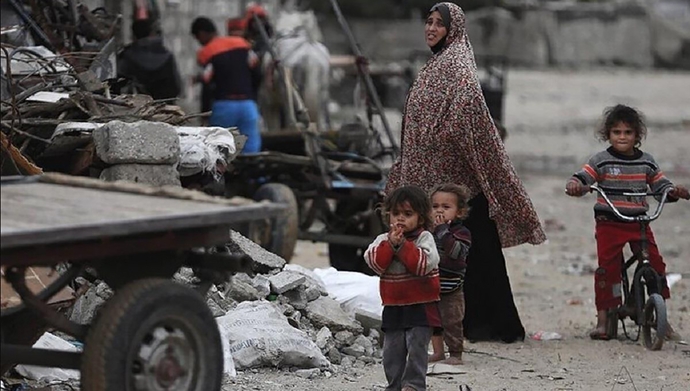
These comments confirm what the Iranian Resistance has long argued: the poverty crushing the Iranian people is not an external accident, but a result of predatory state policies. This “intentional” strategy has institutionalized unprecedented poverty, dragging millions of Iranians into a vortex of hunger and pushing more of the population below the poverty line every day.
The mathematics of misery
The scale of the catastrophe is reflected in the regime’s own statistics. On November 15, state-affiliated media reported that the poverty line in Iran had crossed 550 million rials. Furthermore, for a family of four, a monthly income of 600 million rials is now officially recognized as the poverty line.
With inflation hovering above 45 percent, the “livelihood basket”—the minimum cost for survival—is shrinking daily. On November 13, Ali Ghanbari, a former deputy minister of the regime, admitted the terrifying reality: “Except for 10 million people, all the people are struggling to get through today and tomorrow.” Fatemeh Azizkhani, a regime-linked labor expert, warned on November 14 that the situation is so fragile that “even individuals near the poverty line may fall below it with a single shock, such as an illness or financial problem.”
From “severe” to “no shroud” poverty
The destruction of the middle class has become a subject of dark satire even within state-controlled media. On November 11, Reza Rafi, a regime television host, categorized the new strata of destitution in Iran, illustrating that earning even 500 million rials a month now constitutes “severe poverty.”
His classification for lower incomes reveals the depth of the humanitarian crisis:
- 300 million rials: “Mind-boggling poverty.”
- 250 million rials: “Two steps away from misery.”
- 200 million rials: “Museum-level poverty.”
- 150 million rials: “Fossil-level poverty” (found among fossils).
- 100 million rials: “No shroud poverty” (meaning the individual cannot even afford a burial shroud).
A “crime against the people”
Economist Hossein Raghafar, speaking on November 15, described this deliberate cycle as a “crime against the people.” He noted that decisions to artificially inflate currency rates cast large groups of the middle class into poverty. “Continuing such programs, these privatizations, and increasing the price of currency is truly a crime,” he said.
He further exposed the corruption driving these policies: “These criminal policies have winners, and those winners are the ones who control the media and encourage these policies. They buy Members of Parliament, they buy court judges, they buy the policymakers.”
The powder keg ready to explode
While the kleptocratic regime continues to loot the nation, it is simultaneously fueling the anger of a population that has nothing left to lose. As Mrs. Maryam Rajavi emphasized in her speech to the Free Iran Convention in Washington, D.C., on November 15, 2025, this unprecedented poverty is filling society with rage toward the regime.
” In Iranian society today, the vast majority of women and young people are either unemployed or earn far too little to sustain a dignified life, and they form the engine of any future uprising,” Mrs. Rajavi stated. She noted that residents of shantytowns and poverty-stricken suburbs—comprising one-fourth to one-third of the country’s population—have formed a “powder keg poised to erupt.”
The people of Iran, whose lives have been crushed by severe inflation, water scarcity, and power outages, are impatiently waiting to overthrow the clerical regime.