

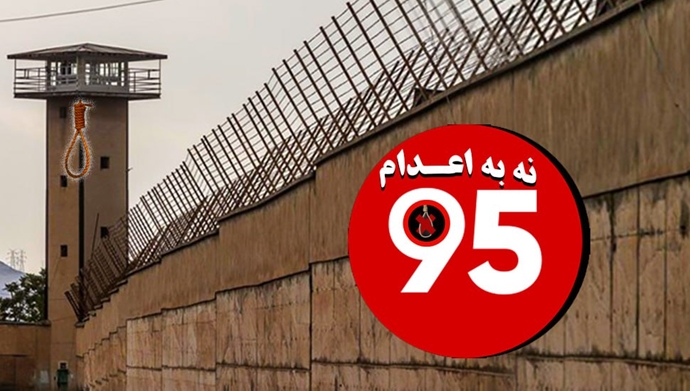

The nationwide “No to Executions Tuesdays” campaign marked its 95th consecutive week on November 18, 2025, with coordinated hunger strikes inside 54 prisons across Iran, coupled with widespread public protests in dozens of cities. This powerful display of unified resistance comes as the clerical regime intensifies its use of capital punishment, executing over 250 people since October 23 (beginning of the Persian month of Aban) in a desperate bid to quell dissent.
The campaign’s 95th week statement highlighted the regime’s unabated cruelty, citing the recent re-confirmation of death sentences for three political prisoners in Ahvaz’s Sheiban Prison—Alireza Mardasi, Farshad Etemadifar, and Masoud Jamei. The prisoners also condemned a medieval-style public hanging that took place in the past week, underscoring the judiciary’s normalization of brutality.
A voice of defiance from behind bars
In their weekly statement, prisoners participating in the campaign linked their struggle to the legacy of the November 2019 uprising, in which the regime killed over 1,500 protesters. They vowed to continue the fight for those who sacrificed their lives for freedom. “As long as there is oppression and injustice, Aban continues,” the statement declared, using the Persian month name for November to signify an unbroken chain of resistance since the November 2019 protests.
95th Week of #NoToExecutionTuesdays | Nov 18, 2025
In 54 prisons across Iran, prisoners and families resist the regime’s killing machine.
Over 250 executions since Oct 23, including a public hanging this week.
Death sentences of three political prisoners in Sheiban Ahvaz… pic.twitter.com/uvdmFUoHXk— SIMAY AZADI TV (@en_simayazadi) November 18, 2025
The prisoners issued a direct appeal to the Iranian people, emphasizing their crucial role in stopping the regime’s killing machine. “We, the people, are the only supporters and shields for the prisoners against the gallows,” they wrote, urging all freedom-loving Iranians to break the silence. Their message underscored a clear and unwavering goal: “We insist on continuing their path until the gallows are completely dismantled and freedom and equality are achieved.”
Streets erupt in solidarity
The prisoners’ call was answered on the streets. Despite heavy security presence and threats of reprisal, citizens in dozens of cities—including Tehran, Mashhad, Isfahan, Shiraz, Tabriz, and Rasht—held protest rallies in solidarity.
Demonstrators brandished placards with powerful slogans such as “Death to the dictator,” “Political prisoner must be freed,” and “The next execution is the next uprising.”
The families of death-row political prisoners, especially justice-seeking mothers, have become a central and courageous force in these public demonstrations. At a recent gathering, the mother of Shahrokh Daneshvarkar, a political prisoner sentenced to death, held a photo of her son and cried out, “No to executions, do not execute our children!” These families have transformed their personal anguish into a collective call for justice, giving the campaign a powerful human face.
November 18—Iran
Families of political prisoners on death row joined the 95th week of the “No to Executions Tuesdays” by holding rallies, demanding an end to executions and freedom for their children.#IranProtests pic.twitter.com/WWS4fERxSj— People's Mojahedin Organization of Iran (PMOI/MEK) (@Mojahedineng) November 18, 2025
A failing strategy of fear
The dramatic rise in executions is a calculated strategy by a terrified regime to create a climate of fear and prevent another nationwide uprising. However, the sustained and organized nature of the “No to Executions Tuesdays” campaign shows this strategy is failing. The movement has evolved from a sporadic protest into a targeted, weekly program of resistance that unites Iranians inside and outside prison walls. The regime’s machine of repression is being met not with silence, but with organized defiance.