


Analysis by PMOI/MEK
Iran, March 1, 2020—Since 1979, some institutions in Iran were formed under command of regime supreme leader Ruhollah Khomeini and became known as parallel institutions in the structure of the mullahs’ regime. These institutions receive their budget from the government, but they report to the supreme leader’s office alone. An obvious characteristic of these institutions is tax immunity, which is the main subject of conflict between various governments and the supreme leader’s office, occupied by Ali Khamenei since 1989.
These institutions are divided in three main categories:
- Economical institutions such as the Mostazafan Foundation of Islamic Revolution and Astan Quds Razavi Charity Foundation
- Political and legal institutions such as Expediency Discernment Council and the Guardian Council
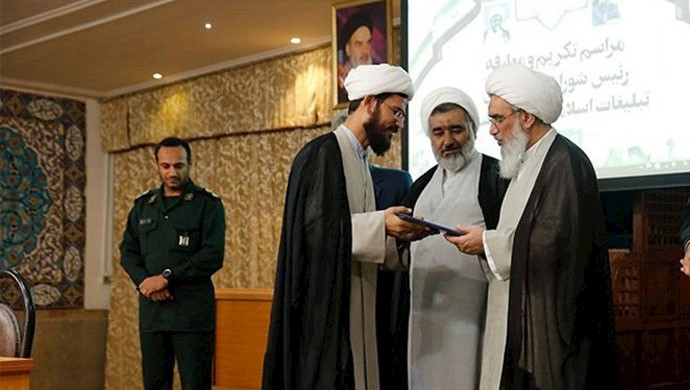
- Cultural institutions such as Islamic Publicity Coordination Council or the Al-Mustafa International University (MIU)
The responsibilities of religious and cultural foundations
The diversity of these cultural and religious foundations is enormous and each of them has a specific scope and responsibility. But in reality each of these institutions represents a faction in the mullahs’ regime. In fact, these parallel institutions have only one aim, which is to legitimize the religious tyranny of the supreme leader’s regime inside the country and promote and spread its ideology abroad.
For instance, the Council of Supervision on State Media is tasked with monitoring everything that is broadcasted by the media outlets and to censor and punish any content that is against the regime.
Another example is the Al-Mustafa International University, which is in charge of foreign seminaries where the fundamentalist ideology of the mullahs are taught.
The Islamic Publicity Coordination Council is an institution that was founded in the summer of 1980 based on regime’s political necessities at the time. Because of their decision-making power in overseeing the work of government and ministries, universities, factories, science institutions, schools and all countries organs, these kinds of institutions have become a source of corruption. Under the cover of creating an Islamic structure in the society, they promote all kinds of overt and covert corruption.
The dilemma of parallelism
Because of the limitations these institutions impose on the government’s authority and decision-making power, the executive branch has been in conflict with them. The reason is that, the existence of parallel power beside a government will slow down the moving economic wheels and will create political tensions. In the corrupt regime of the mullahs, these institutions create conflicts among factions that are competing for power and wealth.
In September 2018, the government of Hassan Rouhani rejected the motion of the parliament to fight economic corruption. Hossein Ali Amiri, Rouhani’s parliamentary deputy, said in this regard: “Creating a new organization to fight corruption in a form of a motion will prepare a parallel structure and work with systems who their nature is to fight corruption and this is why the government rejected this motion to create such a organization.” (Iran Daily September 9, 2018)
For example, the main goal of the parallel institutions such as the Expediency Discernment Council and the Guardian Council is nothing but to control the parliament to adopt motions and laws that are in conflict with the goals and objectives of the supreme leader Ali Khamenei. The members of these institutions are appointed directly under supervision of Khamenei. Recently, we witnessed tensions and conflicts between the government, parliament and these non-governmental institutions on the international contracts of Palermo and CFT. Finally these institutions blocked the adoption of the bills and the Iranian regime was again put into the FATF blacklist. Ironically, it is the government that must pay the budget of these institutions.
The budget and the share of parallel institutions
The proposed 2020 budget of the Rouhani government, based on its facts and figures, was so unrealistic and fictional that the majority of the parliament, which by the way belongs to Rouhani’s faction, did not vote for it. In this budget bill the share of many of the parallel institutions was increased which shows Khamenei’s need for these institutions to extend the life of his regime.
For example, the Al-Mustafa International University (MIU), whose responsibility is to train foreign religious students and promote and spread of religious propaganda abroad had a 53-percent increase in its budget, totaling to 308 billion tomans.
The proposed budget for the parallel institutions and religious and propaganda centers in 2020 is increased about 18.9 percent, which the government tries to supply by tripling the gasoline price.
A source of suffering from the people of Iran and the Middle East
In the past 41 years, Khomeini and later Khamenei used these public and religious institutions and even military bodies such as the Basij paramilitary force and the Revolutionary Guards (IRGC) to suppress all political and cultural protests and movements in universities, factories etc. The main responsibility of these institutions in various organizations is to spy on dissidents and protesters and prevent any kind of anti-regime movement.
Regardless of the names these institutions have, their main goal is to consolidate Khamenei’s position as the regime’s main pillar. For that, they are ready to commit any kind of crime in Iran and in the region and for many years the people of Iran and the Middle East have suffered from the workings of these institution to grow and promote the regime’s fundamentalist ideology.