

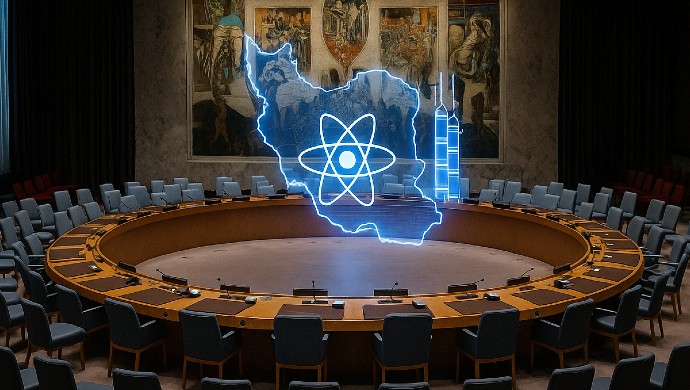

On September 19, the United Nations Security Council voted against a draft resolution that would give the Iranian regime an extended grace period to return to its commitments under the 2015 nuclear deal, confirming the snapback of six punishing international sanctions resolutions. The resolution to permanently lift the sanctions failed decisively, with nine members voting against, four in favor, and two abstaining. This overwhelming rejection, which did not even require a veto from one of the permanent members of the UNSC, was the predictable conclusion of the regime’s intransigence and continued violation of its nuclear commitments—a dangerous path the Iranian Resistance has warned about for years.
The outcome exposes a regime that is diplomatically bankrupt, strategically cornered, and increasingly paranoid about internal dissent. As Mrs. Maryam Rajavi, the President-elect of the National Council of Resistance of Iran (NCRI), stated, this step is “belated but extremely urgent and necessary.” This is a strategic blow that pushes the regime, already grappling with domestic unrest, closer to its breaking point. Starting on September 28, the mullahs’ regime will once again be subject to the full force of international sanctions, including severe restrictions on their missile program, arms trade, and nuclear commerce.
The collapse of a failed strategy: Deception and division
For three months, Tehran desperately tried to create a rift between European powers and the United States to avoid accountability, but this strategy of blackmail and deception failed spectacularly. French President Emmanuel Macron confirmed the futility of the regime’s approach a day before the vote, stating that the “latest news from the Iranians is not serious,” proving that the E3 (France, Germany, and the UK) would not be fooled by empty gestures.
In a telling sign of desperation, Foreign Minister Abbas Araghchi lashed out on X, blaming the E3 for rejecting what he called a “reasonable and actionable plan” and claiming it was met with “a host of excuses.” This was a clear attempt to shift blame after his diplomatic maneuvering was exposed as hollow. The failure was underscored by a letter from 50 U.S. Senators who urged the E3 not to be swayed by the regime’s “hollow gestures and cynical threats” and stressed that the regime “must fully and verifiably dismantle its nuclear program, restore full IAEA access, terminate its support for international terror proxies, and end its ballistic missile program—at a minimum.”
A belated but necessary end to appeasement
The international community’s decision to trigger the snapback mechanism was a direct response to the regime’s blatant violations, including enriching uranium far beyond agreed limits and obstructing IAEA inspections. The representative of France noted Tehran’s large stockpile of 60% enriched uranium, while the UK representative stated the snapback was “entirely legal” and necessary due to the regime’s non-compliance.
As Mrs. Rajavi noted, “it has been proven that the mullahs’ regime has not renounced its nuclear project and that Europe has no option but the ‘snapback.’” This firm stance vindicates the long-held position of the Iranian Resistance, which has consistently exposed the true nature of the regime’s nuclear program. “The world knows that if it were not for 133 exposés by the Iranian Resistance over the past 34 years—and especially for the revelation of the secret nuclear facilities in Natanz and Arak in August 2002—the theocratic dictatorship ruling Iran would by now have armed itself with an atomic bomb,” Mrs. Rajavi emphasized. The current crisis proves that had the world listened to the Resistance and avoided a decade of appeasement, this dangerous confrontation could have been avoided entirely.
Panic in Tehran: The snapback ignites internal blame game
The diplomatic fallout is already reverberating within the crisis-ridden regime, sparking fear and recriminations. The state-run newspaper Ebtekar admitted the gravity of the situation, calling the snapback a “political turning point” whose consequences go “beyond the return of sanctions.”
More revealingly, the mouthpiece of Supreme Leader Ali Khamenei, the Kayhan newspaper, exposed the regime’s deepest fears. Instead of directing its anger outward, it attacked “internal enemy mouthpieces” who might use the crisis to advocate for renewed negotiations. This paranoid reaction shows that the regime’s leadership sees the threat not from foreign pressure, but from within its own ranks. But what Kayhan did not dare mention is the real threat that the regime faces, which is the restive society that has made it clear that it wants to overthrow the regime. And as the regime weakens, that threat becomes more prominent.
Pressure must be maintained
The reimposition of UN sanctions marks the definitive failure of the regime’s foreign policy and lays bare its profound isolation. While Tehran’s diplomats may talk of an open “door for diplomacy,” their actions have proven they cannot be trusted. The international community must learn from this episode. The path forward is not to seek further concessions from a duplicitous regime, but to stand firmly with the Iranian people and their organized Resistance, who are the true agents of democratic change in Iran. The pressure must not be lifted until this illegitimate regime is gone.