

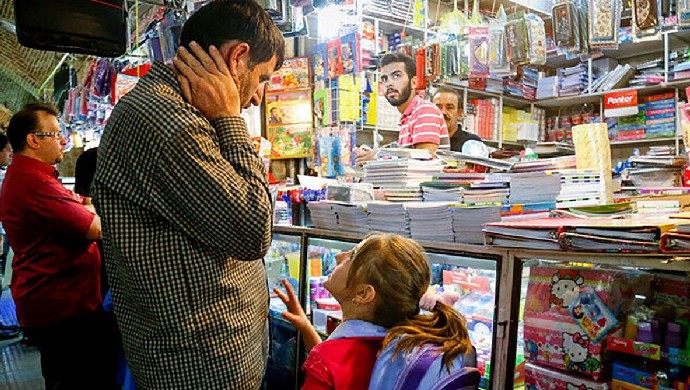

As the new school year begins in Iran, a season that should be marked by hope and excitement has been transformed into one of anxiety and despair for millions of families. While shop windows are filled with colorful notebooks and pens, state-run media admits that behind these displays, “price tags are like the dark borders of a painting” (IRNA, September 20), narrowing choices and silencing joy. For countless Iranians, the excitement of school has been extinguished amid the high prices, revealing a deep-seated crisis that goes far beyond simple economics. This is the story of a nation’s future being systematically plundered by the corrupt mafias at the heart of the regime.
A crisis of astronomical proportions
The scale of the financial burden placed on families is staggering. According to the regime’s Eghtesad News website, the price of stationery has skyrocketed by 30 to 50 percent compared to last year, making even the most basic purchases a struggle. The market has become a showcase of extreme inequality, with luxury items sold at prices unthinkable for the average citizen. Backpacks are being sold for as much as 120 million rials and electric erasers for over 20 million rials.
This is not a minor inconvenience; it is a full-blown educational catastrophe. The regime-affiliated Tasnim news agency, linked to the IRGC’s Quds Force, issued a chilling warning on September 14 that as many as “5 million students” are at risk of being deprived of basic school supplies this year. This crisis is pushing education, the cornerstone of any nation’s future, out of reach for a significant portion of the population.
Unmasking the real culprit: the regime’s organized plunder
Regime officials have attempted to deflect blame by citing predictable excuses like currency fluctuations and summer power outages. However, candid admissions from within their own media apparatus expose a far more sinister reality. The Akharin Khabar website wrote on September 16 of an “economic mafia” that controls the entire supply chain, revealing that “not every producer in Iran has the ability to import paper, and imports are in the hands of a specific economic mafia.”
This is not a free market failure; it is calculated, organized plunder. The Mehr News Agency further elaborated on September 8 that the “stationery distribution mafia has taken control,” and that this cartel “is not very inclined to distribute Iranian goods in the market and constantly throws obstacles in the way of these products entering the cycle.” This mafia intentionally sabotages domestic production to protect its monopoly on lucrative import schemes. The source of this corruption goes to the very top, as this network is a subset of the vast mafia linked to the office of regime supreme leader Ali Khamenei.
The devastating human cost of corruption
Behind the shocking statistics are countless stories of human suffering. This crisis is not an unfortunate event but a “planned shock” deliberately targeting Iran’s youth. The Tejarat News website on September 10 shared the heartbreaking account of one mother, Susan, who said, “Since last year, I haven’t been able to send my son and daughter to school anymore.” While the regime makes a show of distributing aid packages and conducting superficial market inspections, these are empty gestures designed to mask the systemic looting that creates the poverty in the first place.
This back-to-school crisis is a clear indictment of a regime that prioritizes the enrichment of its corrupt elite over the fundamental needs of its people. By engineering a system where education becomes a luxury, the regime is not only failing its current citizens but actively stealing the future from the next generation. This blatant disregard for the well-being of Iran’s children is yet another clear sign of the regime’s moral and political bankruptcy and another testament to the fact that Iran’s problems will only be solve when the mullahs are no longer in power.