

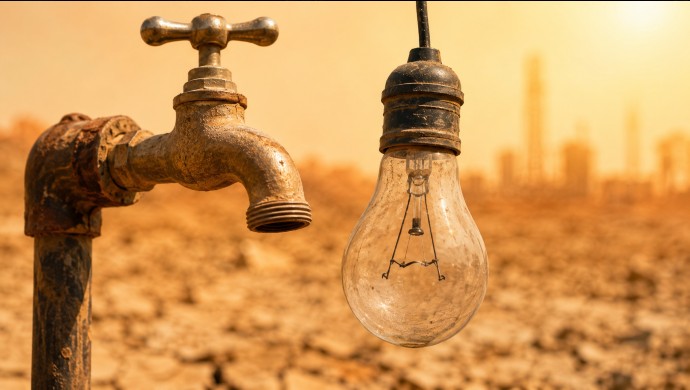

Every summer, the Iranian regime offers familiar explanations for the country’s electricity shortages: unusually high temperatures, rising consumption, or excessive demand for air conditioning. Yet every summer also reinforces the same uncomfortable truth. Iran’s recurring power crisis is no longer a seasonal inconvenience—it is the product of decades of structural mismanagement, chronic underinvestment, and governance that has consistently prioritized political ambitions over public infrastructure.
As another scorching summer begins, millions of Iranians are once again living through a predictable cycle of blackouts, water shortages, economic disruption, and declining quality of life. The crisis has become so routine that it is no longer perceived as an emergency but as an expected feature of life under the regime.
Heatwave Magnifies a Long-Standing Crisis
The latest wave of blackouts comes as temperatures climb across nearly every region of Iran.
Ahvaz recently recorded temperatures of 43 degrees Celsius, ranking among the hottest locations in the world. Tehran reached 35 degrees, Isfahan and Shiraz climbed to 36 degrees, Bandar Abbas and Zahedan reached 38 degrees, Kerman recorded 37 degrees, while even the traditionally cooler city of Hamedan experienced temperatures exceeding 32 degrees.
Under these conditions, reliable electricity is not merely a matter of convenience—it is essential for public health, water supply, businesses, and basic living conditions.
Instead, many communities are enduring scheduled power outages lasting several hours each day.
Blackouts Trigger Water Shortages
The consequences extend well beyond the loss of electricity.
In countless apartment buildings throughout Iran, water distribution depends on electric pumps. When electricity is cut, water supplies immediately stop as well.
Families therefore find themselves simultaneously deprived of electricity and running water during some of the hottest days of the year.
The situation is particularly severe in Bandar Abbas, one of the hottest cities in the Middle East, where residents report daily interruptions to both electricity and water supplies despite the extreme heat.
In Khuzestan Province, where temperatures regularly exceed 50 degrees Celsius, scheduled blackouts have resumed despite the province’s role as one of Iran’s primary energy-producing regions.
Residents increasingly question how a province that produces substantial portions of the country’s energy continues to suffer from daily electricity shortages.
The Crisis Has Become Nationwide
The problem is no longer confined to southern Iran.
Northern provinces, where high humidity makes summer conditions especially uncomfortable, are also experiencing daily power cuts lasting between two and four hours.
In Damavand, near Tehran, electricity distribution authorities have announced twice-daily scheduled outages lasting up to four hours, advising residents to prepare sensitive electrical equipment before each interruption.
These announcements illustrate how planned blackouts have become institutionalized rather than exceptional.
Instead of presenting emergency measures, authorities now treat recurring electricity shortages as a normal method of managing the national grid.
Official Figures Reveal the Scale of the Deficit
Government data itself demonstrates the severity of the crisis.
According to the regime Parliament’s Research Center, the country’s electricity network is expected to face a production deficit of approximately 13,000 megawatts during the summer of 2026 under its most realistic scenario.
Even the most optimistic estimate projects a shortage of around 10,000 megawatts, while the worst-case scenario places the deficit at nearly 18,000 megawatts.
These projections contradict repeated assurances from the Ministry of Energy that electricity shortages would be brought under control.
The report also notes that more than 90 percent of Iran’s electricity generation still relies on thermal power plants, making the system highly vulnerable to fuel shortages and operational constraints while leaving renewable energy development far behind international standards.
Decades of Underinvestment Are Catching Up
The crisis extends beyond electricity production.
Officials responsible for Tehran’s electricity distribution acknowledge that the capital requires approximately 15,000 megawatts of electricity during peak demand but currently receives only 10,000 to 11,000 megawatts.
The result is a shortfall approaching 4,000 megawatts in the country’s largest metropolitan area alone.
At the national level, electricity demand has increased by roughly 4,500 megawatts compared to last year, placing even greater strain on an already overstretched network.
Industry experts argue that the underlying causes are primarily financial and structural.
The secretary of Iran’s Electricity Industry Syndicate has stated that the government owes hundreds of trillions of tomans to the electricity sector. Years of unpaid subsidies and insufficient investment have deprived the industry of the financial resources needed to modernize infrastructure, expand generation capacity, and upgrade aging transmission networks.
The consequences now extend into agriculture as well.
Since May, electricity supplied to agricultural wells has reportedly been interrupted for approximately five hours each day, threatening irrigation systems, reducing agricultural production, and raising new concerns about food security.
Inflation Makes Adaptation Impossible
Even those attempting to adapt face another obstacle: affordability.
Demand for cooling equipment has risen sharply with increasing temperatures, but inflation has placed many air-conditioning units beyond the reach of ordinary households.
According to domestic media reports, the price difference between the least expensive and most expensive air conditioners on the Iranian market now exceeds 100 million tomans.
For many families, purchasing new cooling equipment is simply impossible.
Even those who can afford it remain uncertain whether frequent blackouts will allow them to use it reliably or whether higher electricity costs will make operating it financially unsustainable.
The Regime’s Promises Continue to Fall Short
The regime continues to promote the expansion of solar power as a long-term solution to the electricity crisis.
Renewable energy undoubtedly represents an important part of Iran’s future energy mix. However, energy specialists argue that even if the government’s announced projects are completed on schedule, solar generation alone will remain insufficient to offset electricity deficits measured in the tens of thousands of megawatts during peak summer demand.
More fundamentally, renewable projects cannot compensate for decades of neglected transmission infrastructure, delayed investments, mounting financial liabilities, and an energy sector weakened by chronic mismanagement.
These structural failures require governance reforms that extend far beyond the construction of additional power plants.
A Governance Crisis, Not Simply an Energy Crisis
Iran’s annual cycle of blackouts illustrates a broader reality about the country’s governance.
Each summer follows the same pattern: rising temperatures lead to electricity shortages, blackouts interrupt water supplies, businesses suffer financial losses, agricultural production is disrupted, and households endure increasingly difficult living conditions. Meanwhile, authorities continue to offer temporary explanations and repeated promises that the following year will be different.
Yet the crisis returns, often in a more severe form than before.
The persistence of these failures reflects not an unavoidable consequence of climate conditions but the cumulative effect of decades of poor planning, misplaced priorities, corruption, and inadequate investment in essential infrastructure. While ordinary Iranians bear the costs through deteriorating public services and mounting economic hardship, the regime’s inability to modernize critical infrastructure has transformed what should be manageable seasonal demand into a recurring national emergency.
Until those underlying governance failures are addressed, every hotter summer will simply expose the same structural weaknesses—and leave millions of Iranians once again paying the price.