


After the U.S. administration announced the return of the maximum pressure policy and U.S. President Donald Trump threatened that the Iranian regime must choose between negotiation and military action, regime supreme leader Ali Khamenei stated in his speech on February 7, 2025: “Negotiating with the United States… one should not negotiate with such a government, negotiating is not rational, it is not wise, it is not honorable.”
Two months later, there is now news of negotiations in Oman.
On Monday night, April 7, 2025, Trump, responding to reporters’ questions and encouraging the regime to negotiate, said: “We are dealing with them directly and maybe a deal is going to be made. That would be great, it would be really great for Iran.” Contrary to the Iranian regime’s repeated denials regarding direct talks, the U.S. President explicitly declared that negotiations will be held directly on Saturday and at a very high level.
Trump emphasized that the situation is approaching a very critical point and the regime would be in “great danger” if the talks don’t succeed in persuading them to abandon their nuclear weapons program. “Iran is going to be in great danger, and I hate to say it,” Trump said.
On the other hand, Abbas Araghchi, the Iranian regime’s Foreign Minister, who had previously stated, “The proposal for direct negotiations, for reasons repeatedly stated, is not acceptable to us,” after Trump’s remarks, confirmed the negotiation scheduled for Saturday and said, “Iran and the United States will meet in Oman on Saturday for indirect high-level talks.”
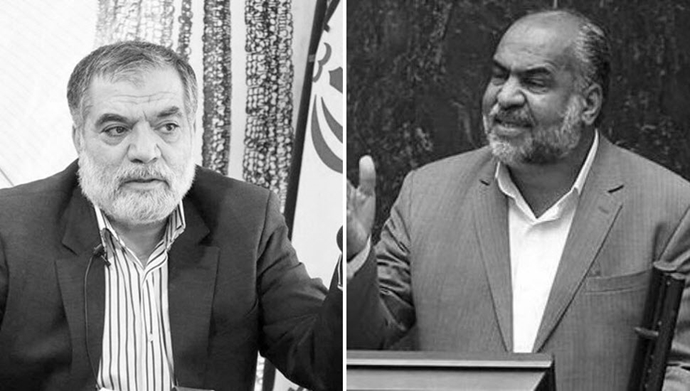
With the publication of this news, the infighting within the crisis-ridden regime flared up. On April 8, 2025, Mohammad Reza Sabbaghian Bafghi, a member of the regime’s parliament, attacked Araghchi and regime president Masoud Pezeshkian, saying: “Gentlemen diplomats, gentlemen decision-makers in foreign relations, a believer is not bitten from the same hole twice. Mr. Pezeshkian, do not be deceived by the carrot and fear of Trump’s stick. If you negotiate with this trickster this time but are deceived and get no results, the people will compare you to the Qajar rulers, and the treaties of Turkmenchay and Golestan [symbols of territorial loss and humiliating agreements for Iran] will be remembered.”
Salar Velayatmadar, another MP, said, “On Saturday, negotiations with the enemy begin. He has said either surrender or there will be war and bloodshed. He only understands force, nothing else. We have tested this matter a thousand times; if anyone doesn’t believe it, they are surely pretending to be asleep.”
Another MP shouted: “Didn’t Khamenei say negotiating with America is not wise, rational, or honorable… Now the Foreign Minister goes [to negotiate] with the murderer of [IRGC Quds Force commander Qasem] Soleimani?… None of the problems of the state will be solved by this negotiation.”
An analyst on the regime’s Jaryan television network anxiously asked, “Isn’t the fate of Gaddafi right before our eyes?” referring to Libyan ruler Muammar Gaddafi was overthrown and killed a few years after renouncing his WMD programs. “Why do we want to seal the same fate with our own hands by going to the negotiation table?”
On the other side, when Fatemeh Mohajerani, spokesperson for Pezeshkian, was asked about the reason for negotiating with the United States, she replied: “We will have a wise negotiation ahead.”
Justifying this “wisdom” and explaining the regime’s need, the state-run website Fararu wrote: “In August, the process of triggering the snapback mechanism [reimposition of UN sanctions under the JCPOA] by the Europeans begins, and by then, a nuclear agreement (with the US) must have been reached so that this disaster does not befall us.”
The Donya-e-Eqtesad newspaper wrote: “There should be no doubt that if an agreement is not reached, the West will definitely proceed to activate the snapback mechanism.”
Fereydoun Majlesi, a former diplomat and regime-affiliated analyst, lamented: “Internally, some threw so many obstacles in the path of the, and we didn’t appreciate it, that now we are forced to wish for a JCPOA to get out of such a crisis.”
Thus, with the prospect of “negotiation” arising at one of the most sensitive and critical junctures for the clerical regime, the internal power struggle within the deadlock and quagmire of four decades of crime and wrongdoing has intensified. One side views negotiation as falling into a trap whose fate is “becoming Gaddafi”; the other side sees refusing to negotiate as accepting consequences whose fate is destruction.